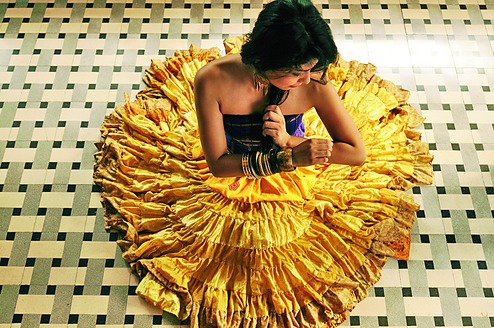


Old threads are seldom just that. The wearer's person imbues every warp and weft. Every fold has a memory tucked away. Every stain is a story in itself. Every darn is an aside. As for a sari, it is six yards of an intensely personal association.
Forty-five-year old Sanyukta Banerjee lives in the United States. Her mother lived in India. Frail and infirm with age, during her last days she would inevitably drop food on her saris, leaving stains down the front and the pleats. When she died a couple of years ago, Sanyukta could not bring herself to discard those saris. She had had no control over her mother's passing, but the thought of throwing or giving away those saris felt akin to junking her own sentiments, her own mother.
When she said as much to a friend, she was referred to Meghna Nayak, founder of LataSita, a clothing brand launched in 2012. She was told Meghna recycled used saris. Meghna prefers to say "upcycled".
The name of Meghna's venture derives from two very common women's names in India, joined without a hyphen, not separated by a pause, just bleeding into one another or as the "with it" set would say - an organic extension of one another.
Meghna used one of the saris Sanyukta brought to her to create a skirt. And, she used the parts with the food stains to make the underskirt. "So it is all there. Whenever I see the stains I feel Ma is still with me," says Sanyukta.
Meghna's studio is in south Calcutta. She talks about her interest in clothes and design, and holds forth seemingly knowledgeably on handloom vis-à-vis ikkat, organic cotton, Monsanto cotton; but we are interested in the sari stories.
The old sari put to new use isn't a new story. Generations of women have recycled them as either quilts or early-winter wraps, swaddles or nappies for babies; there are, in fact, several women's self-help groups that do this on an organised scale. What Meghna has done is give the old sari a reincarnated style quotient.
She gets talking about what she had done with her mother's and grandmother's saris, which she came upon while cleaning up the house. "There was my grandmother's boubhat-er [wedding] sari, a beautiful coral and gold tissue Benarasi, almost like brocade. That really spoke to me. Much of it had fallen apart. I made a classic, old-fashioned blouse from whatever I could salvage."
She describes a simple traditional Bengali laal paar-sada sari (white sari with a red border) that was old and soft "beyond belief", from love and wear. "I turned it into a kimono that was so comforting that I wore it till it literally fell apart," she says fondly.
The silhouette in the LataSita logo is reminiscent of the late Bengali act-ress, Suchitra Sen. Upon hearing this, Meghna says that the lady of the logo is her maternal grandmother, one of Sen's contemporaries. Kaberi Bose was a 1960s Bengali actress. She had acted opposite Uttam Kumar in Shyamali, was directed by Satyajit Ray in Aranyer Din Ratri... She passed away almost 40 years ago, but her saris remain in Meghna's vigilant custody.
Meghna lends her skill to saris of pedigree and even those without. Last year, she bought around 900 saris from the Jodhpur Park puja committee. The saris had been used to create the Puja pandal and later a Kali Puja pandal in north Calcutta. "They were just going to be discarded. So, instead of going to a used-sari market, I bought from them," she reasons. These are now finding utility in the form of sidebags, aprons, and so on.
To label Meghna as a designer alone would be most unfair. She is that and also a bit of a used-sari evangelist. "I don't throw away a single piece of scrap. I try and use them as far as possible, for example, to stuff cushions. A lot of it goes to the NGO, Goonj, which makes eco-friendly, affordable and sustainable sanitary pads." The latest additions to the LataSita line are neckties and bows - all from sari anchals or pallus, the portion that is draped over the shoulders.
Her perks, according to Meghna, are the memories associated with the saris she is recycling. "A glimpse into people's personally curated space."
She rounds off with the anecdote of a family that had come to her with some saris recently. "As it happens often, the father was waiting, aloof and disinterested, impatient for the whole thing to get over. The daughter picked up one sari saying she wanted a dress out of it. That's when the father piped in saying this was the first sari he had bought for his wife when they were courting. How and from where he had bought it."
Memories all come undone.