
As a child, Ramesh Raskar often wished that he had a pair of eyes at the back of his head to help him see what was happening behind him. The fascination to see what was not visible went on to become a lifelong passion for the celebrated America-based scientist who grew up in Nashik in Maharashtra.
Raskar, 46, was recently awarded the prestigious $5,00,000 Lemelson-MIT Prize that recognises outstanding mid-career inventors who put their ideas to practical use on a large scale. Raskar has done that and more.
Among his recent inventions are an ultra-fast imaging camera that can peer around corners, a camera that allows users to read pages of a book without even opening it, and a portable low-cost eye care gadget.
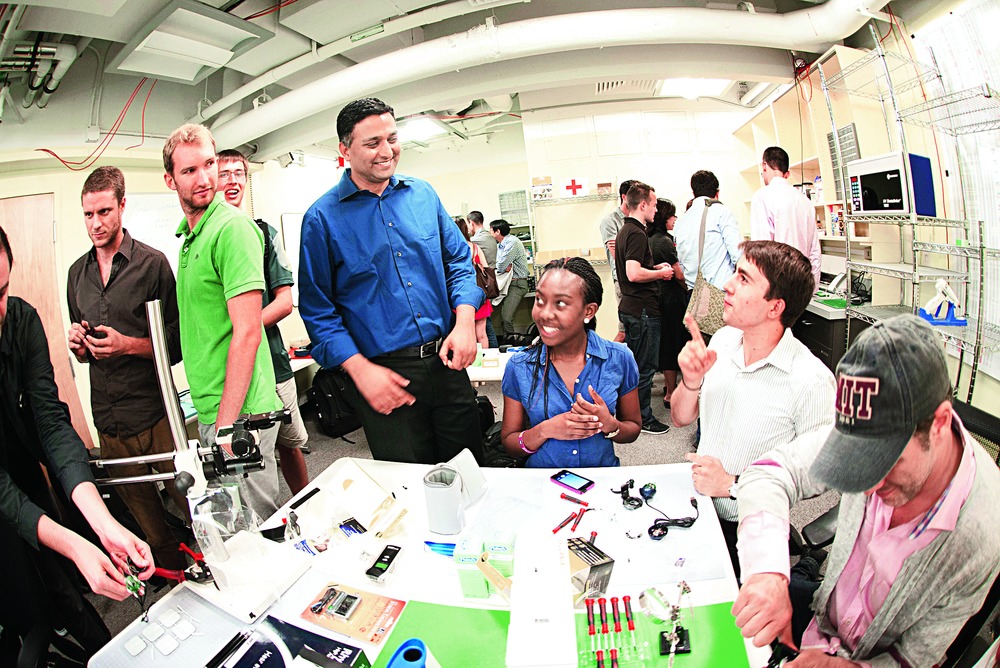
The founder of the Camera Culture research group at the Massachusetts Institute of Technology (MIT) Media Lab, who works as an associate professor of Media Arts and Sciences at the MIT, leads a team of young scientists in search of "disruptive technologies" that can bring about a marked change in real life.
"Much of the world uses incremental technology and believes in a step-by-step process. But what's more important is to come up with disruptive models and solutions," he says.
Past winners of the prize have been no less "disruptive". These include Douglas Engelbart, inventor of the computer mouse, and Nick Holonyak, the man behind light-emitting diodes or LED.
Raskar, who has spent two decades in the United States, retains his Indian accent, except for an occasional rolling of his "R"s. He also retains his interest in India.
With the prize money, he seeks to bring about change on a "massive" scale with the help of a platform called Emerging Worlds - that brings together young inventors from countries such as India, Brazil and Mexico. The scientists seek to find solutions to local problems.

In fact, this "philosophy" of working with young innovators started well before he won this award. This was in full display last year in the run-up to the Kumbh Mela in Nashik.
Raskar was on the forefront of a programme called Kumbhathon - which worked towards finding solutions to problems that the mega gathering was expected to face. He flew in students, local entrepreneurs, technocrats, industry leaders and heads of government agencies to MIT to ensure safety and order at the Kumbh Mela - which he likens to a "large petri dish for experimentation".
The experiment was a grand success. Over 12 solutions were launched at the mela that saw 30 million Hindu pilgrims assemble in Nashik. For instance, an analytics-based system detected impending disease outbreaks in real time. There was a quick ambulance service using GPS co-ordinates. A crowd steering application used cell phone tower data to map crowd movements.
The innovations didn't stop with the Kumbh. "The Nashik Municipal Corporation proposed collaborating with our efforts to solve pressing challenges of the city and empowering its citizens," he says.
So March 2016 saw the birth of the DISQ Center (Digital Impact Square) - a Tata Consultancy Services Foundation initiative. DISQ, in collaboration with Raskar and his MIT team, has come up with hardware and software solutions to ensure hundred per cent hospitalisation of pregnant women for delivery, immunisation and zero loss of life because of shortage of blood in banks.
It also offers a teaching medium for autistic children, real-time tracking of city buses and real-time crime detection. "Technology and adoption are two different things. The challenge is to find opportunities and make them successful," Raskar says.
One of Raskar's greatest successes in mass application has been EyeNetra, a hand-held gadget that can be attached to a smartphone and, with the pressing of a few buttons, analyse eye deficiencies, if any. The mobile phone can produce the results almost instantly and help doctors prescribe remedial measures.
His associates stress that the inventor manages to get things done. "His greatest strength is that he has this ability to scale up everything and visualise how it can be used on a large scale. He sees what others can't and he takes it upon himself to motivate his team," says Sachin Pachorkar, a professor of management at Nashik, who has worked with him on several projects.
Raskar says he is a believer in "crazy science" that people often dismiss as impossible. One "crazy science" event that inspired him was the 1993 Steven Spielberg classic, Jurassic Park. As a student of electronics and telecommunication at the College of Engineering in Pune, Raskar was stunned by its special effects.
"It was the first movie that used special effects with the help of large silicon graphics. For me, the power of the pixel became very obvious. I wanted to do something on those lines," he recalls. And as he read about the making of the film and the science and technology behind it, he knew that he wanted to do something similarly amazing.
Some of his "crazy science" projects include a toothbrush that can see through teeth and cars that can penetrate fog. But his inventions that could benefit millions in a country like India include a CAT scan machine that can work out of an autorickshaw and a very low-cost wearable (at a cost of Rs 100 or less) that can track everything from patients to school students to school buses.
"We are looking at technology that can have a significant impact on the way things are done in the future," he says.
A long-term project is a Second Skin garment studded with sensors that can gauge the wearer's motions during a physical task - such as practising a golf swing or doing physical therapy following a stroke - and nudge the person towards its proper execution. Perhaps one day it can help Indian batsmen negotiate chest-high balls on bouncy pitches abroad. But, on the other hand, there is no reason why the rival team wouldn't have access to the garment!
As a mentor of thousands of youngsters, Raskar doesn't believe in the age-old system of writing dissertations and publishing papers, which define much of research work in India.
"The paradigm has shifted from 'publish or perish' in the past to 'demo or die'," he says. "But I take it one step further. Through hardware technologies, software platforms, cloud architectures and worldwide networks, it's evolved further to become 'deploy or disappear'," he says.
"Creative freedom is very intoxicating," Raskar sums up. And, clearly, very rewarding too.