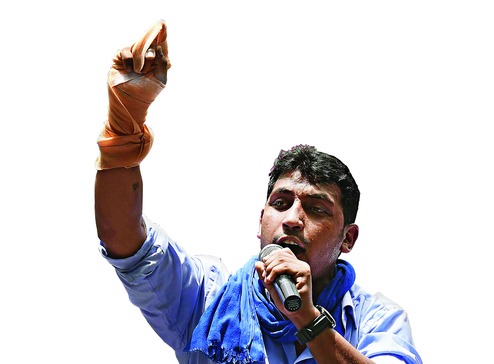


A little less than a fortnight ago, Chandrashekhar Azad "Ravan" was arrested in Himachal Pradesh's Dalhousie. At the time, Azad, the chief of Bhim Army, a group championing the Dalit cause and functioning out of western Uttar Pradesh's Saharanpur district, had been on the run for a month.
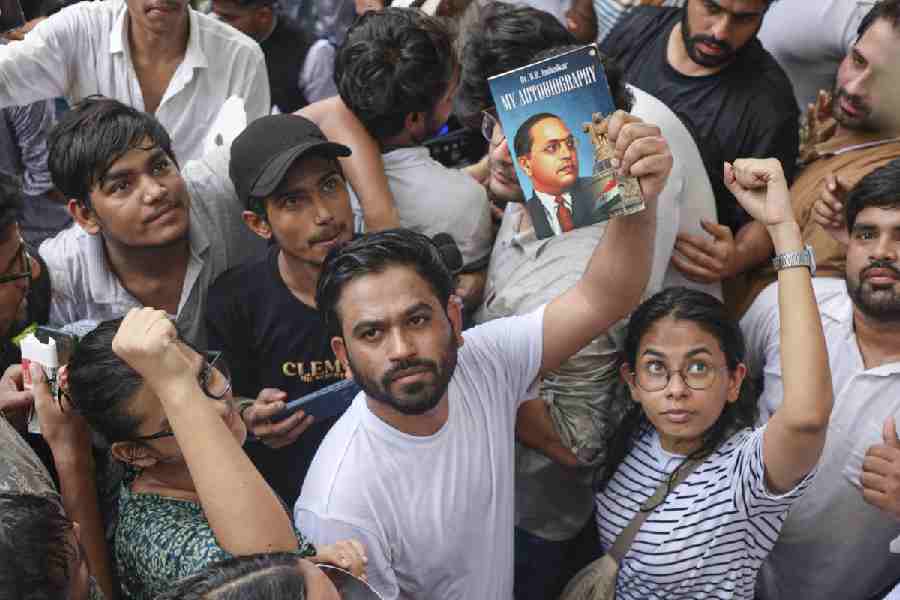
Saharanpur had turned violent on May 9, the Dalits protesting Thakur aggression; Azad stood accused of inciting mobs. Despite the fact that the UP police was hot on his heels, Azad surfaced briefly on May 21 at Delhi's Jantar Mantar, only to give a rousing speech and disappear again.
The Bhim Army was founded in 2015 with the two-point agenda of educating Dalits and protecting their interests. The last many months have witnessed a growing increase in its ranks. Post arrest, Azad's mother has been named chief, but will the movement now lose momentum?
Jai Bhagwan Jatav, a close confidant of Azad, is unperturbed on that count. "It doesn't matter where he is. His roar can be heard by the Dalits of not only Uttar Pradesh, but the whole country," Jatav says.
It seems the legions of Azad's admirers have only increased after his arrest. His fiery speeches have been posted and reposted and shared several times over on YouTube and other social media sites; these have logged lakhs of views. Enthusiastic supporters have replaced their Facebook, Twitter and WhatsApp profile pictures with the image of a dapper Azad in aviators and trademark blue gamchha of the Bhim Army, giving his formidable moustache a twirl.
After Jignesh Mevani, the former journalist who became the face of last year's Gujarat protests after the flogging of four Dalit youths in the state, Azad is the second leader from the community to fire the imagination of the community's youth. At 31, he is even younger than Mevani.
"These leaders have emerged in response to the newer forms of oppression at the ground level," says Kancha Ilaiah, Dalit intellectual and director of the Centre for Study of Social Exclusion and Inclusive Policy at Hyderabad's Maulana Azad National Urdu University (MANUU). "I think it is a great sign for the Dalits in the country."
Since Independence, India has witnessed countless Dalit unrests, but the recent ones seem different in tone and tenor. "This is nothing short of a revolution. Educated youths are attending the rallies in droves and they in turn are inspiring many more," says Valji Patel, an Ahmedabad-based Dalit activist.
The impact of recent Dalit movements is there for all to see. Within a month of the Mevani-led agitation, then Gujarat CM Anandiben Patel was forced to resign. And now Azad's agitation seems to have put the newly-formed Yogi Adityanath government on the back foot.
According to Chandra Bhan Prasad, Dalit activist and entrepreneur, Dalit youth are no longer willing to take the slights of the upper castes lying down. "They are not concerned as to what their forefathers did, unlike upper caste youth, who are fed on their supposed glorious past. So a clash is inevitable every time upper castes try to impose themselves like they have been doing in the recent past."
The upper castes apparently have been spoiling for a fight. Says Mevani, "With the BJP in power at the Centre and in several large states, including UP, many upper castes feel it is their time to bat and hit fours and sixes against the Dalits and settle scores. The Saharanpur incidents happened because of the Thakurs, not us."
Dalit movements in India have a long history ( see box). But it is safe to say that it was Kanshi Ram who built the most formidable and politically significant Dalit coalition, taking every section of the community on board. First came the All India Backward and Minority Communities Employees Federation in 1973, followed by a social organisation known as the Dalit Shoshit Samaj Sangharsh Samiti. He also started working towards a political party with an all-India character. Ten years later, in 1984, the Bahujan Samaj Party (BSP) was formed.
And the BSP remains. So what is with these new groups and faces? Ronki Ram, professor of Political Science at Panjab University, Chandigarh, says, "There has been no Dalit leader with a nationwide appeal like Kanshi Ram. Mayawati has limited herself to Uttar Pradesh and in her pursuit of power she has forgotten how to struggle. If these young men form parties of their own, it would only be good for the Dalits."
Indeed, one gets the sense that for Dalit youth, current political leaders or even politics hold little relevance. "We have shown everybody that we can fight back even without the support of political parties which supposedly represent us. This has given our community more confidence," says Vikas Kumar Gautam, a member of Bhim Army and a BSP supporter. Gautam, in fact, has no qualms saying that he may consider voting for Azad if he forms a party.
Says Mevani, "They [politicians] hop, skip and jump when Dalits are being oppressed. Leaders like Mayawati have made many compromises in their pursuit of power. Educated youth no longer like that."
This distancing and distinction from mainstream politics seems to be the biggest reason for the groundswell of support for these new leaders. It adds to the general sense that the new lot possesses greater integrity.
"The Bhim Army had around 50,000 members until a few months ago. Now it runs into lakhs and most of them are students and professionals from across the country. This is because of Chandrashekhar and his leadership. People in Saharanpur know about his work, but outsiders know him through his speeches and his leadership," says Jatav.
This ripple-effect could well shake up Dalit student politics in states such as UP, Madhya Pradesh and Bihar from stupor. "Dalit forums have cropped up in almost every university after Rohith Vemula's suicide. They regard people like Azad and Mevani as their role models. Dalit student politics will see a massive change and so will the politics at the state and national levels," says Richa Singh, former president of Allahabad University Students Union and currently a doctoral student there.
What does the old guard make of this prophecy? Says Ambeth Rajan, former Rajya Sabha MP and the BSP's national treasurer, a little dismissively, "Mayawati is the leader of the oppressed classes. The recent developments are more local in nature. As Mayawati said, the BJP may have propped up the Bhim Army." Azad was reportedly a member of Akhil Bharatiya Vidyarthi Parishad, the BJP's youth wing, when he was a law student in Dehradun.
Divisions persist in Dalit ranks, over political leadership and social status. R.K. Chaudhary, a Kanshi Ram loyalist and a prominent Pasi (an SC sub-caste) leader who fell out with Mayawati and formed the Rashtriya Swabhiman Party, points out that both the BSP and the Bhim Army are largely led by Jatavs (another sub-caste). "Pasis are also facing the brunt of Thakurs. Azad needs to widen the base," he says and adds that Mayawati's influence on Dalits remains strong.
But the leaders of the new Dalit movements appear unmoved by all this nitpicking and comparison with the BSP and Kanshi Ram. Both Mevani and the Bhim Army claim they have no political ambitions "as of now". "We are concentrating on mobilising the youth and fighting harassment of any kind. Politics is not on our minds. We are a social organisation. Let us see where the future takes us," says Azad's associate, Jatav.
Ruth Manorama, a Bangalore-based women's and Dalit rights activist, is more wary than pessimistic. She says, "I am very encouraged by these firebrand youngsters, but I fear that they may not be allowed to rise beyond a point as they would threaten the entrenched political parties."
Ilaiah of MANUU recalls that figures like Ramdas Athawale and Udit Raj came up as young leaders with fire in their bellies to fight for the Dalit causes, but have since been co-opted by the BJP. "Now they are silent on these issues. So you never know," he says.
Mevani, whom Chandrashekhar often consults, says that young people of the community from across the country want to know about their next move. "Things are bubbling under the ground. We cannot let them cool down. They will come onto the surface soon and will hopefully change the way Dalits look at themselves and how others look at them."
Who knows, maybe this is the beginning of a new beginning. After all, Ram politics has run its course. And as Azad keeps saying, Ravan was an honourable man.
CAUSE AND EFFECT: A BRIEF TIMELINE OF DALIT POLITICS
- 1942: The Scheduled Castes Federation (SCF) is founded by B.R. Ambedkar after a long struggle with the Congress. It is the first political party formed exclusively for Scheduled Castes
- 1957: After Ambedkar's death, the SCF becomes the Republican Party of India (RPI)
- 1960s: RPI splits into various groups. Dalits go back to voting for the Congress
- Late 1960s: Dalit youths and student leaders in Mumbai form the Dalit Panthers inspired by the Black Panther Party, US
- 1973: Kanshi Ram forms the Bahujan and Minority Community Employees Federation
- 1981: Kanshi Ram sets up the Dalit Shoshit Samaj Sangharsh Samiti
- 1984: The Bahujan Samaj Party is founded by Kanshi Ram on April 14, the birth anniversary of Ambedkar
- 1990s & 2000s: BSP gains strength in the north. RPI factions dominate Dalit politics in Maharashtra. Viduthalai Chiruthaigal Katchi comes into being as a Dalit party in Tamil Nadu.