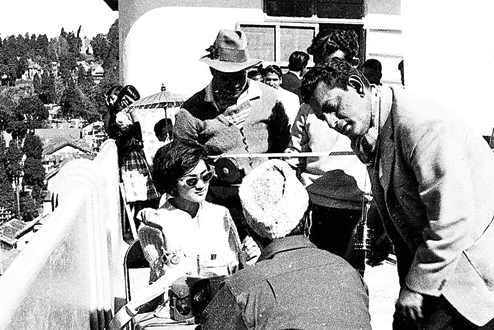

Several hundred kilometres from Darjeeling, the death of an actor in Calcutta jogs the memory of a member of the royal family of Jaipur. Vidya Sinha - better known as Rani Vidya Devi of Jaipur - recalls her role in Kanchenjunga when she was fresh out of school over 50 years ago.
Set in Darjeeling, Satyajit Ray's iconic film is about an elitist Bengali family on a vacation. The patriarch, Raibahadur Indranath Roy, is a snob who wants his daughter, Monisha, to marry into wealth. His wife is submissive and his elder daughter, Anima, is caught in a bad marriage. Monisha meets Ashoke, an unemployed youth who reads Tagore instead of English literature, in Darjeeling.
Arun Mukherjee, who acted as the unpretentious Ashoke, died some weeks ago. The news stirred people connected with the film to relive their moments of it.
Vidya Devi, originally from the Jubbal royal family of Himachal Pradesh and daughter-in-law of the late Gayatri Devi, grew up in Darjeeling and Calcutta and speaks fluent Bengali. She recalls that she and her friend Nilima were just out of Loreto Convent, Darjeeling, when they were approached by a family friend related to the Rays.
'With no acting background, we did whatever Satyajit Ray asked us to do. I remember, we borrowed the Rani of Nandgaon's Pekingese dog for the film,' she says.
Her role was that of a young girl dating Indranath's son, Anil - played by Anil Chatterjee, who was considered one of the finest actors of Bengali cinema.
'What I found striking was that my father had stepped out of his serious roles and played this flamboyant womaniser for the first time perhaps,' says Arup Chatterjee, the actor's son.
Many of those who were associated with the film are dead. Ray died in 1992 and Chatterjee in 1996. Chhabi Biswas, who played the role of Indranath, died the year the film was released. Actor Pahari Sanyal, Calcutta academic and actor N. Viswanathan and Karuna Banerjee, who played Indranath's wife, are no more.
Although it was his eighth film, Kanchenjunga was Ray's first original screenplay and his first colour film. It was also played in real time - the incidents take place in the 100-odd-minute duration of the film. Kanchenjunga, however, did not do well on its release in 1962.
'It was a good 10-15 years ahead of its time,' Ray had later said in an interview. 'The reaction was stupid. Even the reviews were not interesting. But, looking back now, I find that it is a very interesting film.'
Shot over 29 days in October 1961, the film was lost for many years after its original negative had been damaged because of mishandling. Ray's son, the director Sandip Ray, says that a negative of the film was available at the archives of the Pune Film and Television Institute of India, and copies were made from it.
'The Academy of Motion Pictures, Arts and Sciences in the US has a copy of the master negative. They are likely to restore it digitally,' he says.
The film may have a more appreciative audience today than it did then. 'It was not linear story telling of the boy-meets-girl kind,' says Alokananda Ray, who played Monisha. 'For the first time Ray used parallel stories - of different people entrapped in different situations.'
Film critic Shoma A. Chatterjee describes it as a social satire that broke through the 'feudalistic mindset' of the elite. 'In a scene where a Lepcha boy is eating a Cadbury chocolate, the class conscious father, Indranath, is almost angry. Half a century ago, Ray showed that a branded chocolate was a class divider. Also, common man Ashoke was not overawed by Indranath's job offer. He was his own person.'
-

Picture perfect: Rani Vidya Devi, as she is now; a poster (below); Satyajit Ray directing Rani Vidya Devi in the film (Top)
Recalling her scenes with Mukherjee, Alokonanda says he was a sensitive actor. 'We were all put up in a high-end hotel. But after the first day he went and stayed with the technicians in another hotel. Since the film portrayed him as a common man, he wanted to sense this alienation.'
Mukherjee, who had a theatre background, was a part of Sambhu Mitra's Bohurupee theatre group. Ray had seen him act and was impressed by him, recollects Alok Ray Ghatak, a radio theatre personality who knew Mukherjee well.
'Ray had wanted him as Goopi in Goopi Gyne Bagha Byne but that somehow did not happen. So he had him in mind for the role of Ashoke. This was Arun's debut movie and the only Ray masterpiece in which he worked.'
Alokananda points out that when the film was shot - she was then, like Monisha, 18 and a literature student at Presidency College - she did not understand the 'underlying theme' of the film. 'I realised the importance only later. All the three women protagonists - the submissive wife Lavanya, Anima, the elder daughter caught in a troubled marriage, and Monisha - come into their own at the end.'
Arup Chatterjee, who was six when the movie was shot, says that every time he watches the film, he feels nostalgic. 'Every scene of the film has something of Darjeeling in it,' says Chatterjee, who spent eight years in a Kurseong school. 'The unseen bird calls, the animal bells, the radio interlude, the locals in their traditional dress, the sudden creeping up of the mist, the lonely walks all had parts to play in the film.'
Nature, indeed, played the lead in the film. 'The idea was to have the film starting with sunlight. Then clouds coming, then mist rising, and then mist disappearing, the cloud disappearing, and then the sun shining on the snow peaks. There is an independent progression to Nature itself, and the story reflects this,' Ray had said in an interview.
The clouds and the mists, Chatterjee points out, symbolised the underlying tension between the characters. 'At the end as the sun set, it turned the mighty Kanchenjunga into a dazzling golden glow, displaying it in all its splendour. That moment of Kanchenjunga - the film and the peak - can be summed up in just two words: picture perfect.'