A MEDITATION ON OURSELVES

Zard patton ka ban jo mera des hai,
Dard ki anjuman jo mera des hai
( A forest of dying leaves that is my country
An assembly of pain that is my country)
- Faiz Ahmed Faiz, Intesaab
Every summer in Delhi, there is a war. War of the winds: between the easterly and the westerly. The hot dry wind of the east collides with as much force as the moist and pregnant west. The fight to prevail goes on. In the time it persists, not a leaf moves; offering only sweat. Victory and defeat have no finality in this fight, like political power. It is only when the Poorva pours down, as catharsis drenching the soul, a battle gets over.
India, these days, is like Delhi in summer. Only, the gust of the hot, dry wind has been blowing with more intensity than hitherto known. The wave, the leher that has been much in parlance has not stopped for a respite. Respite to the thousand and one cuts, it was whisked to render, with its knife-like sharp bearing.

As hate plumes menacingly like bomb smoke, waiting for a more urgent time to act will make this country a forest strewn with dead leaves. Already, our political imagination, from its inclusive ideals during the freedom struggle, has diminished to now being a homogenised approximation of the religious Right. The unity of ideas, which is the basis of our syncretic culture, is fast being reduced to a singularity by creating a scission in our society. The current crop of political leadership, who have built their life's politics on the graves of the innocent, and continue to do so, are the ones fashioning this scission. Expecting from them the just ideals of freedom, equality and dignity would be unfair.
What must, then, be done to contain this leher of lynching and violence? History teaches that change takes seed slowly, but surely - with persistence. Simple ideas bring about the most impactful of changes. As Rebecca Solnit has put it "ideas are contagious, emotions are contagious, hope is contagious, courage is contagious." The solution, therefore, is to persist in nurturing love, truth, and in raising our voices against hate and bigotry. It is important to keep expressing concern, calling out falsehood, amidst family and friends or in public. There is no other way but to resist and engage at all levels. Fake news and malevolent WhatsApp forwards that foment hatred can only be countered with truth and engagement. Little steps make for little revolutions, which ultimately will form a cloud of ideas strong enough to rain over the wave.

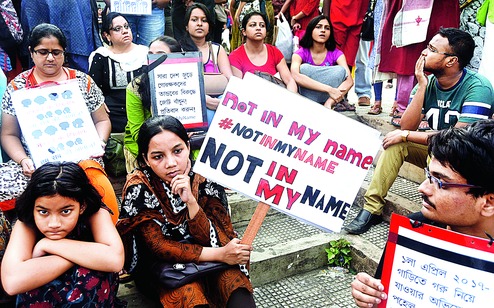
The "Not in My Name" protests or rather the congregations of solidarity for Junaid and several others were manifestations of this concern. Standing up against mindless violence is an act of compassion towards a fellow human. Protesting is following the inner ethics, the conscience, and cannot merely be construed as a political tactic. People who gathered for "Not in My Name" were not countering the malignant "narrative", for which it came under criticism. There was pain in people's hearts, and in showing their solidarity lay their hope. Deaths had brought grief, but solidarity brought strength. This conjoining of hands and hearts, coming together of ideas, can raise up a storm.
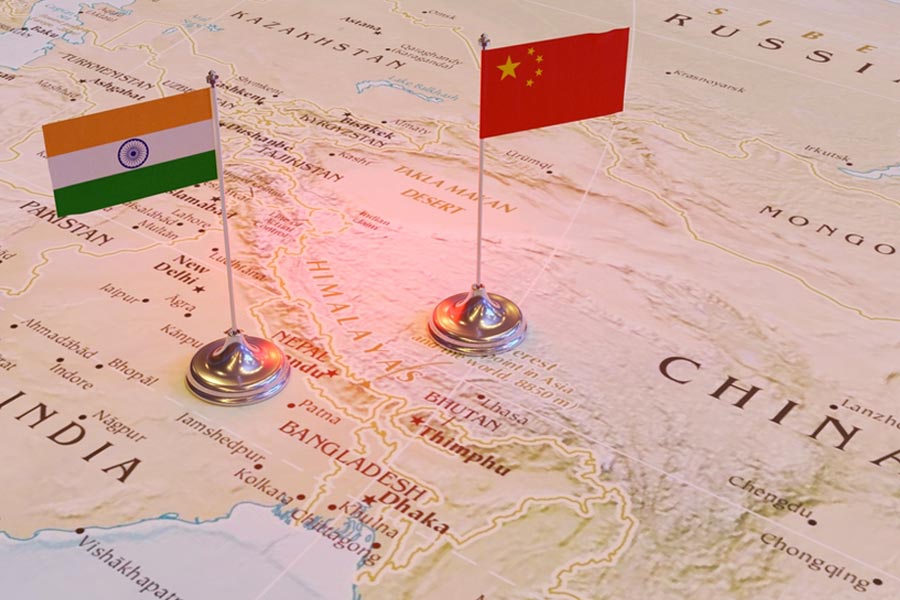
Living in India, it is not easy to realise how our languages (and therefore our thoughts) developed over a period, building up like the fold mountains. Plates moved towards each other, collided and then crumpled up, creating mountains like the Himalayas. Words from different regions, similarly, got assimilated by the movement and commingling of people. Segregation to create a "purer" form, as has been the agenda of some, can create a dent: be it in language or in society. The language politics of the first part of 20th century worked to create this division. It gave language a religious varnish, and it has persisted, almost bringing down Urdu from being the people's language to one known by a few. This paring of language is like cutting of trees that one day leads to erosion of the mountains and of societies. Ananya Vajpeyi has written that language is being manipulated to "effect the tectonic shift of a plural and diverse India into a Hindu Rashtra", and for "the erasure of historical memories, the marginalisation of minorities and women, the crushing of institutions". This country, made of a multitude of people, religions, caste and community, will only be withering its fabric away if the "othering" is not stopped.
The only way of knowing the "other" is knowing their story. The "other" ceases to be the other, once there's a story. When people meet and talk, new stories are made. In July, Shabnam Hashmi led a programme - Mere Ghar Aake to Dekho (Visit My Home, Be My Guest) - to build and celebrate such stories. People traversed across caste, class, religion, languages and prejudices to start a thread of conversations.
Harsh Mander, with a clutch of groups, is leading a movement to meet families that have been victims of riots and lynch mobs. Mander's Karawan-e-Mohabbat (Caravan of Love) is a journey "to share pain, for atonement, for solidarity and for love".
All these strands - Not in My Name, Mere Ghar Aake to Dekho and Karawan-e-Mohabbat - are like the tributaries that make a river. Yamuna in Delhi was once a river. Various nallahs, or streams, which fed the people of the city, flowed into it. Today, they have become nallah, or drains - choked with filth, or have been cemented over. Yamuna will never become a river again if these little streams aren't cleaned. Similarly, our ideas, our syncretic culture, our stories have risen from a legion of thoughts. To sustain them, myriad small, incremental actions will be needed. Saba Dewan, Rahul Roy, Shabnam Hashmi, Harsh Mander and all of us who act are the tributaries who will slowly, very slowly, make a river of love.
Often, it is expected that protests will bear immediate results. But more often, it does not. Resistance takes time to build. After all, it is about riding against the wind, rowing against the current. It is endurance that leads to change. In resistance, boldness and generosity, pervasiveness and diversity, work. Ideas with depth and breadth, and strength make it worth having. Impatience, the curse of our time, can have no place in it.
We live in an interconnected world, in which everything matters, and everyone is important. The sustenance of action depends on the participation of every group and diversity of people. On the first day of Mere Ghar Aake to Dekho movement, a few women from the Hindu community went to Juhapura in Gujarat. For these women, Juhapura is a no-entry zone. They had lived all their lives in the neighbourhood, but never ventured inside, for they had been told that death lurks in the place. Going for the first time they met other women from the area, talked and came out alive and happy at having established a bond. Similarly, for the residents of Old Delhi, when its walls had stood, the children were not allowed to go outside the gates after sundown for the fear that Mewatis or Meos, who were known in Delhi as dacoits, would attack. Some of us from the city visited Chilla, a village in Mewat, where a family opened its home and fed us. The Sangam age poet Sembula Peyaneerar's lines tell these experiences best: We knew not each other in anyway, just as red earth and pouring rain: the love-filled hearts merged.
When we started back from Mewat, heaven had opened and big droplets hammered down. It had also poured at Jantar Mantar that day. And it will rain over this wave.
Nikhil Kumar is a policy analyst and tweets at @niksez