Will Wisden bring wisdom to India?
 |
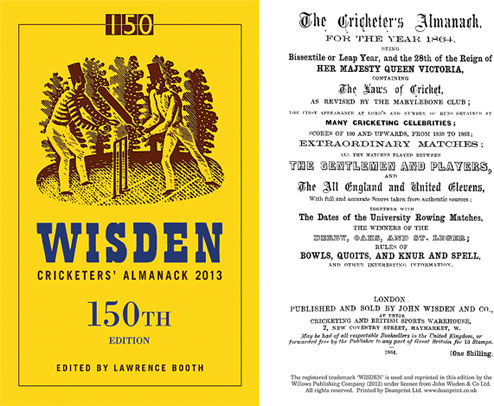
| Cover story: Wisden covers in 1864 (right) and 2013 |
The 150th edition of Wisden Cricketers’ Alamanack 2013 contains several references to India, especially in Lawrence Booth’s “Notes by the Editor”, but the book also includes all manner of enjoyable distractions.
In 1864, London to Madras by ship via Cape of Good Hope took 65 days but this journey, through the Suez Canal, can now be done, notionally, in 21 days.
We learn that in 1864 “five pirates were publicly hanged at Newgate prison”. We are not told if play was suspended because of the interruption.
The leading cricketer in the world is Michael Clarke; the five cricketers of the year are Hashim Amla, Nick Compton, Jacques Kallis, Marlon Samuels and Dale Steyn.
The IPL auction of 2008 is included as one of 10 moments which changed the game for ever.
“You want to know what you are worth — and you don’t want to know what you are worth,” comments Australian seamer Nathan Bracken:
In “Cricket and Sexuality”, Steve Davies, who has kept wicket for England in eight ODIs, writes about coming out as gay: “The hardest decision of my life.”
Virender Sehwag may be out of favour now but he was Wisden’s “leading cricketer in the world” in 2008 and 2009, followed by Sachin Tendulkar in 2010.
There is a slightly perverse piece by Simon Barnes, “The Glory was in the Numbers”, in which he argues it might have been better for Tendulkar to have left it at 99 International centuries.
The editor’s reflections on Indian cricket are contained in his note, “Cricket’s Crown Princes”.
Booth writes: “When Prabir Mukherjee, Eden Gardens’ 83-year-old curator, refused to do the BCCI’s bidding (to doctor the pitch), he also set an example to the non-Indian members of the ICC.”
He goes on: “We may, though, have to defer our hope that power will spawn responsibility... As long as a majority of Full Member nations remain in India’s pocket, administrators can peddle the illusion that cricket’s politics operate in a free world.”
Booth may have a point.
 |
| Bye bye: Sudha Bhuchar (left) and Kristine Landon-Smith |
Parting ways
Last week I went to see a Tamasha play about the sorrows of migrants who leave behind their homes for pastures new, called The Arrival, directed by Kristine Landon-Smith.
Afterwards her best friend and artistic collaborator, Sudha Bhuchar, got up on stage and made an emotional announcement: “This is an arrival and a departure.”
The departure is that of Kristine, who is leaving for Australia, thereby breaking up their partnership which began in 1989 when, as artistic co-directors, the two women set up the Tamasha Theatre Company.
In the last 24 years, I have not missed a Tamasha play, which began with a moving dramatisation of Mulk Raj Anand’s Untouchable, though Kristine agrees the highlight was putting on Ayub Khan Din’s East is East in 1996.
There was a time in the 1950s and 1960s when ambitious Australians such as Germaine Greer and Clive James headed for England but Australia has been changed by South Asian immigration, feels less “white” than before and more connected to its region.
For Kristine, Australia isn’t exactly alien territory, however.
Her late father, a doctor, was Australian; her mother, who lives in Australia, is Punjabi. She was a student at the Slade School of Fine Art in London when “they met on a train going to Paris”.
“I was born in London but I went to Australia when I was three but didn’t come back here to Britain until I was 21,” explains Kristine.
Now, 33 years later, accompanied by her musician husband and two sons, aged 13 and 12, she is on her way to a new life in Sydney. She has been headhunted to be lecturer in acting at the National Institute of Dramatic Art. Part of her job will be to encourage young actors from different ethnic origins to “start making work from their own backgrounds”.
“One knows when you are ready for a new challenge, and I did feel that, although it’s painful to leave,” acknowledges Kristine.
 |
| Book signing: Jonathan Dimbleby (seated) with Lord Gulam Noon (right) |
Battle honours
Indian soldiers, especially infantry on the front line, played a valuable role in the decisive battle of El Alamein in north Africa, according to BBC broadcaster Jonathan Dimbleby, who spoke last week at the Reform Club in London about his new book, Destiny in the Desert: The Road to El Alamein — The Battle that Turned the Tide.
Dimbleby is a familiar voice on Radio 4 where he chairs a panel discussion, Any Questions. His older brother, David, does the television equivalent, Question Time.
Their father, Richard Dimbleby, was the authoritative voice of the BBC — he fronted the BBC’s coverage of Churchill’s state funeral in 1965. David will be doing the same at Lady Thatcher’s funeral.
In his book, Jonathan Dimbleby has quoted from letters written home by soldiers in the desert, but was unable to track down any correspondence from the Indians — though there were 2,00,000 of them.
Dimbleby was introduced to the Reform Club audience by an old India-trained soldier, Viscount Slim (son of the 1st Viscount Slim), who pointed out the Memorial Gates at Hyde Park Corner had been built as an expression of British gratitude to Indian soldiers.
That Churchill was opposed to Indian independence is not new. But Dimbleby also examines the deepening row between Churchill and President Roosevelt over India.
The US President wanted Churchill to let go of India but “Roosevelt’s intervention, with its anti-imperialist tone, infuriated the Prime Minister”.
Dimbleby sums up Churchill: “A child of Victorian England, his imperial outlook had long since crystallised into a firm belief that white men — especially English white men — were inherently superior to the African and Asian natives over whom they ruled.”
 |
| Exclusive club: Indira Gandhi and Margaret Thatcher in 1981 |
Guest list
India should consider having suitable representation at Lady Thatcher’s funeral at St Paul’s Cathedral in London on Wednesday since it will be a world event. Some 2,000 invitations have been sent out though Mikhail Gorbachev and President Reagan’s widow, Nancy, have said they cannot come because of their frail health.
Considering Mrs Thatcher attended Indira Gandhi’s funeral in Delhi in 1984, perhaps Sonia or Rahul Gandhi should represent India.
Tebbit talk
Former Conservative Party chairman Norman (now Lord) Tebbit produced a memorable quote when the Lords and the Commons heard tributes last week to Lady Thatcher.
Recalling Thatcher was knifed, Brutus style, by her own Cabinet colleagues, Tebbit’s bitterness showed through: “I left her, I fear, at the mercy of her friends.”
Tittle tattle
The government of Mali is to give President Francois Holland another, even “better looking” camel. This is because the one he was gifted by way of thanks for French intervention against Islamic radicals was killed and eaten by the family which was temporarily looking after the animal prior to its transfer to a Paris zoo.
This recalls the occasion when I accompanied Margaret Thatcher to the Pakistan-Afghanistan border. When her helicopter landed near Landi Kotal in a swirl of dust, the puzzled PM was presented with two fine rams by local tribal elders.
She patted them on the head — the rams, not the tribal elders — and murmured: “Look after them for me.”
But a chieftain assured me: “Sahib, they will be hot curry by this evening.”