|
 |
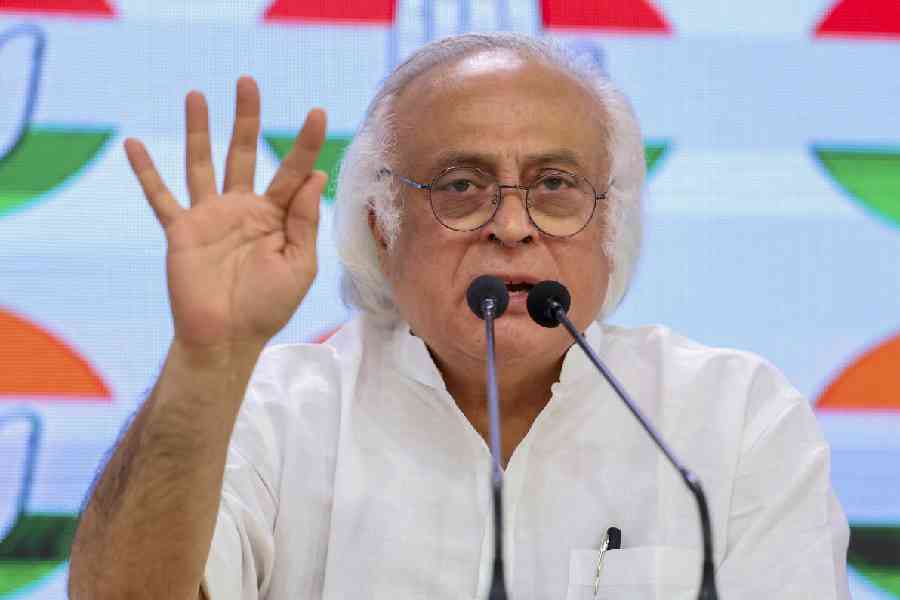
| Centre stage: Posters of Speed-the-Plow (top) and Blackbird (above) |
Wanted: Bollywood stars for London stage
When you ring the box office at the Old Vic Theatre in London, a recording informs callers that Speed-the-Plow “is sold out”.
This is an American play, written by David Mahmet, which tells us that Hollywood producers will nearly always choose to make a trashy but commercially successful movie over one that is artistic but may not attract audiences.
The current production, which stars Jeff Goldblum and Kevin Spacey, two big names from Hollywood, has had the most gushing reviews of any play since Nicole Kidman appeared naked in The Blue Room at London’s Donmar Warehouse in 1998.
Speed-the-Plow (an expression denoting a wish for success or prosperity) is directed by Matthew Warchus. He has directed the stage version of The Lord of the Rings, featuring A.R. Rahman’s music, and would also quite like to do Mahabharat, the musical. If we had a Bollywood cast for the Mahabharat, Warchus could have another hit on his hands.
Also at the Old Vic Theatre, how clever of Lakshmi Mittal’s 32-year-old son to link his name to a scheme called “the Aditya Mittal tickets for under 25s”. Under this sponsorship arrangement, 100 seats are set aside at every performance for under 25s at a concessional price of £12 — a bargain when you consider I paid £95 for two tickets.
But it was worth it. Britain is the best country in the world for theatre. Not all the plays make easy viewing. Last week, for example, I also saw Blackbird at the Rose Theatre in Kingston, 25 minutes by train from Waterloo.
Written in 2004 by David Harrower, it focuses on the confrontation between an older man and a young woman 15 years on from when he had sex with her when she was 12. There is a twist: having beaten up the man, physically and verbally, she is still so psychologically vulnerable she wants to have sex with him — she has slept with 83 men since the first time — and renew their relationship.
I am going to try and recover by going to see The Importance of Being Earnest.
 |
| Source of Inspiration? Waris Hussein |
Lean times
The word “epic” seems most appropriate when describing the films of Sir David Lean, whose birth centenary on March 25, 2008, is being celebrated with the screening of such masterpieces as Brief Encounter (1945), The Bridge on the River Kwai (1957), Lawrence of Arabia (1962), Dr Zhivago (1965) and A Passage to India (1984).
Now, an intriguing anecdote reaches me that in making A Passage to India, he may have borrowed more than a little from the British Indian film director, Waris Hussein, who had made a television version of E.M. Forster’s novel for the BBC 19 years previously in 1965.
“I wouldn’t like to say Lean copied me,” emphasises Waris, who was born in Lucknow in 1938, moved to Britain at a young age, read English at Queens’ College, Cambridge, before distinguishing himself in British television, then lived in America for many years and is now happily back in circulation in London.
However, when Lean’s big budget version went into production, he did borrow a copy of Waris’s film which he kept for months. There is more than a passing similarity with one scene, in particular, viewed through a lattice work, of Cyril Fielding struggling with his collar stud while conversing with Dr Aziz.
“It is exactly as I shot it,” observes Waris.
Waris had himself wanted to make a film version of A Passage to India. He put out feelers through the actress Peggy Ashcroft — “she had played Queen Mary in my (1978 TV drama) Edward and Mrs Simpson”. But the request was turned down because Forster had been adamant that his books should not be turned into films.
However, after Lean was given the clearance — Lord Brabourne, son-in-law of Lord Mountbatten, had done the negotiations at a high level — Waris received an apologetic note from George Ryland, the executor of Forster’s will.
“I knew Ryland as he had been one of my tutors at Cambridge,” Waris tells me. “His note said, ‘Dear Waris, very sorry, money talks.’ ”
 |
| Eve of destruction: Tom Young with his painting, Beirut Bombed |
Lost in transition
It’s very embarrassing: every time I hear of an Indian train journey by a British person, I learn his or her bag or camera has been stolen, usually while the passenger was asleep.
The latest incident concerns a 34-year-old British artist, Tom Young.
“Luckily, I had taken out my sketch book which I was clutching when I dozed off, otherwise I would have lost everything,” he tells me.
Since India, Tom has been in Lebanon, reflecting his emotions at the destruction left by the Israeli bombing of 2006. Tom’s powerful Lebanon paintings are on display at Indar Pasricha Fine Arts, a London gallery.
The theft hasn’t put Tom off India, which he is keen to visit again soon. “I was inspired by my grandmother Dorothy Vaughan, who grew up in India as an artist. She would show me her sketches.”
Tom expects, at least, a couple of his Indian paintings to be included in one of the artistic highlights of the summer season — the annual May exhibition of the Royal Society of British Artists.
Made in India
There must be a significant number of British people who have descended from Anglo-Indian stock but who have either not wanted to admit their origins or perhaps have been unaware of them. The pop singer Cliff Richard, born Harry Webb in Dehra Dun, has always insisted he is white.
However, last week on BBC Radio 4, one of the country’s best known impressionists, Alastair McGowan, 43 — he mimics, among others, David Beckham and Tony Blair — spoke openly of how he discovered that when his father died in 2003, aged 74, he had put “Anglo-Indian” under caste in his birth certificate. Then followed a trip to Calcutta, the city of his father’s birth.
Occasionally, there had been calls from a woman in India whom his father had addressed as “Aunty Gee”. Now, he realises, it was “Auntyji”.
Tittle tattle
 |
| Football fan: Amit Bhatia in the Evening Standard |
Nice to see Lakshmi Mittal’s son-in-law, Amit Bhatia, getting a favourable mention in the Evening Standard, following his first press conference as vice-chairman of Queens Park Rangers.
The Mittals, who have a 20 per cent stake in the English football club, have promised to retain its traditional character. The hoops in the logo, the subject of speculation, will definitely stay.
QPR has just signed a five-year £20m kit deal, the biggest in the club’s history, with Lotto Sport Italia.
Mittal, Bhatia told the paper, will be involved for the time being at an “emotional” level, as a fan, rather than an owner.
The Mittals generally steer clear of sponsoring ethnic enterprises but their presence at QPR may encourage more Indians to turn up for football matches, especially for QPR fixtures at Loftus Road in west London.