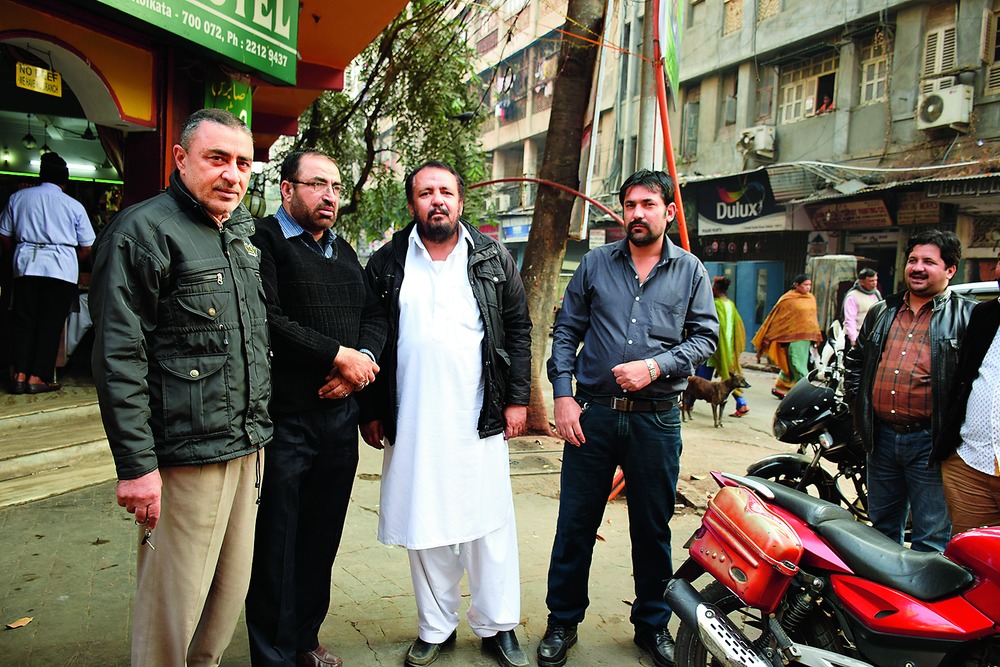

We are in a small eatery in central Calcutta and Ali Baizullah is wiping his plate clean with the last shred of his roti. A waiter arrives, bangs down a bowl of nihari and glides to the next table.
It is not even 6am but the place is abuzz. The tinkle of spoons and rattle of crockery form the background score; but what rises above the din is a guttural hum that turns out to be Pashto. Sitting in the stark dining hall are more than a dozen Pashtuns like Baizullah, wolfing down generous portions of kalejis and bhuna with piles of rotis before getting on with their day.
Pashtuns or Pakhtoons are natives of Afghanistan, locally known as Kabuliwalas. Pashto is their mother tongue.
Three words that keep cropping up are sange, khuda panam and notebandi. It turns out that the first two mean "how are you" and "see you". "Pashto mein notebandi ka barabar shabd nahi hai (There is no Pashto equivalent of notebandi)," grunts Baizullah.
Notebandi is a clever post-November 8 coinage. It invokes the surgical procedure of nasbandi or vasectomy, the 1970s mass drive engineered by Sanjay Gandhi that boomeranged, and melds it with the effect of demonetisation. The impact of notebandi on the Kabuliwalas, who have traditionally worked as moneylenders in this adoptive land of theirs, has also been emasculating.
Kadir Khan is 28. He has just started learning the ropes of the trade from his grandfather. He will tell you how helpless it felt to be caught in the middle of the demonetisation drive minus a bank account to his name. The Kabuliwalas are not citizens, more like migratory birds on tourist visas, and therefore not eligible to open bank accounts here. Says Kadir, "We were forced to exchange whatever cash we had at heavy losses."
Rehmanullah has been in the moneylending business since 1971, possibly when Kadir's parents were toddlers. The 72-year-old has around Rs 5 lakh stuck in the market. "About 30-40 people owe me money. No one has paid the principal amount since demonetisation, let alone the interest." Rehmanullah's monthly income of Rs 25,000-30,000 has halved and he was even beaten up by a borrower recently for insisting on repayment.

Demonetisation or no, the Kabuliwalas' fortunes had anyway started to take a beating these past years. Banks offering loans at competitive rates had eaten into their moneylending business. "Almost all of them are now switching to businesses such as clothes, carpets, dry fruits and other knick knacks," says Yasmin Nigar Khan, great granddaughter of Khan Abdul Gaffar Khan and president of the All India Pakhtoon Jirga-e-Hind, an organisation that looks after the interests of Pakhtoons in India.
True enough. Kadir is planning to set up a carpet shop. Fazlul Rehman, who commands much respect in the community, also has a parallel clothes business. He has Rs 5-6 lakh stuck in the market but is hoping to get his money back. He applauds the PM for doing the "right thing". Others are not so forthcoming, but are not openly criticising either. Most of them are grateful to India for its support to their movement for an independent Pakhtoonistan.
While the younger generation is focussing on new livelihoods, old-timers are struggling to maintain status quo. Returning home does not even feature in the list of options of either. "I am more used to trading and living in this country. So it's better to think of sustainable alternatives here," says Kadir as he takes one last sip of his buffalo milk tea.
Rehmanullah's reasons are different. "There is a war-like situation there," he says. "Moreover, moneylending is haram in Islam. I might even be ostracised. But I have no stamina to start an alternative business at this age."

It is broad daylight now. The grimy curtains at the entrance have been pulled back to let in the bullion sun. The young Pakhtoons have left, but Rehmanullah is in no seeming hurry. Half reclined in his corner seat he stares at the street, a glint of steel in his surma-laced eyes. Thinking of new ways to recover his hostage lakhs? Possibly.