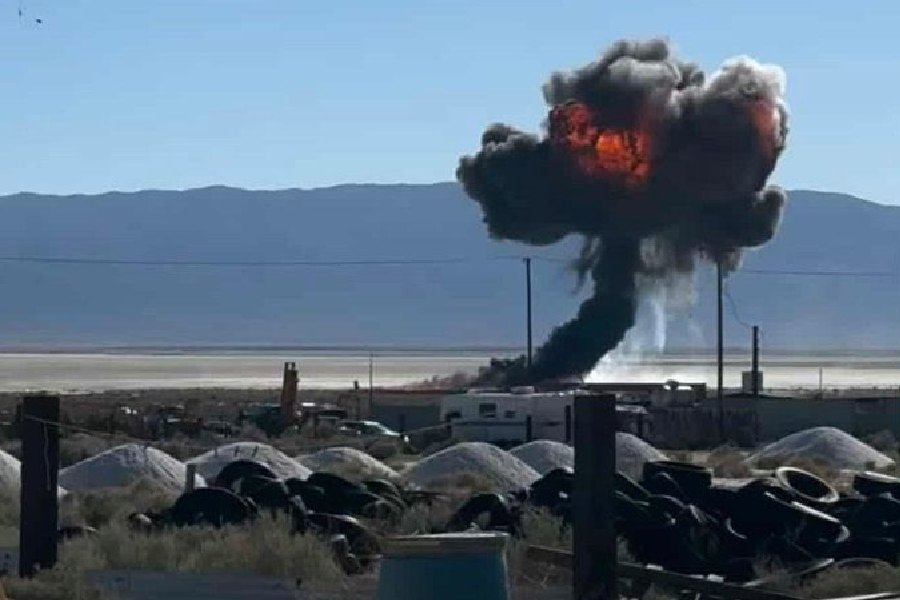
A training mission for the United States Air Force’s elite Thunderbirds demonstration squadron ended in a crash on Wednesday morning in the Mojave Desert, raising fresh questions about the risks involved in high-precision aerial displays carried out by US military units.
The F-16C Fighting Falcon went down around 10:45 am “over controlled airspace in California,” according to a statement from Nellis Air Force Base in Nevada.
The aircraft crashed near Trona, an isolated community in the Southern California desert about 180 miles north of Los Angeles.

The San Bernardino County fire department said it responded to an “aircraft emergency” in the area and confirmed that the pilot had ejected. The pilot was taken to a hospital with injuries described as non-life-threatening.
In 2022, a Navy F/A-18E Super Hornet crashed in the same region, killing the pilot. The terrain around Trona has long been used for training operations by multiple branches of the US military, drawn by its vast stretches of restricted airspace.
Wednesday’s crash is under investigation. “Further information will be released from the 57th Wing Public Affairs Office,” the Air Force said, without offering details on what may have caused the jet to go down.
The Thunderbirds, formed in 1953, are known for their tight-formation flying at air shows across the US. Their routines involve flying within inches of each other in high-speed sequences that require intense preparation.
The Air Force’s brief statement did not say whether weather, mechanical issues, or human factors played a role in the incident.
The squadron practices seasonally out of Nellis Air Force Base near Las Vegas, where F-16 Falcon and F-22 Raptor fighter jets, along with A-10 Warthog ground-attack aircraft, are based.
Over the decades, both the Thunderbirds and their Navy counterpart, the Blue Angels, have faced scrutiny after multiple crashes during training and performances.