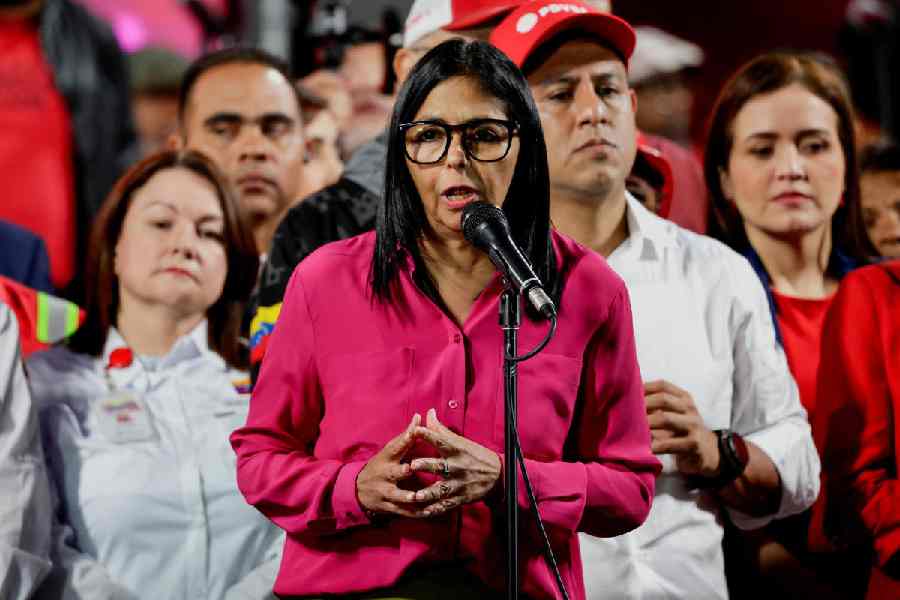
Prime Minister Narendra Modi on Friday spoke to the acting President of Venezuela, Delcy Rodríguez Gomez, weeks after she took the helm following her predecessor Nicolas Maduro’s capture by the US Special Forces.
“We agreed to further deepen and expand our bilateral partnership in all areas, with a shared vision of taking India-Venezuela relations to new heights in the years ahead,” Modi said while announcing his conversation with Gomez on X.
There was no immediate word on the conversation from the Venezuelan side.
The external affairs ministry, in a late-night readout, said Gomez had called the Prime Minister. “The two leaders agreed to further expand and deepen the India-Venezuela partnership in all areas, including trade and investment, energy, digital technology, health, agriculture and people-to-people ties. Both leaders exchanged views on various regional and global issues of mutual interest and underscored the importance of their close cooperation for the Global South,” it said.
India had been cautious in its response to the US action in Venezuela, taking well over a day to take a position that was quite similar to New Delhi’s stand after Russia attacked Ukraine in February 2022. India did not pick a side. The short statement did not name the US and made no mention of Maduro’s detention. Nor was there any reference to the need to respect sovereignty or uphold the rule of law, something that India articulates often.
India and Venezuela have had cordial relations for long and the positions of the two countries on global issues have often aligned. Both are members of the Non-Aligned Movement and India was a major importer of Venezuelan oil till US President Donald Trump imposed sanctions on the South American country in 2017 and forced India to cut back oil purchases from Caracas.
As a result, bilateral trade with Venezuela has fallen drastically from $6,397 million in 2019-20 to $96 million in 2023-24. In 2019-20, Venezuela accounted for about 7 per cent of India’s total crude imports. Today, Venezuelan crude has a negligible presence in India’s oil basket.
Maduro’s ouster can change this as the White House has indicated that it is prepared to allow India to buy Venezuelan oil under a new US-controlled framework. However, earlier this week, Reuters quoted four refining executives as saying that Indian oil refiners are only being offered small volumes of Venezuelan crude as most supply is heading to the US.
Oil overhaul plan
Venezuela’s National Assembly on Thursday approved a sweeping overhaul of legislation governing the oil industry, granting foreign oil companies greater control over operations and potentially slashing the royalties they pay to the government.
The move showcases how, experts say, the Trump administration has returned to an era of gunboat diplomacy, in which the US has wielded its military superiority to coerce Latin American nations into yielding to Washington’s priorities.
The new legislation gives foreign companies clear operational control over production ventures, effectively relegating the national oil company, Petróleos de Venezuela, to secondary status.
It also opens the way for the authorities to sharply reduce the royalties and taxes paid to Venezuela’s government and allows companies to resolve disputes in international venues instead of doing so in Venezuela’s legal system. Still, the changes did not go as far as some investors had wanted, leaving Petróleos de Venezuela under state control instead of breaking it up or privatising it.
The overhaul effectively reverses much of Venezuela’s nationalisation of oil projects in 2007, which led US oil giants like Exxon Mobil and ConocoPhillips to exit a country with some of the world’s largest oil reserves. That takeover was a central pillar of Chavismo, the political movement that has held sway over Venezuela for nearly 30 years.
Additional reporting by New York Times News Service