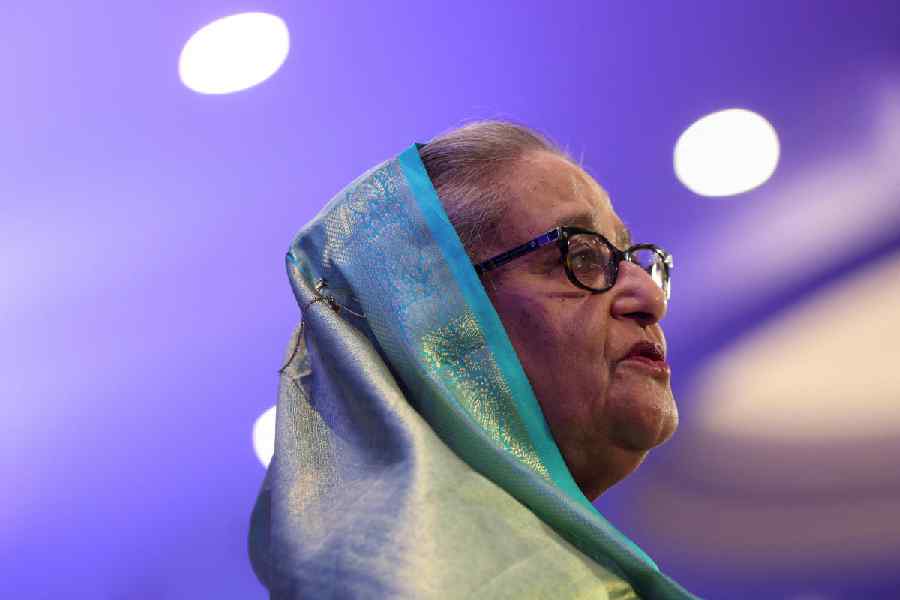
A report of the parliamentary standing committee on external affairs on the future of the India-Bangladesh relationship — tabled in both Houses on Thursday — reflects the broad political consensus on the stand taken by the government vis-à-vis the political developments in Dhaka after the July 2024 uprising and the refuge given to ousted Prime Minister Sheikh Hasina.
“The committee notes that the government of India has adopted a calibrated policy of non-interference in Bangladesh’s internal political processes, while maintaining constructive engagement with the interim government and other democratic stakeholders. The committee also notes India’s overall approach to its relationship with Bangladesh has remained unchanged following the events of August 2024,” the panel said.
“India continues to pursue a constructive, pragmatic, mutually-beneficial and forward-looking relationship with Bangladesh, engaging with the interim government of Bangladesh, engaging with several issues of strategic interest as well as regional security.”
On Hasina’s presence in India for over a year since she was forced to leave her country, the committee — headed by Congress MP Shashi Tharoor — said this was in keeping with India’s “civilisational ethos and humanitarian tradition of offering refuge to individuals facing circumstances of grave distress or existential threat”. There is only a passing mention in the report of the death sentence Hasina is facing back home and the request of Bangladesh to extradite her.
Concerned about the evolving political situation in Bangladesh since August 2024, “particularly the uncertainty surrounding elections, political violence and the rise of extremism”, the committee acknowledged that these developments have strained certain aspects of bilateral ties, especially security cooperation and people-to-people relations.
Commending India’s “quiet diplomacy” during the period of rapid and transformative change, the committee appreciated the “non-interventionist” approach while remaining a strong supporter of a participatory and inclusive election process in
Bangladesh”.
Apart from airing its own views on the subject after deliberations, the report also flagged the comments made by some of the expert witnesses who appeared before the committee. “Two of the non-official witnesses, characterised the current situation as India’s greatest strategic challenge in Bangladesh since 1971.”
One of them was quoted as saying: “India faces its greatest strategic challenge in Bangladesh since the Liberation War of 1971. The challenge in 1971 was existential, a humanitarian crisis, and a birth of a new nation. Today, the threat is subtler but probably graver, more serious; a generational discontinuity, a shifting of political order, and a potential strategic realignment away from India. The collapse of the Awami League dominance, the surge of youth-led nationalism, the re-entry of Islamists, and intensifying Chinese and Pakistani influence collectively marked a turning point.”
The four non-official experts who appeared before the committee were former national security adviser Shiv Shankar Menon, former high commissioner to Bangladesh Riva Ganguly, dean and professor at JNU’s School of International Relations Amitabh Mattoo and Lt Gen. (retd) Syed Ata Hasnain.
With regard to the impact of recent developments on broader bilateral relations, the external affairs ministry informed the committee that India has made every effort to insulate bilateral relations from the impact of recent political developments. “To that end, India has continued interactions with the interim government and are also supportive of the aspirations of the people of Bangladesh. While communicating our support, the government of India have underlined that our policies are people-oriented and not aimed at any particular political dispensation.”
Visa centres
India on Thursday resumed operations at its visa application centre in Dhaka, a day after closing it over escalated security concerns, but closed two other identical facilities in Khulna and Rajshahi over the same apprehensions.