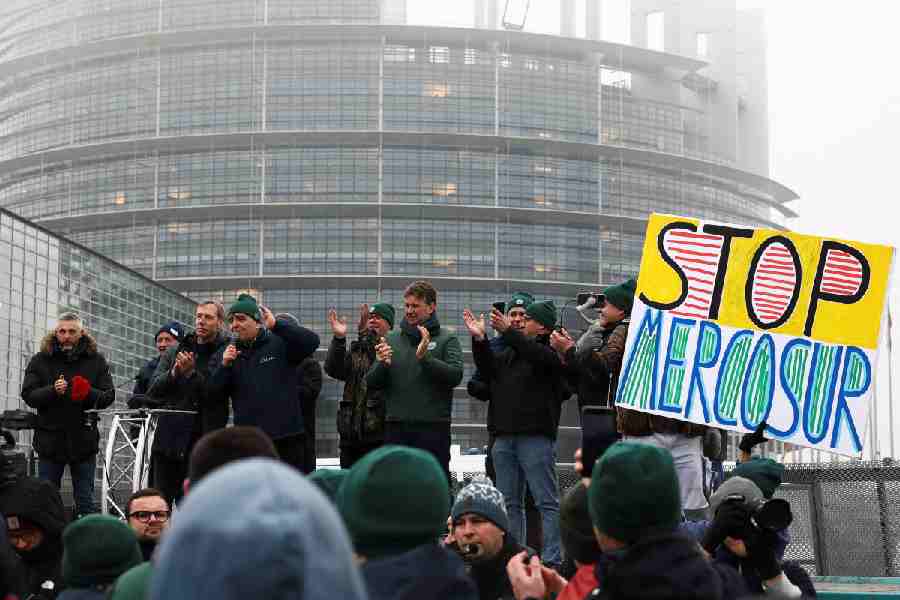
European Union lawmakers on Wednesday voted to hold up ratification of a major free trade agreement with the Mercosur group of South American countries over concerns about the legality of the deal.
In a vote in Strasbourg, France, lawmakers narrowly approved sending the EU-Mercosur agreement to Europe's top court to rule on whether it is in line with the bloc's treaties. The result was 334 votes in favour to 324 against, with 11 abstentions.
The assembly cannot vote to approve the pact until the European Court of Justice has ruled, and this could take months.
The long-sought-after free trade agreement was signed into effect on Saturday. Twenty-five years in the making, it aimed to strengthen commercial ties in the face of rising protectionism and trade tensions around the world.
The deal was seen as a central priority of European Commission President Ursula von der Leyen, who shepherded it through a key vote on Jan. 9 among the EU's 27 leaders. “The more trading partners we have worldwide, the more independent we are,” von der Leyen said at the World Economic Forum in Davos, pointing to Mercosur and another trade deal in the works with India.
Supported by South America's cattle-raising countries and European industrial interests, the accord is aimed at gradually eliminating more than 90% of tariffs on goods ranging from Argentine beef to German cars, creating one of the world's largest free trade zones and making shopping cheaper for more than 700 million consumers.
France, Europe's major agricultural producer, wanted stronger protections for farmers and has sought to delay the pact. Foreign Minister Jean-Noel Barrot welcomed the parliament's vote, saying in a social media post that the assembly “expressed itself in line with the position that we have defended. France takes responsibility for saying no when it has to, and history often proves it right. The fight continues.”
The European Commission said that it “strongly regrets” the parliament's decision.
However, the EU's powerful executive branch can provisionally apply the deal until then. EU leaders are expected to discuss the way ahead at an emergency summit focused on transatlantic relations on Thursday.
In a post on social media, German Chancellor Friedrich Merz described the EU parliament's decision as “regrettable.”
“It misjudges the geopolitical situation. We are convinced of the legality of the agreement. No further delays. The agreement must now be applied provisionally,” Merz wrote.
Bernd Lange, head of the parliament's committee on trade, said the vote was “absolutely irresponsible” and “very harmful for our economic interests.”
Opponents should simply vote against ratification "instead of using delaying tactics under the guise of legal review,” he wrote on X.
Ratification is considered all but guaranteed in South America, where the agreement has broad support.
Mercosur consists of the region's two biggest economies, Argentina and Brazil, as well as Paraguay and Uruguay. Bolivia, the bloc's newest member, is not included in the trade deal, but could join in the coming years. Venezuela has been suspended from the bloc and is not included in the agreement.