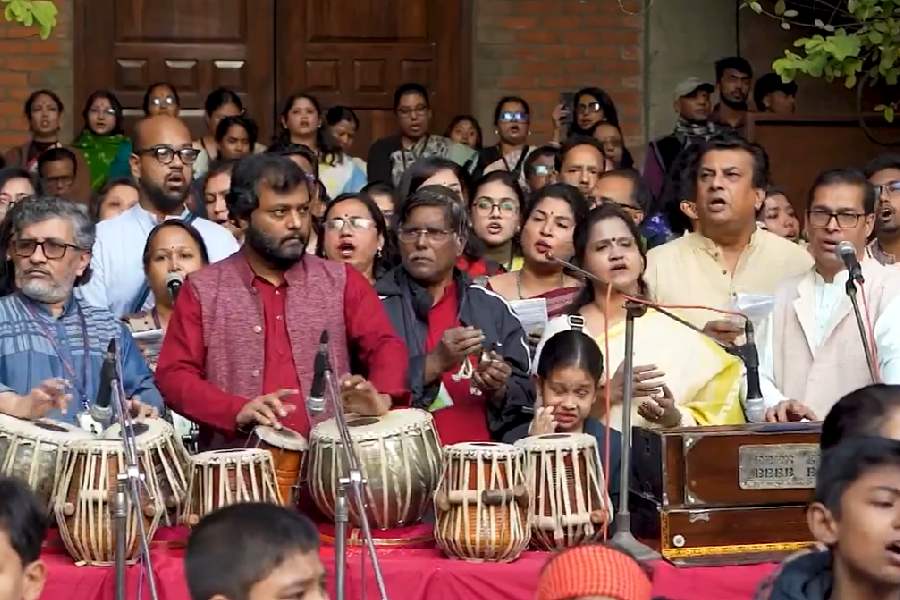
Thousands of students, alumni, artists and cultural activists gathered outside Chhayanaut on Tuesday afternoon to sing Rabindranath Tagore’s “Jodi Tor Daak Shune Keu Na Ashe.”
The gathering on Satmasjid Road in Dhanmondi was not a routine cultural programme but an act of resistance against last week’s vandalism at Chhayanaut, a symbol of Bengali cultural pride against oppression before Bangladesh was born.
Fundamentalists had damaged parts of the building and resorted to arson amidst the violence following the murder of Inquilab Mancha leader Sharif Osman bin Hadi.
Titled “Gaane Gaane Sanghati Samabesh,” the event unfolded as a peaceful, music-led protest against recent attacks on cultural spaces and growing concerns over freedom of expression in Bangladesh.
Outside the Chhayanaut premises, artistes and participants sang in unison: “O Amar Desher Mati,” “Gramer Naujowan Hindu Musolman,” “Amar Mukti Aloy Aloy,” and “Jodi Tor Daak Shune Keu Na Ashe.”
Near the Abahani Club field cultural figures including singer Farzana Wahid Shayan, actress Azmeri Haque Badhan, actor Aanon Siddique, and filmmaker Akram Khan gathered under the banner of Drishsho Madhyam Shilpi Shomaj (Visual Artistes Collective).
Condemning what they called systematic attacks on cultural spaces and voices, they marched together to Chhayanaut.
Children and adults joined together as tabla, harmonium, dholak, and manjira set the rhythm, turning the street into a shared performance space rather than a stage.
Other songs performed included “Mora Jhonjhar Moto Uddam,” “O Bhai Khanti Sonar Cheye Khanti,” and “Chol Chol Chol Urdhya Gogone Baje Madol.”
Chhayanaut’s role in Bangladesh’s cultural and political history explains why the attack on its premises resonated deeply. Founded in 1961, when the Bengali language and cultural practices were under threat, the institution emerged as a site of resistance well before independence.
Through the teaching and practice of Rabindra Sangeet, Nazrul Geeti, and classical Bengali forms, Chhayanaut asserted and preserved cultural identity.
The programme concluded with the national anthem, “Amar Shonar Bangla, Ami Tomay Bhalobashi,” as the national flag was waved.