 |
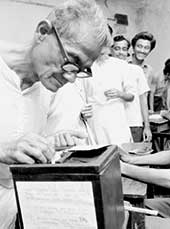
| A Calcuttan casts his ballot on June 11, 1977 |
Retired IAS officer Swapan Chakrabarti was an assistant returning officer in Midnapore when Bengal voted the Left Front to power for the first time by a landslide margin in 1977. Chakrabarti recounts to Metro the election that defined Bengal’s political future for three decades
With weeks to go for the Assembly elections (in June), the then chief minister Siddhartha Shankar Ray was scheduled to hold an election meeting in Kharagpur. The arrangements were in place but where was the audience? As the minutes went by, the babus were getting worried. The superintendent of police then came up with a face-saver. He got a sizeable number of his men to take off their uniforms and occupy the seats in plainclothes. The incident was a pointer to what we had been suspecting for some time — the Congress wasn’t the force it used to be.
Yet, there was no knowing exactly what the outcome would be. There were no pre-election surveys in those days. Doordarshan, the only TV channel, was state-controlled. Which is why it was easy for the government to hush up things should the need arise. Newspapers made only broad predictions.
Campaigning had a different feel to it in those days. It was to be a crucial mandate for the Left that had been all but erased during the Emergency. After quitting the Congress, it was a matter of political survival for Prafulla Sen of the Janata Party as well. But this desperation to win at any cost that we see now was not there. Politics still meant serving one’s country, to some extent.
 |
The Left in Midnapore was then controlled by Sukumar Sengupta, a freedom fighter who had served a prison term in the Andamans. Surjya (Kanta) Mishra was a medical student, or perhaps had just graduated — a sincere worker in the party’s junior cadre. There were hand-written posters, cloth banners and graffiti on the walls. Nothing more. Hardly any money was spent on the campaign.
Polling used to start much later than now as there was so much to do before that. Every ballot paper had to be stamped and signed by the officer in charge (of the booth). I was posted in Midnapore town, assisting the district magistrate, who was the returning officer. There were no observers; the post was created later. All of us — assistant returning officers, sector magistrates, electoral registration officers — did the rounds of the constituencies to check how much polling had taken place, if there was intimidation or a booth jam. Polling was peaceful. Just one constable was enough to guard a booth.
Counting took place three days later, on June 14. Midnapore was the largest district of Bengal with 37 seats. I took my place on a dais, keeping watch on all the counting tables in the hall. It was surprising how the Left was sweeping table after table.
Of course, the results were to be officially announced much later. There were no news channels to telecast trends but we, the officials, posted in various districts, were calling each other up from time to time on the hotlines. The trend was the same everywhere.
In the evening, we saw the street lights wrapped in red cellophane. They had done the same in Calcutta, too. Promode Dasgupta complimented voters in a radio address. But he also urged restraint. Celebrations were muted. Only small victory rallies were taken out. Such was the discipline of the party that even national newspapers hailed the new government.
I did not vote for many years, because of polling duty in my service life, and after that because of the apathy of the same old faces who would go about seeking votes. But this time I will. I was a part of history then. I do not want to miss the chance to be a part of history one more time.