Two nurses at a private hospital in Barasat, North 24-Parganas, are suspected to be infected with the Nipah virus, the state government said on Monday.
Both patients were unconscious and on ventilator support on Monday evening and are being treated at the same hospital where they work, according to sources in the state health department.
Fluid samples from the nurses have been sent to AIIMS Kalyani, while the National Institute of Virology (NIV), Pune, will provide the final confirmation on whether the patients are infected with Nipah virus.
A neurologist treating the nurses first suspected infection after reviewing a CT scan of the brain that showed signs of viral involvement, a health department source said.
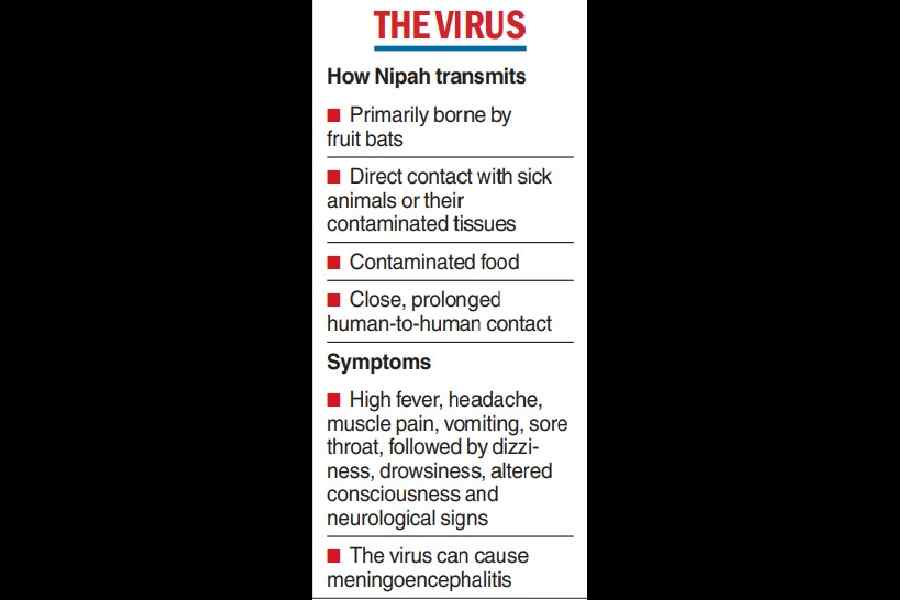
Doctors and public health experts said that Nipah virus is primarily zoonotic, meaning it transmits from animals to humans, but human-to-human transmission is possible with prolonged contact. This places healthcare workers at higher risk of infection. The health department has begun monitoring all doctors and nurses who treated the two nurses for any signs or symptoms.
The Barasat hospital has created an isolation ward in the ICU for the two patients. All nurses who provided care have been quarantined, and their samples have also been sent for testing, health department sources said.
At a news conference on Monday evening, chief secretary Nandini Chakravorty said: “Two suspected cases of Nipah virus have been found in Bengal. They are admitted at a private hospital in Barasat.”
“We have started contact tracing. We are also creating strategies for treatment and testing... Some basic safety precautions like handwashing must be followed. We are asking people not to panic but to remain careful,” she said.
An official from the health department said one of the nurses initially fell ill and returned home in East Burdwan on December 31 with high fever and respiratory issues. The patient went to a local health centre but later fell unconscious on January 4. The nurse was shifted to Burdwan Medical College and then moved to the Barasat hospital on January 6 after their condition worsened.
The second nurse was admitted to the Barasat hospital on January 4. “They were on duty together between December 28 and 30,” a health department official said.
The health department official added: “This was confirmed after speaking to both nurses’ family members and hospital authorities.”
Chakravorty did not comment on the nurses’ current condition, stating only that they are “under treatment” and that a standard operating procedure (SOP) for the situation is being prepared.
Chandramouli Bhattacharya, an infectious disease specialist at Peerless Hospital, said healthcare workers are at particularly high risk during Nipah outbreaks. “Previous outbreaks, including one in Kerala in 2023, showed that hospital staff are highly vulnerable,” he said. “It is not as contagious as Covid-19, but the fatality rate is very high. Symptoms begin with fever and cough, followed by drowsiness, abnormal behaviour, and neurological symptoms. Nipah can cause meningoencephalitis.”
Though primarily zoonotic, he reiterated that human-to-human transmission can occur through prolonged contact. “Healthcare workers near suspected cases should wear masks and full personal protective equipment (PPE),” Bhattacharya said.
The World Health Organization (WHO) notes that “in Siliguri, India in 2001, transmission of the virus was also reported within a health-care setting, where 75% of cases occurred among hospital staff or visitors”.
Doctors said there is no specific treatment. “Intensive supportive care is recommended to treat severe respiratory and neurologic complications,” the WHO website states.