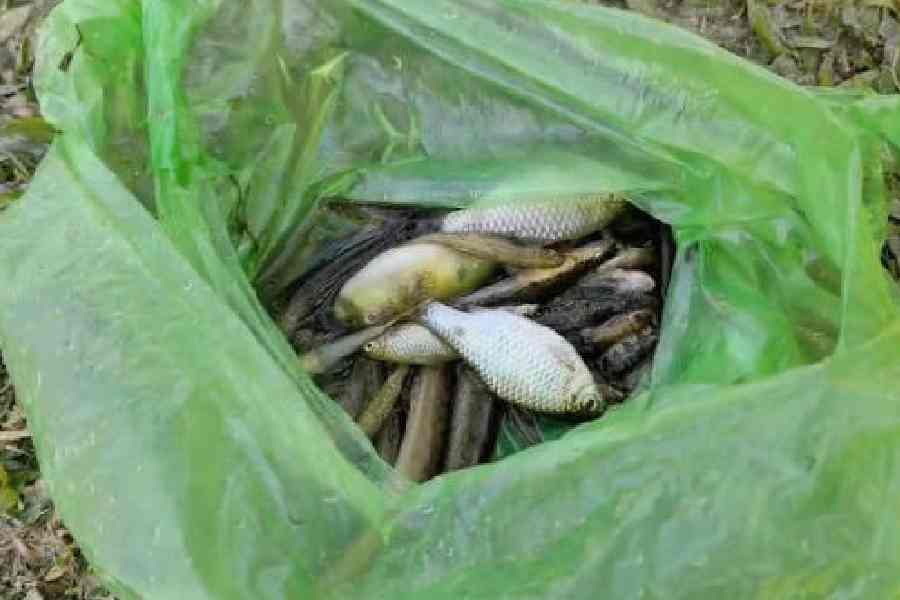
Jalpaiguri: Hundreds of fish poisoned to death were found floating in the Rangati river of Jalpaiguri district on Wednesday morning, barely 24 hours after a similar incident of aquatic mortality in the Teesta.
On Wednesday morning, residents of Dhupguri and Banarhat blocks —particularly those living in Salbari and Angrabhasha 1 and 2 panchayats — noticed large numbers of dead fish in the Rangati.
Local fish species tyangra (Gangetic mystus), baim (eel), taki (spotted snakehead) and puti (pool bard) were found dead in significant quantities. A group of local people was seen collecting the dead fish that were drifting along the river.
According to sources in the state fisheries department, a toxic oil-like substance may have been used in both the Teesta and Rangati rivers, causing the fish deaths.
On Tuesday morning, large numbers of fish were found dead in a stretch of the Teesta near Donohoni in Jalpaiguri district. Water and fish samples were collected from the Teesta by the department for laboratory testing.
The Rangati is shallow and the residents noticed the dead fish accumulating near the Rangati bridge, where the river flows from a higher to a lower level. Many people gathered to collect the fish that had floated on the surface.
Kartik Ray, a resident who collected some of the dead fish, said he believed unknown individuals had poisoned the river.
Debarshi Biswas, a member of the Banarhat panchayat samiti, said illegal sand lifting had already altered the river’s natural flow and poisoning the water to catch fish was “unfortunate”.
Officials from the fisheries department visited the area and expressed doubt that toxic substances could be detected in water samples because of strong river currents. They collected dead fish samples from residents and buried the remaining fish to prevent further contamination.
Ramesh Chandra Biswas, an assistant director of the department posted in Jalpaiguri, said the poisoning might have been carried out by anti-social elements upstream who used toxic oil to kill fish before collecting them.
He also pointed to another possible cause. “The tea gardens located nearby often draw river water in drums for spraying pesticides. After spraying, workers sometimes wash the drums in the river, which could release harmful chemicals and lower dissolved oxygen levels, resulting in fish deaths,” said Biswas.
The samples, he said, will be sent to a laboratory in Calcutta. “We will soon conduct awareness campaigns in Mainaguri, Dhupguri, and Banarhat blocks,” he added.