
Is my antique cupboard a piece of art? And is my bright red sofa design?
What is "design"? What is "fine art"?
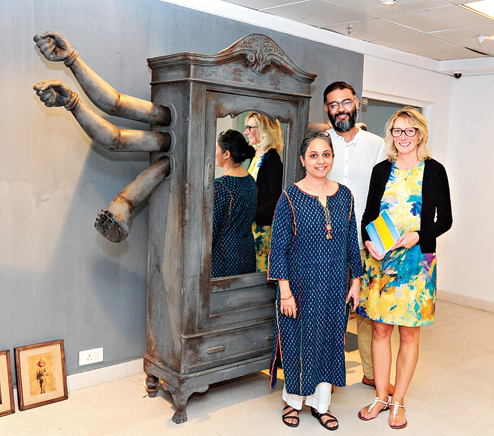
Sixteen German artists, together with artist Swarup Dutta from Calcutta, present us their answers to these questions with 29 artworks, individual objects, sculptures, installations and videos at Come in: Interior Design as a Contemporary Art Medium, an art exhibition by the Institut für Auslandsbeziehungen e. V. (ifa), Stuttgart, Germany, presented by Goethe-Institut/Max Mueller Bhavan Calcutta and Emami Chisel Art Gallery.
The exhibition will be held from September 10 to October 2 at Emami Chisel Art Gallery in Anandapur.

After a world-tour through 16 countries, the exhibition "Come in", curated by Renate Goldmann and Volker Albus from Germany, arrives in Calcutta before it concludes in Mumbai this December.
The interior spaces chosen by many of the contributing artists form links between aspects of contemporary history and their own biography and critical aesthetics.
"Design" is IN in India. It seems that we get, virtually as a free gift, status and prestige on top of the mere usable object if only we can put the label of "design" on it. Obviously, this only works when we make our private space public, in the way that people have to "come in" and watch. Quite like the Tollywood and Bollywood stars who invite a newspaper or magazine into their homes and show "us" their interior design.
Already in 1927, German "Bauhaus", famous also in Calcutta because of the legendary 1922 Calcutta Bauhaus Exhibition, tried to give a "production art"-based answer to the question of how one should design the interior of one's own house. Since, every decade has come up with a new trend and a new answer to the relationship between form and function.
Many of the participating artists have produced works especially for "Come in". It focuses on two kinds of objects: those treating the phenomenon of personal and collective memory in the tradition of sculpture and/or installation art, and those which assume definitive "form" only by means of their communicative functioning, i.e. in practical use.
Calcutta-based architect and actress Anubha Fathepuria together with artist and scenographer Swarup Dutta have created a series of events in order to explore and explain different aspects of the exhibition and to contextualise it to our living spaces. The programmes include architects like Subhrajit Das, artists like Bidyut Biswas and Lipi Biswas participating in a panel discussion, the architect and urban designer Partha Rajan Das talking on Bauhaus and young design practitioners from the city like Chhandak Pradhan, Siddharth Sengupta and Jit Choudhary exploring notions of order and disorder through photographs and illustrations.