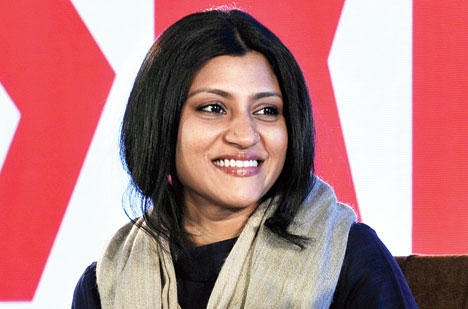

Victoria Memorial: Questions about directing, acting, childhood, parenting and more came up when director-actor Konkona Sen Sharma was in conversation with Renu Roy at the Tata Steel Kolkata Literary Meet, co-organised by Victoria Memorial Hall in association with The Telegraph.
Konkona said she had grown up with the story of A Death in the Gunj being discussed anecdotally by her parents, but did not want to focus too much on either the real incidents that inspired the story or the short story written by her father, Mukul Sharma, which formed the basis of the script.
"I have fictionalised so much of it and brought in my own experiences and my own memories so much that it's not really that story anymore," she explained, adding that the film is not just about the death of Shutu but the decline of McCluskieganj, its Anglo-Indian community and the way of life it represented.
She also spoke of her own experience with bullying, adding that it has given her a unique perspective into "group dynamics" and the "casual cruelty" that people can be capable of. "To me, none of the characters in the story is a villain... it's just that, as people, we are often not aware of the extent to which we can affect other people's lives," she said.
The character she identified with the most in the film? Shutu, of course - if she had to play any role from the film, it would be him, although she wrote him with Vikrant Massey in mind. Her fond on-set memories included banter with the late Om Puri, who "constantly made fun" of her!
Despite being rejected by at least four producers, Konkona found it easier to obtain funds for her unusual directorial debut as she already knew many people in the industry through her parents and from her acting days. "There are so many talented people who never get a chance. The system is not fair at all," she asserted.
Her parents' help proved "invaluable" during the actual filming as well, as she called them up "every day, if not twice a day" to confirm details of life in McCluskieganj in the Seventies.
The director also fielded questions from the crowd, including one from a young man who asked her what masculinity meant to her. "Thank you for asking this question, as I'm raising a little boy at home," she said, smiling, and added that to her, it cannot mean just one thing; individuals should be allowed to interpret it the way they want to, rather than anyone dictating what it should be.