
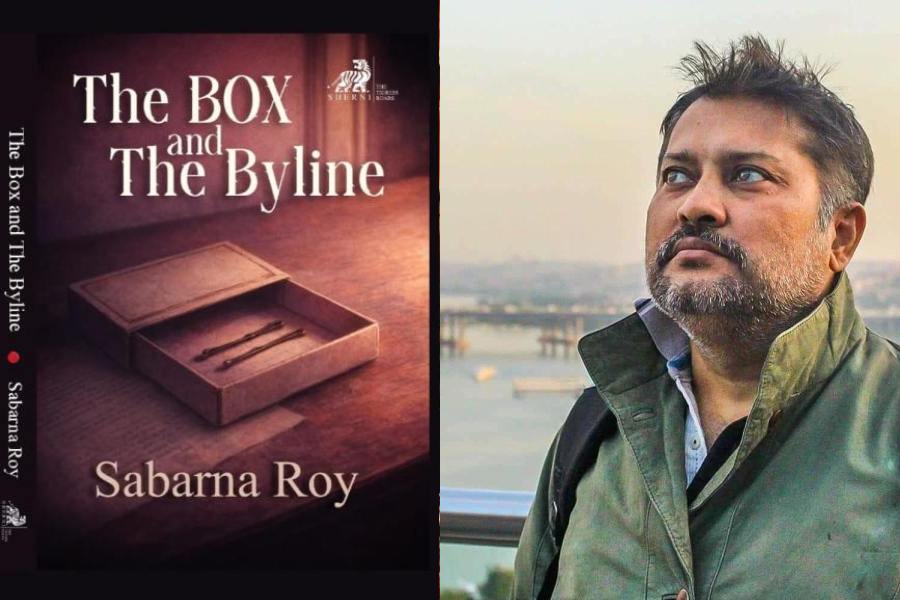
Sabarna Roy’s newest novel, The Box and the Byline, strikes the reader as a unique experiment in telling a love story, and quite out of the box. Anita and Sanjoy seem to know from the start that they have something very special. Like-minded young souls, they refrain from muddying their crystal friendship in the murky waters of marriage and a dull life. The fractured tellings and pastiche of genres, from fiction to sparse poetry to memoir, are cradled in this unusual repository and reflect the dissonance, dysfunction, and chutnification of our postmodern world.
Incredulously adept in capturing the minutiae in the most light-hearted banter or Haiku-style words, Roy uses ordinary phrases to convey the most extraordinary expressions of grief. “I did not marry because the letters were already a house and I live conservatively,” is one blistering piece of wit that stands unshaken like stalactites frozen on a brutal winter’s morning at the beginning of the story.
But more than any other, “She left within the month. Our friendship took the shape it would keep for forty years: brittle envelopes at first, then clean envelopes, then emails in fonts I never learned to love. She married in 1990 — a batchmate with kind eyes who once wrote me a postcard from a conference I never understood — and had two boys who, in school photographs, looked like they were ready to outrun a storm. I never married. We never stopped writing.”
The book lets two kinds of truth speak without competing in the space of 284 pages neatly arranged into 36 chapters. The clippings carry the newsroom’s discipline — datelines, verified detail and the hard-earned restraint of reporting. The letters answer with a different fidelity — domestic rituals, literature, food, worry, and the quiet encouragement that arrives. Excerpts from an interview with Roy.
Some of the most powerful books in world literature, like 84 Charing Cross Road and The Colour Purple, have been written by writers who have used letters as a vehicle to carry the narrative. Why did you decide to use this style, and how did it help you to tell the story?
I chose the epistolary or letter-writing mode because I wanted distance itself to become part of the narrative architecture. A letter is never only a message; it carries delay, silence, waiting, memory, and the emotional weather of the one who writes and the one who receives. In this novel, that was essential. Sanjoy lives in the urgency of the newsroom and in the public violence of events; Anita inhabits another continent, another rhythm, another domestic and intellectual life. Letters allowed me to place these two temporalities beside each other without forcing them into artificial simultaneity.
In your last book, Fragmented, you showcased a city full of blemishes, gashes, intellect, and beauty to create the city as a character. In this novel, you deftly bring to the newsroom a kind of human quality. Was it the same stylistic skill in the new novel?
There is certainly a continuity, but I would not call it exactly the same stylistic skill. In Fragmented, the city was a sprawling, wounded, seductive organism; I was trying to evoke a civic body made of memory, fracture, vanity, intelligence, and survival. In The Box and the Byline, the newsroom is more enclosed, but no less alive. So yes, I was again interested in animating space, but the method had to change. A city can be rendered through movement, crowds, weather, history, and architecture. A newsroom must be rendered through rhythm, speech, routine, pressure, and ethical tension.
In Fragmented, there is friendship, but there is a dissonance that refuses any progression to a lasting relationship between four friends. Here, between the protagonist/reporter/writer in India and Anita in the US, there appears to be a tremendous connect but somehow the lapse in time and space refuses to be completely bridged. What has shaped your idea of love lost and grief? And do you think it is the tenuousness of human relationships that interests and challenges you most?
I think I am deeply interested in relationships that remain unfinished, because unfinishedness is often truer to life than resolution. Love does not always fail because feeling is insufficient; sometimes it is altered by time, vocation, geography, silence, responsibility, and the strange dignity of restraint. In this novel, I did not want love to become possession or melodrama. I wanted it to survive as attention, fidelity, and memory — something durable, but not fully claimable.
Although snappy and easily recalled, your title The Box and the Byline might leave some readers confused. Do you use them only as metaphors, or is there a clearer meaning?
The title is both metaphorical and literal, and I wanted that doubleness quite consciously. The “box” is, in one sense, an actual repository: a carton filled with clippings, letters, notes, remnants, and the paper residue of a life lived in public and in private. But it is also the chamber of retention — the place where what cannot be published is still preserved. The “byline”, likewise, is literally the journalist’s public signature, the name printed above or below an article. The novel lives in the tension between these two realms. The byline belongs to history as recorded, edited, and circulated. The box belongs to memory, intimacy, and what escapes publication.
In two years, you have produced three innovative, beguiling, and thoughtful novels that speak to us in these troubled times. What is the secret to your being so prolific and provocative?
There is really no secret except long gestation, discipline, and an inability to look away from the world. A book may appear to arrive quickly, but inwardly it has often been forming for years through reading, note-taking, observation, memory, and formal restlessness. But I also think troubled times demand moral and imaginative alertness from a writer. If there is any secret, it lies there: to remain porous to history, faithful to craft, and unafraid of reinvention.
Julie Banerjee Mehta is the author of Dance of Life, and co-author of the bestselling biography Strongman: The Extraordinary Life of Hun Sen. She has a PhD in English and South Asian Studies from the University of Toronto, where she taught World Literature and Postcolonial Literature for many years. She currently lives in Calcutta and teaches Masters English at Loreto College. She curates and anchors the Rising Asia Literary Circle