Humne suna tha ek hai Bharat by Md Rafi, Asha Bhosle and Sudha Malhotra
As Bengal and some other states face the results of their franchise, let us revisit a 1959 song captures the questions our country faces even in 2026. Humne suna tha ek hai Bharat is a song from a film that most have forgotten.
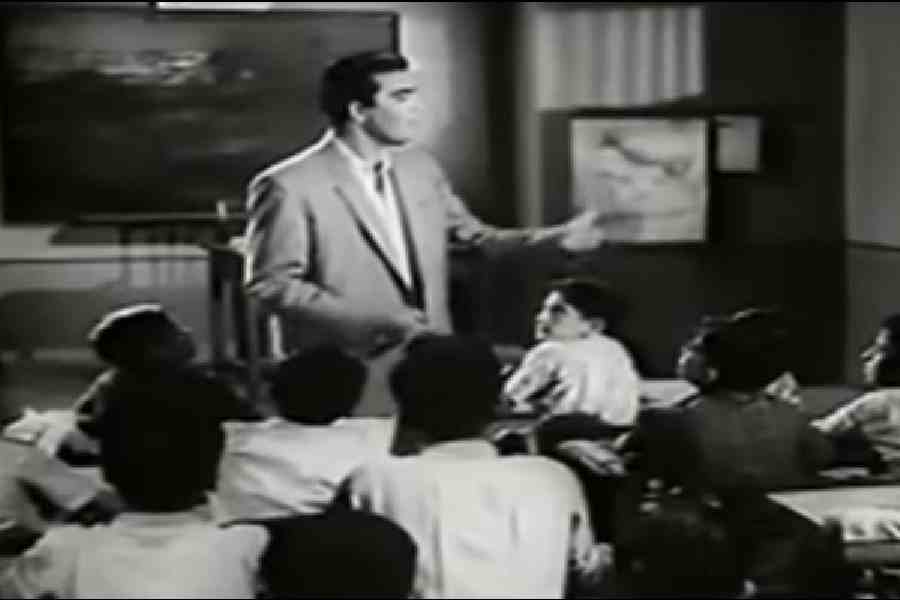
Didi (1959), directed by K. Narayan Kale, best known for his Marathi classic Mazha Mulga (1938), is a lighthearted family film about an idealistic schoolteacher played by Sunil Dutt, whose elder sister is very keen that he marry. But as it sometimes happens in Bollywood, a song remains for the ages even when the movie becomes strictly nostalgia fare.
Humne suna tha ek hai Bharat, written by Sahir Ludhianvi (1921-1980) with music by his close friend Datta Naik (1927-1987), is one such song. Set in a classroom, the exchange of ideas between a teacher and his students makes for lively listening. Sung impeccably by Md Rafi, Asha Bhosle and Sudha Malhotra, the song, however, focuses on Sahir’s lyrics, the composer keeping the orchestration minimal and the conversational structure tight with minimal interludes.
In the song, the schoolboys ask the teacher pointed questions about communalism and casteism and why people still suffer despite India being independent. The teacher blames communalism on the remnants of the colonial divide-and-rule policy. He negates caste, prioritising a person’s work over their birth. And to his students, who are probably of the same age as the 12-year-old Independent India, he explains that centuries of hunger and deprivation take time to disappear, and he exhorts the new generation to usher in “navyug”.
But imagine students in 2026 asking their teacher this:
Wahi hai jab Quran ka kehna/ Jo hai Ved Puraan ka kehna/ Phir yeh shor sharaaba kyun hai/ Itna khoon kharaaba kyun hai/ Apne watan mein? (If the Quran and the Vedas and Puranas say the same things, why is there so much noise and violence in our country?)
Or this: Kuch insaan Brahman kyun hain/ Kuch insaan Harijan kyun hain/ Ek ki itni izzat kyun hai/ Ek ki itni zillat kyun hai/ Apne watan mein? (Why are some people Brahmins and some Harijans? Why are some so revered and some so humiliated in our country?)
This was in 1959, when India could still be called newly Independent, but the wounds of Partition had started healing amid the general air of optimism and nation building. Sahir’s own Bollywood songs, the barometer of popular sentiment, reflected this. For example, for the blockbuster Naya Daur of 1957, Sahir wrote Saathi haath badhana and Yeh desh hai veer jawano ka. But in 1958’s celebrated Phir Subah Hogi, Sahir wrote the scathing Sara jahan humara and the poignant Woh subah kabhi toh ayegi, both of which addressed the fissures in the Great Indian Dream. As the conscience of the young nation-state, the film lyricist spoke his mind. He didn’t polish egos. Perhaps no one had asked him to.
To come back to Didi, the film is also known for possibly the best song for unrequited love — Tum mujhe bhool bhi jao toh yeh haq tumko, meri baat aur hai, maine toh mohabbat ki hai. As composer Datta Naik fell ill, singer Sudha Malhotra gamely stepped in to score the music for this song and also sang it with Mukesh. It became one of the landmark songs of Hindi cinema.
But as far as film songs about ideas go, Humne suna tha ek hai Bharat is one of Sahir’s best, its lyrics criminally underrated in the algorithm-driven age of social media. The song’s standout vibe? It shows not only politically aware children but also a teacher willing to engage with them. Today’s India has a lot of catching up to do.
Sulagana Biswas