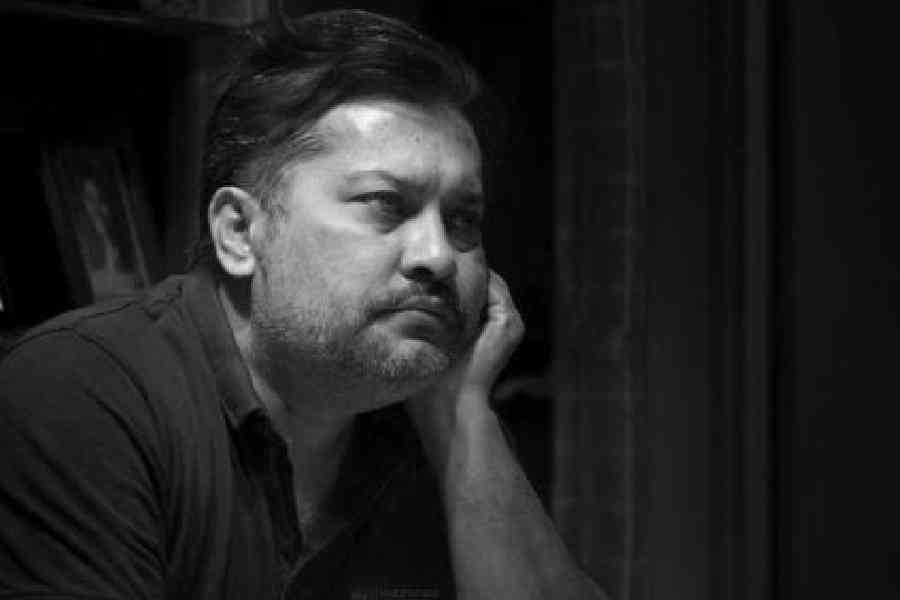
Sabarna Roy’s 13th book is a phenomenal stroke that employs fiction to see the same city as one of hope and light and darkness and death. Fragmented Kolkata in Pieces is a collection of two novellas centred around Calcutta — one a musically romantic tale painted with vivid colours, and the other a thriller, with dead bodies and a wily serial killer.
It is the preface to the story that gives the reader a sense of what Roy is after: Calcutta as “an archive of contradictions” where stories are “interrupted, paused, reshaped, and returned to in fragments”, and where the two narratives are linked by “the act of witnessing”.
The Alipore Chronicles (the first novella) begins with an instantly persuasive sensory hook: “The scent came before the light”, and the scent is rasgullas — sugar syrup, cardamom, milk fat — rising from the sweet shop below Ayan Roy’s flat. It is here that Ayan reconnects with Rhea — artist, activist, former love — and the story widens to include two more friends, Tara and Neil. On paper, they could read like clean “representative” roles (writer/artist/lawyer/musician), and even the preface leans into that idea of different creative “chords” in one quartet. What saves the novella from schematic neatness is Roy’s patience with the small stuff: the way old friends circle topics, the way jokes deflect regret, and the way the city’s everyday friction (commutes, weather, deadlines) rubs against big ideals.
The mural at the novella’s centre — painted on a “cracked wall” near an old tram depot — works as both a metaphor and a civic act: friendship made public, and therefore vulnerable. Roy is particularly good at staging emotion through what remains unsent. One of the book’s most quietly affecting observations is that “no one sent what they wrote”, and yet “somehow, Kolkata knew”, as if the city can receive private drafts through tram-wire hum and chai-steam curls.
This is also where Roy’s prose earns its lyricism: the images are not just pretty; they mirror the characters’ dislocated adulthood, where you can feel intensely without having the language — or the timing — to say the right thing. The Vandalism chapter is where the novella’s optimism gets its bruises, and it is handled with specificity rather than melodrama. The wall is described as “bleeding”; the painted woman’s face is “obliterated”; the spray paint arrives with its own verdicts — “NOT ART. PROPAGANDA”; “PAINT WALLS, NOT POLITICS”. The scene lands because it feels like an argument Calcutta would have, with the added cruelty that the argument is written on someone else’s labour. It also clarifies one of the book’s key claims: fragmentation is not only internal; it is public and imposes. The epilogue is a quiet triumph. Two years later, the wall remains — cracked, layered, touched up, added to — “something closer to a living document than a mural”, with one surviving line: “Some walls bleed. And still they stand.”
The Monologue of a Serial Killer, the second novella, opens with “Smell of rust and rain”, and a first-person voice that is frightening because it is controlled. The narrator insists on ordinariness — “I walk among you… You would not notice me. That is the trick.” He presents murder as aesthetic correction, killing “not in frenzy” but in pursuit of what he calls “equilibrium”. The result is less a procedural thriller than a psychological one, written like a manifesto in calm sentences: horror not as chaos, but as a tidy philosophy. Roy’s sharpest observation here is about how people outsource fear to myth. The killer notes that “myths are useful”; they let citizens pretend evil is “theatrical — caped, costumed, far away”, instead of the ordinary man who rides the metro or sits beside you on a tram ride back home. That insight keeps the book from becoming merely lurid: the menace is not only in the killings, but in the city’s urge to convert proximity into a story it can keep at arm’s length.
The second novella becomes most distinctive once Ira Sen enters, an archivist who begins “to respond, leaving notes, mapping patterns”, turning a monologue into a dialogue “he never invited”. Ira shifts the stakes from “catch the killer” to “who gets to tell the story of what happened”. When an imitator appears, the struggle turns to identity; the narrator realises he is “no longer the subject… [but] the theme”.
The final pages push toward an ethics of preservation — remembering as a counter-force to both sensationalism and silence — until the book can imagine a future where the “archive… would grow… not in blood. But in ink”.
Taken together, Fragmented Kolkata in Pieces is occasionally uneven — the first novella can flirt with archetype, the second with thesis — but it is consistently atmospheric, and often genuinely moving. Readers who like city-centred fiction, art-and-friendship stories, and literary thrillers with a philosophical edge will find a lot to admire. If you want Calcutta rendered in smell, argument, and moral weather — and you do not mind the darkness — this book is worth walking through.
Julie Banerjee Mehta is author of Dance of Life, and co-author of the bestselling biography of Cambodian Prime Minister, Strongman: The Extraordinary Life of Hun Sen, with historian Harish Mehta. She currently teaches Masters English at Loreto College, and curates and anchors the monthly Literary Circle of the Rising Asia Foundation, of which she is founder trustee
Fragmented Kolkata in Pieces will be launched on January 2 at Oxford Bookstore,
in association with t2