
Hesaraghatta Lake and grasslands are supposed to be one of the more picturesque places near Bangalore. Moreover, because it attracts a lot of migratory species as well, it is a favourite of birdwatchers. We wanted to find out for ourselves. It, however, turned out to be a ‘supposed to be’ story because Google Maps took us to a point that clearly said that we could not take a vehicle any further. So, guess Hesaraghatta Lake will have to wait for another day.
We, however, didn’t really mind, the reason being that the road we had come along went through the spra-a-a-w-ling Indian Council of Agricultural Research (ICAR) campus and driving down the winding stretch through it is like going through a forest, in fact, a lot of it actually is. The moment you drive out of the gates, the city wallops you in the face, but for some time it is bliss and we were thoroughly enjoying ourselves and went up and down it a couple of times to get a good feel of it. It is really pretty and in the middle of an urban sprawl, at that too.
As is obvious by now, we were in Bangalore (yes, again!) and this time driving all the updated Tata Tiago in all its avatars — petrol, CNG and electric — that have just been introduced. Right now we are going to talk about the ICE versions, that is the petrol and the CNG, which have the same underlying set-up. But we drove the petrol only version with a manual transmission and the CNG with an automated manual transmission, or AMT. Both of them were in their respective top trims, the petrol in Creative+ and the CNG in Creative. Here are our first impressions.
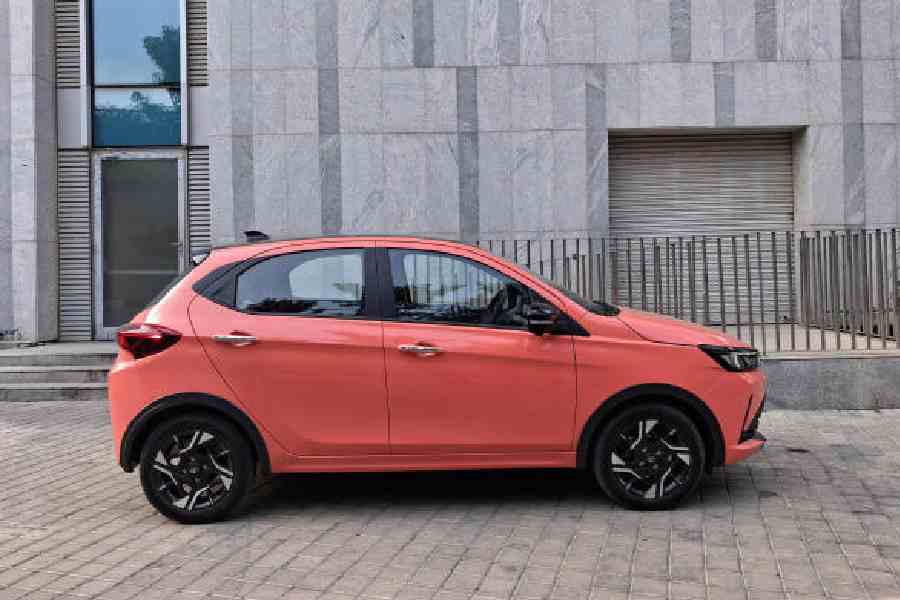
ON THE OUTSIDE
The updated Tiago receives subtle cosmetic changes rather than a complete redesign. The revised front grille, refreshed bumper design, and new colour options give the hatchback a more modern appearance. It has lost some of the ‘sharkiness’ of its nose, but remains recognisable as a Tiago and the tweaks help it look fresher and more contemporary. The headlamps are now LED with separate ones for high and low beam and an eyebrow daytime running light. The square fogs move to the bottom of the new bumper that now has a smooth design. The air intake is now entirely in the black section at the bottom of the bumper while the top is completely blanked out.
Down the flanks, the old door handles remain and, oddly, have the only pieces of chrome in pretty much the entire car. Why those have been retained beats us, but they are there. The wheels have a new design cover that looks a lot like diamond cut alloys and are designed to reduce drag.
At the back, the tail lamp clusters are new and the light signature is in keeping with the headlamp cluster. There is a red plastic horizontal piece that looks like a light bar connecting the tail lamp clusters, but it does not light up. The bumpers here are new too and have these reflective inserts and a black section at the bottom, similar to the front bumper.
The CNG versions do not have a black roof option, while the top petrol version does. On the whole, the Tiago(s) look smart and contemporary and there is a whole bunch of very nice pastel colours like light blue, light orange, light pistachio, and a light brown (they have some fancy official names too). It does well on the looks front for an entry-level hatchback.
ON THE INSIDE
Step inside and the Tiago continues to impress with a cabin that feels quite substantial. The dashboard design is clean and functional, while the materials, although not luxurious, feel durable. We are a little iffy about how the textile bit on the dash will hold up over time. Black-and-grey is the theme for the interior – upholstery, plastics, et al. The seats in front are quite generous and have extra under-thigh support. The rear ones are large enough and leg room is adequate but not overly generous. The space under the front seats lets rear seat occupants place their feet there and find a comfortable position. Headroom is enough and fairly large glass areas make the space light and airy.
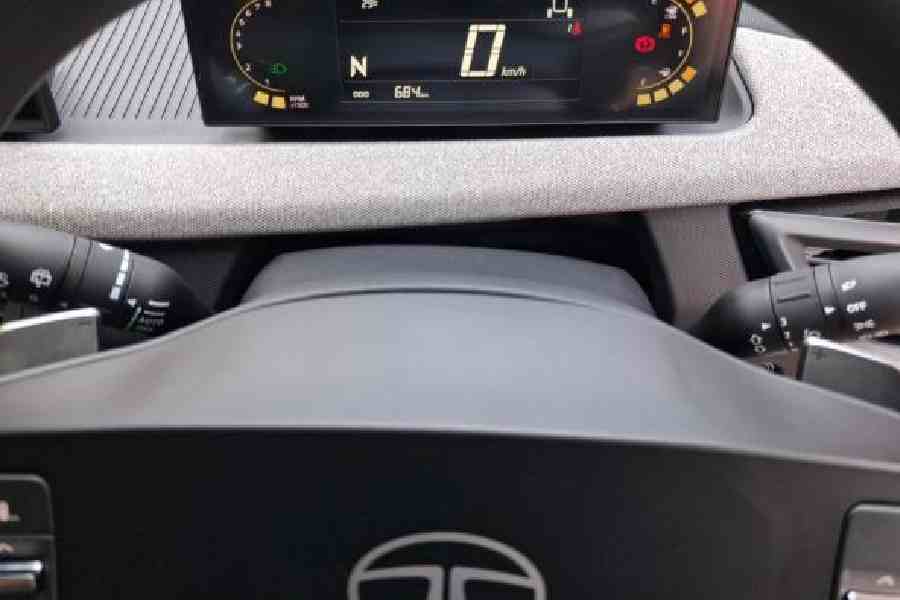
While the Tiago CNG AMT gets paddle shifters, the car takes a bit to respond to upshifts and downshifts
The rear seats now get air-conditioner vents and while the petrol has a 65W USB-C charging port as well, the latter is absent in the CNG. We cannot understand why some versions have that USB-C and some don’t — we have become so gadgety that something or the other always needs charging. And while there are three seat belts, the rear seat is better for two.
There is a larger 10.25-inch touchscreen infotainment system in higher variants, and a 5-inch digital instrument cluster, smartphone connectivity, loads of steering-mounted controls, cruise control, surround view camera and automatic climate control on selected trims. The audio system remains one of the highlights and delivers rather good sound quality. There are pockets to accommodate small items and four one-litre water bottles. The glove box is cooled. There are easter eggs all over the car with a squirrel and its collection of nuts, the squirrel and a drink, and it among a drink and nuts.
While the 242-litre boot space in the petrol is on a par with other hatchbacks in the Tiago’s class, in the iCNG, with Tata’s twin-cylinder CNG technology the space becomes very shallow and can barely accommodate a pair of airline cabin size bags. The spare wheel is below the floor on the outside in the iCNG.
And while the Tiago(s) is fairly well built, both on the outside and the inside there are plastic bits that need to be better finished. And that is one thing Tata needs to look at before sending out cars for delivery.
ON THE ROAD
The petrol Tiago is powered by Tata’s familiar 1.2-litre three-cylinder naturally aspirated engine producing around 86ps and 113Nm of torque.
It is available with either a five-speed manual gearbox, which we drove, or an AMT. Tata has positioned all versions of the Tiago as a city car. And in that capacity, the petrol feels responsive and easy to drive. The clutch is light and so is the steering and visibility is good, making driving it a low-stress thing. The engine delivers adequate low-end performance for urban traffic. The stubby gear shift is fun to use and after a while actually starts feeling nice.
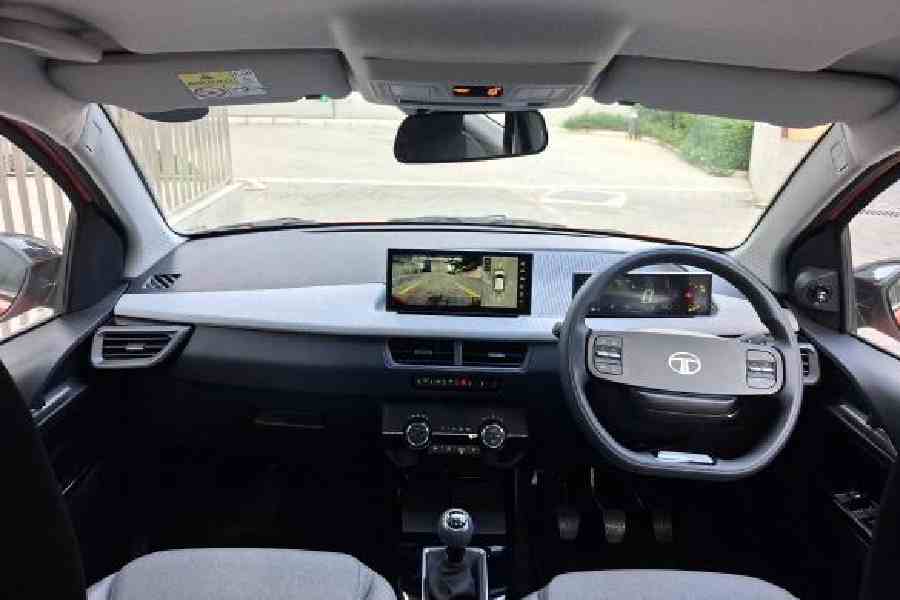
The entire dashboard design is more contemporary and there is a fabric insert which could have a bit of a maintenance issue. The steering is new as well
However, the three-cylinder motor is not the most refined unit in the segment. Vibrations are noticeable at idle, and the engine becomes vocal when pushed hard. Highway overtakes would require preparation, especially with a full load of passengers. And while we think the chassis is good enough to take a more powerful engine like a turbo bolted onto this petrol as in the Punch, the current engine tends to get flustered when pushed to highway speeds and takes its time to accelerate around the three-figure mark. But hold it around 80kmph or thereabouts, and it feels quite mature and comfortable. So, while this isn’t a typical highway car, it will get the job done.
The CNG variant is interesting. Tata’s factory-fitted iCNG technology feels integrated and refined. Power output drops in CNG mode to approximately 75.5ps, and torque to 96.5Nm. This version is clearly for economy and particularly while cruising one can feel the difference. But this is not meant for thrill-seekers and, with the AMT, cuts it when it comes to efficiency and easy driving. This is a rather appealing combination.
Also, the Tiago iCNG can fire up on CNG, unlike some others that need to be on petrol to get going.
Tata cars typically have good ride quality and the Tiago(s) is no exception and even behaves like a vehicle from a higher segment. Potholes, broken surfaces, and speed breakers are absorbed with confidence. The car feels planted at higher speeds and inspires confidence. Steering feedback is predictable, and body control remains respectable during cornering. It tries to balance ride quality and handling, so there’s some roll.
In terms of fuel efficiency, since there is no change in the drivetrain we expect the ARAI-certified figure to be around the same 19kmpl for the petrol and about 28km per kg for CNG.
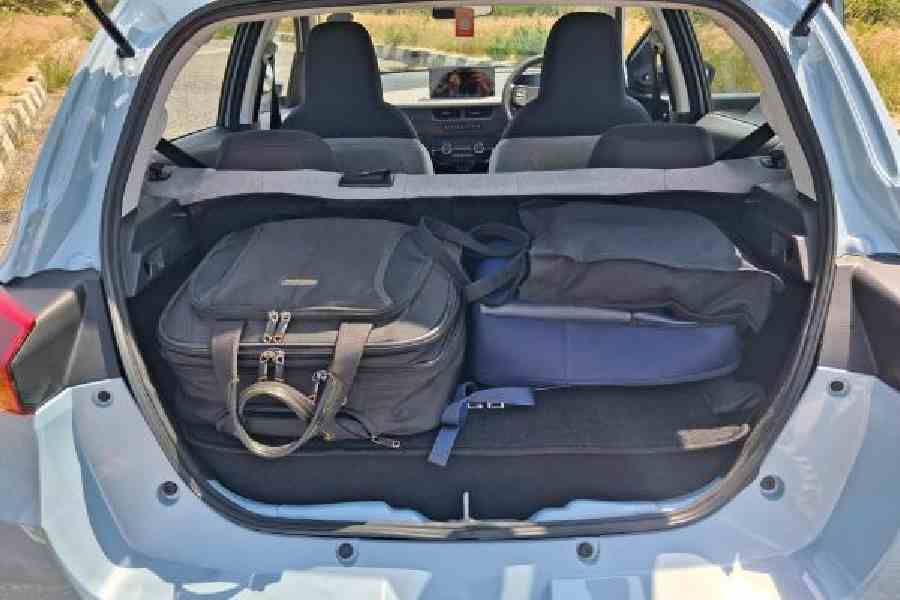
While the petrol version gets a boot space of 242 litres, that number falls drastically in the CNG after fitting in two cylinders under the boot floor
The Tiago is strong on safety. Equipment includes dual airbags, ABS with EBD, rear parking sensors, ISOFIX child-seat mounts, and more.
THE CALL
The 2026 Tata Tiago in petrol and CNG variants remains a sensible hatchback. It has attractive styling, good safety credentials, comfortable ride quality, and is value for money. The petrol is better for longer travel and the CNG is more economical for the city. This car is unlikely to suit speed junkies and enthusiasts who enjoy carving corners. For the rest, it should work just fine.