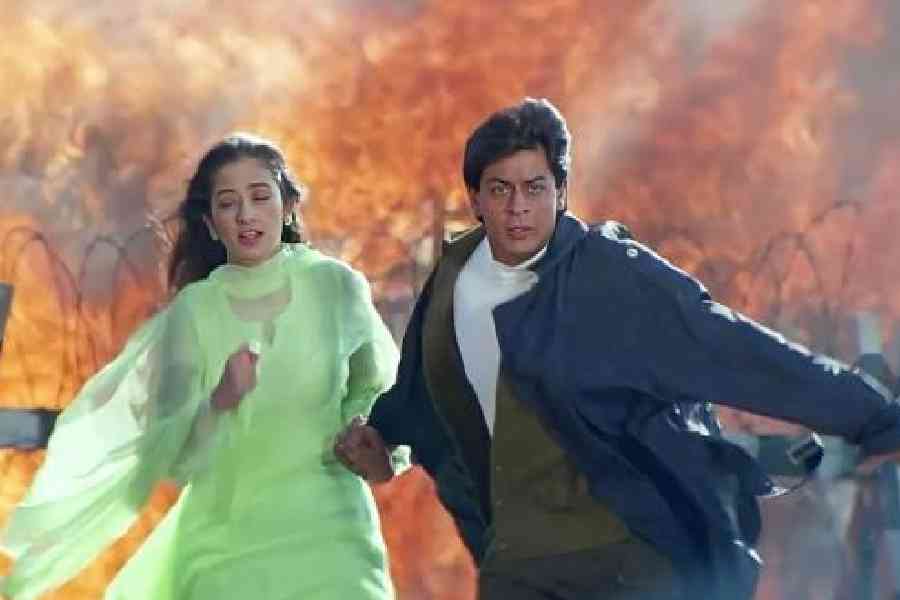
Genre-defying. Disruptive. Music’s new grammar. These epithets are not blarney when used for A.R. Rahman’s score in Dil Se.. (1998). Mani Ratnam’s brave yet naive take on the Northeast insurgency with a mad love story at its core, the Shah Rukh Khan-Manisha Koirala-Preity Zinta starrer didn’t exactly set the box-office on fire. (It was the year of Kuch Kuch Hota Hai after all.) But the film’s soundscape — Rahman’s tour de force, with some of the finest lyrics by Gulzar — did scorch countless dils.
All songs of the film and the background score are haunting, but perhaps the title track, Dil se re, takes the crown.
For starters, Rahman has sung it, his voice simply bleeding into the song. Notice the variations of pitches, the ways he pronounces the word “re”, the sledgehammer impact of a few chosen words, the glue-dripping effect in the end notes. Even the fact that he is not a native Hindi-Urdu speaker adds to the charm.
He is ably supported by Anuradha Sriram, Annupamaa (not to be confused with Bollywood singer Anupama Deshpande) and Febi Mani in the chorus.
Pink Floyd sessions bass guitarist Guy Pratt lays down the magnificent bass spine of the song. And yet Rahman does not let Pratt overpower the other elements of the song — in fact, the complex orchestration with Rahman’s signature percussion evokes a synaesthesia of colours and textures and visuals. Just listen to the long interludes, one with the chorus and one without, and see where your mind takes you. And then there’s Gulzar’s lyrics, where imagery and philosophy meet in meter: Ek sooraj nikla tha/ Kuch para pighla tha/ Ek aandhi aayi thi/ Jab dil se aah nikhli thi/ Dil se re....
From calling the heart a “meethi si mushkil” to defining “gham (sorrow)” as “dil ke bas chulbule hain, paani ke yeh bulbule hain”, Gulzar gives the song its profound humanity and wisdom.
Rahman, born A.S. Dileep Kumar (January 6, 1967), was a child prodigy who started playing the piano when he was four. Initially a pianist for Ilaiyaraaja’s films and a jingle-maker, he shot to fame with the music of Roja (1992) when he was still in his early 20s. Decorated with National Awards, Oscars, BAFTAs, you name it, the reclusive ‘Mozart of Madras’ has always let his music do the talking, whether in India or abroad.