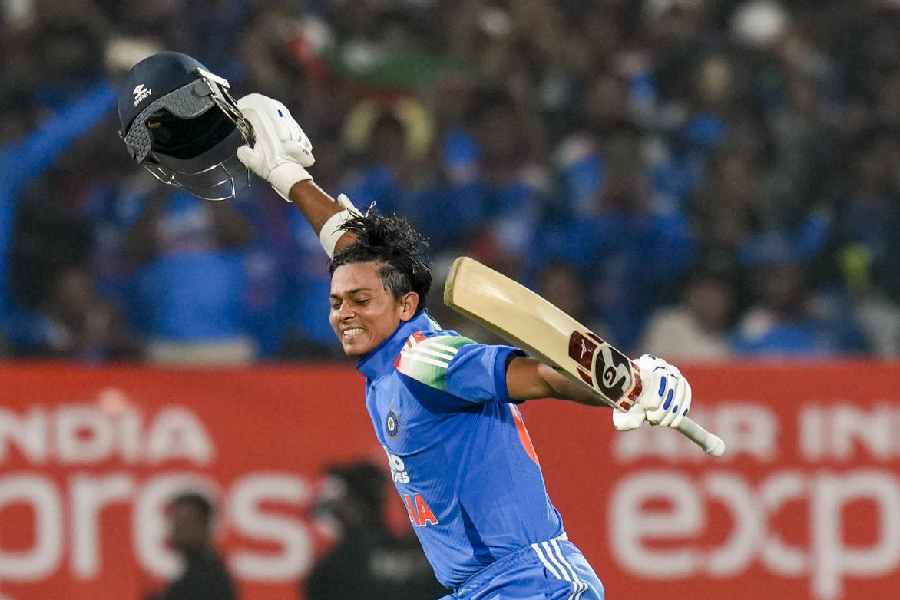
By any modern T20 metric that matters, Yashasvi Jaiswal should be in India’s World Cup squad. He scores fast, attacks the powerplay, clears the ropes without needing sighters and has the ability to change the games in the first ten balls he faces.
Yet as selectors prepare to finalise a 15-member squad on Saturday, Jaiswal remains on the outside, reduced to standby status while batters in far poorer form stay protected.
The reason is not form. India’s T20 selection is no longer about picking the best batters. It is about filling pre-labelled boxes.
Starting at the top, the opening slots are sealed by captain Suryakumar Yadav and vice-captain Shubman Gill. Suryakumar’s place is tied to leadership rather than output. Gill’s is tied to succession planning rather than T20 urgency.
Between them, they occupy not just batting positions but administrative importance. That matters more than recent returns.
Jaiswal’s problem is that he is neither. He is not captain. He is not vice-captain. And he is not considered flexible enough to be moved down the order to accommodate those who are.
That rigidity explains why Gill’s indifferent T20 form has not opened a door. In the selection room, Gill is viewed as a long-term asset across formats.
Jaiswal, despite his superior T20 impact, is still treated as a format-specific option. When continuity becomes the watchword before a World Cup, versatility is rewarded only if it serves hierarchy.
The reserve opener’s slot is already occupied by Sanju Samson. Samson’s presence is not about his suitability as an opener.
It is about role insurance. He doubles as the second wicketkeeper, behind Jitesh Sharma, who is viewed as the designated finisher-stumper. That dual utility keeps Samson in the 15 even when his batting role is undefined.
Jaiswal offers no such safety net. He is a specialist opener in a squad that believes it has already covered that department. In a role-based system, specialists are the easiest to exclude.
Indian selectors, particularly in T20s, prefer players who can be moved around rather than those who demand a fixed position.
Jaiswal’s value is maximised at the top. Asking him to float at No. 4 or No. 5 would dilute the aggression that makes him special. Rather than adjust the order to fit him, India has chosen to preserve the order and exclude him.
India acknowledge that their top order is out of form. They also acknowledge that Jaiswal is a more explosive T20 batter than Gill or Samson, given his stats in the smallest format of the game.
Across 23 T20 matches, Yashasvi Jaiswal has produced numbers that underline his value as a top-order aggressor rather than a work-in-progress. From 22 innings, he has scored 723 runs at an average of 36.15 and a strike rate of 164.32, Jaiswal has combined volume with tempo, the two currencies that matter most in T20 cricket.
Yet they remain unwilling to disrupt the architecture they have committed to.
Part of that is timing. With the World Cup less than two months away, selectors are reluctant to introduce a player who would force a rethink rather than slot into an existing role. Jaiswal represents change. Gill represents continuity.
There is also the IPL halo effect, though it works selectively. While Jaiswal’s IPL performances underline his T20 credentials, India’s squad construction is driven less by franchise fireworks and more by role definitions.
That is how players like Washington Sundar, a bowling all-rounder with modest T20 returns, continue to hold their place. Their role is considered harder to replace than pure batting impact.
On paper, the squad looks formidable. It has power, depth, pace and spin. With Hardik Pandya, Axar Patel, Jasprit Bumrah and Arshdeep Singh, India can claim balance. What it lacks is flexibility at the top, where two of the three batters are short of runs and short of rhythm.
Unless an injury forces a rethink, or the top order collapses in the remaining games, India are unlikely to redraw their plans.
For now, one of the most dangerous T20 batters in the country remains a contingency rather than a cornerstone. And that says less about Yashasvi Jaiswal than it does about how this Indian T20 side has chosen to build itself.
India Likely 15:
Suryakumar Yadav (captain), Shubman Gill (vice-captain), Abhishek Sharma, Tilak Varma, Hardik Pandya, Shivam Dube, Jitesh Sharma (wk), Axar Patel, Jasprit Bumrah, Arshdeep Singh, Varun Chakravarthy, Kuldeep Yadav, Harshit Rana, Sanju Samson (wk), Washington Sundar
Likely Stand Bys (5/6): Yashasvi Jaiswal, Rinku Singh, Riyan Parag, Shahbaz Ahmed/Nitish Kumar Reddy, Prasidh Krishna.