In recent times, the president of the United States of America, Donald Trump, has taken a critical stance on BRICS on account of his perception that the main objective of BRICS nations is to weaken American dominance, especially that of the dollar.
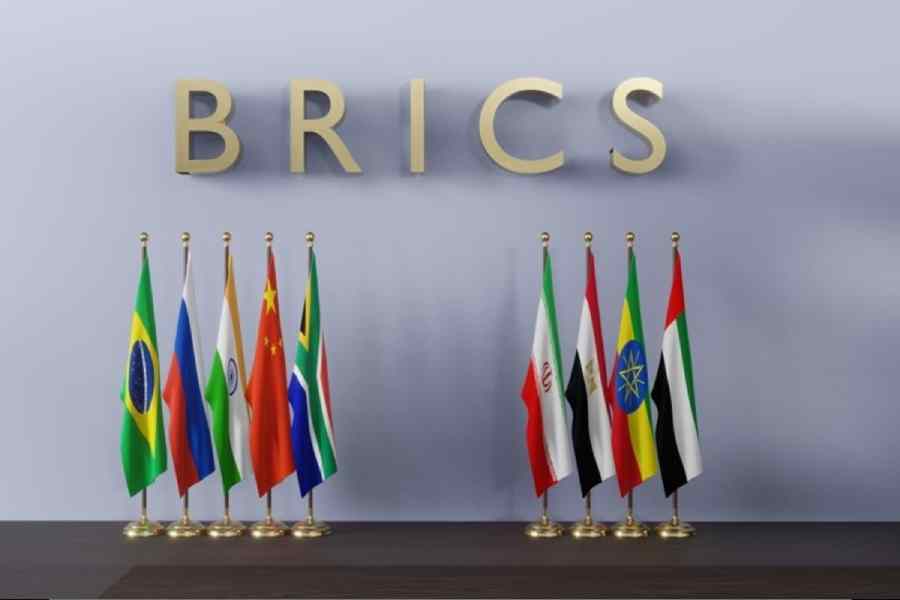
Currently, the BRICS group includes Brazil, Russia, India, China, South Africa, Egypt, Ethiopia, Iran, Indonesia, and the United Arab Emirates. Out of these, Brazil, Russia, India, China, South Africa and Indonesia are also members of G20 that was formed in the aftermath of the global financial crisis.
Trump has reacted adversely to Russia's proposal for a common BRICS currency; Trump thinks that this will weaken the dollar. However, talk of a BRICS currency is premature; the majority of the BRICS members are not convinced about the idea. BRICS countries do not even have a free trade agreement or any measure of coordination on economic policies. Talking about a common BRICS currency under such circumstances is thus far-fetched. India has categorically denied the possibility of any such venture. China also seems to be interested in greater use of its own currency in international transactions rather than going for a common BRICS currency. India has also been promoting its own currency in its trade with other countries, a measure that is not linked to BRICS discussions.
The US dollar is predominantly the standard unit in which goods are quoted and traded and payments settled in the global commodity markets. According to an estimate, the dollar is used in 54% of foreign trade invoices globally. According to the US Federal Reserve Board, the share of the US dollar in international payments is about 50%. The share of the dollar in foreign exchange reserves of countries is still quite high at about 48%; the figure was about 70% at the turn of the century.
The dollar maintains its dominance because the world continued to have confidence in it. The Bretton Woods Agreement gave the dollar the status of the world’s reserve currency as well as the standard of unit. The dollar's pre-eminent position continued even after the collapse of the Bretton Woods Agreement in the early 1970s. This was primarily due to three factors. First, the US was able to get an arrangement done with major oil-exporters to ensure that oil is traded only in dollars. Second, the US is a major economic and trading power. Third, the US follows relatively open and stable economic policies.
Interestingly, the American dollar maintains its dominance despite the fact that the US's share of global GDP is roughly about 25% — it was about 40% at its peak — and America's share in global trade is about 12%. The share of the US in the goods trade is even lower at about 9%. The dollar's decline is thus noticeable. While the share of US dollar in foreign exchange reserves has been falling — the same is rising for currencies of other countries, including China — the most notable feature is that the share of gold in official reserve assets has increased from about 15% to about 23% over the last three years. Trump's utterances on the dollar are thus being interpreted by other countries as a reflection of the lack of collective confidence in that currency.
But the dollar's decline is not due to BRICS. Changes in the global economic structure and other related developments are the reason. American economic and foreign policies might want to maintain the dollar's dominance. For that to happen, the US must strive to maintain an open and stable economic policy.