This column stays away from mentioning my family, but I must now make
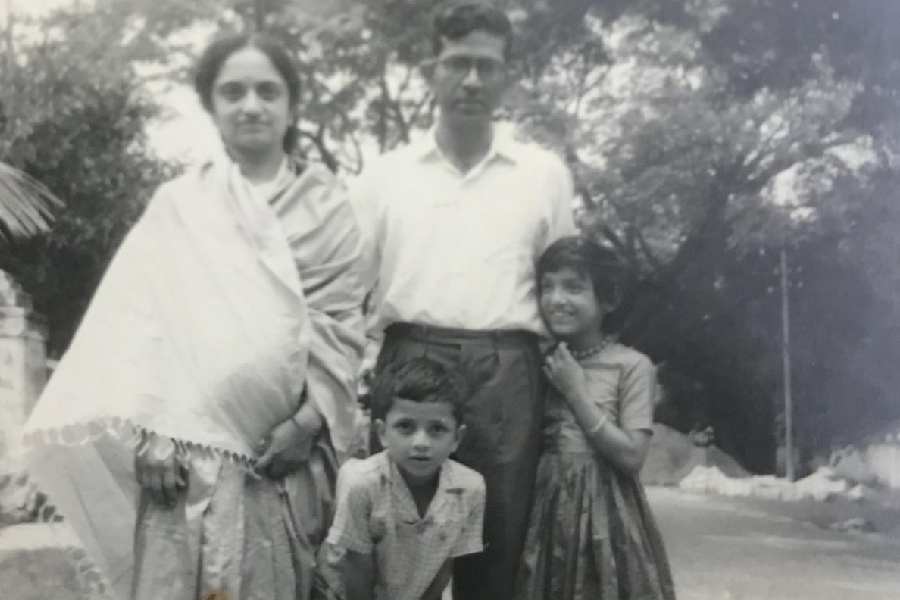
an exception. This is because my mother died last week, twelve years after my father. Never remotely famous, they were both exemplary parents. And there may be some other things to remember them by.
My parents belonged to a generation when one expressed one’s patriotism through quiet service rather than crude boastfulness. In what I write about them here, readers will recognise affinities with people they themselves knew, whether as parents, uncles, aunts, teachers or doctors, who likewise embodied the sort of decency and moral rectitude that run so thinly on the ground today.
My father, Subramaniam Rama Das Guha, was born in 1924, in a hill town once known as Ootacamund. Twenty-three years later, visiting the place of his birth, he met and fell in love with a young lady named Vishalakshi Narayanamurti. He was then finishing a PhD at the Indian Institute of Science, in the same student cohort as the great physicist, G.N. Ramachandran. A postdoctoral scholarship at a university overseas was his for the asking, but affairs of the heart mandated that he instead take a job at the Forest Research Institute in Dehradun, where Vishalakshi’s father worked. My father joined the FRI in 1948 and married my mother three years later. He stayed in the same job till retirement.
My father belonged to a family of public servants. A brother was in the air force, a sister in the army nursing service. An uncle and a brother-in-law were, like him, scientists orienting their research to public ends. My father himself used the words ‘Government of India’ in tones that denoted real and total respect. He believed that State property must never, ever, be used for private purposes. He scorned the use of an official car, choosing to cycle to his laboratory and back every day.
Along with this commitment to public service, my father also had a disregard for social prejudice. Like other such Indian institutions at the time, the FRI’s scientific cadre was dominated by Brahmins. Their sons spoke proudly of their lineage, of how their fathers and they themselves changed their sacred threads together every year. However, my father declined to wear the thread marking out his high-caste birth, and discouraged me from wearing one either.
My father’s disdain for caste hierarchies came from his family background. His own father’s brother was the pioneering social reformer, R. Gopalaswami Iyer (1878-1943), who led the movement for the emancipation of the Untouchables in Mysore state. As a boy, living in their joint family home in Bangalore’s Chamarajpet locality, my father would see his uncle get up very early in the morning and hop on to his bicycle to visit the several hostels for Dalit children that he ran in and around Bangalore city.
My mother came from a more orthodox Brahmin family, yet life as a college student in Madras and Delhi, and a career as a teacher in a non-denominational school in Dehradun, likewise made her reluctant to assess a person’s worth according to their income or social status.
Unlike the writer of this column, my parents never made a public show of their secular beliefs. These were manifest rather in how they behaved. The three families they were most intimate with in Dehradun were Sikh, Kayasth, and Tamil Christian, respectively. In Brahmin homes which had the means to employ a cook, this person was usually male, and from the same sub-caste as the employers, so that the food they ate was ritually ‘pure’. However, while my parents could afford a cook, the two I remember from my youth were both non-Brahmins from the Garhwal Himalaya. Later, in an even more remarkable transgression of caste norms, my parents had a Muslim cook.
My father’s humanity was leavened with a gentle sense of fun, thus safely removing it from sanctimony. The first of his thirty-odd PhD students was a man named V.N. Mukherjee. The day after my father heard from Agra University that his student had passed his viva, he asked him to come to our house in the morning, before work. When V.N. Mukherjee rang our bell, my sister, Vani, and I — then aged twelve and ten, respectively — opened the door. Primed by our father, we greeted him with, "Good morning, Dr Mukherjee!" Of course till the previous evening he had been merely ‘Mr Mukherjee’. The look of pleasure and delight on his face was wonderful to see.
As a schoolteacher, my mother touched the lives of even more people than my father did. For more than two decades, she taught Hindi, English, Economics and Geography at a school named Cambrian Hall, located in the Dehradun Cantonment. She refused to discriminate among her students on grounds of caste, class, religion, or — perhaps most important — learning ability. She was greatly loved by her students, who kept in touch with her for years after they had matriculated. Every Teachers’ Day she got a stream of phone calls, as well as personal visits from former students now in their fifties or sixties, carrying a bouquet of flowers for their beloved ‘Ma’am Guha’.
Visiting Sri Lanka in 2001, I met an Indian police officer seconded to our high commission. On learning of my background, he said, "I was Ma’am Guha’s favourite student." His boss at once corrected him, saying, "it is for her to say who was her favourite student." I felt sorry for the chastened junior officer, for perhaps my mother’s way had been to make every student think of himself or herself as the ‘favourite’.
Fifteen years later still, I was having lunch with an editor in a Delhi restaurant when the waiter brought a note saying it was from a young man on another table. "Doubtless one of your fans," commented the editor — in fact, the message said that the man’s mother, now settled in Pune, had been taught by my mother in Dehradun and still spoke of her with affection and regard.
Since my mother’s death, I have realised afresh how teaching — and schoolteaching especially — may be the most noble of callings. Teachers share and give of themselves in a manner rare — and often absent — in other, more self-obsessed, professions. Although she retired forty-one years ago, I have been receiving an unending stream of messages from those my mother taught, who have themselves gone to become successful academics, actors, army officers, fighter pilots, authors, doctors, corporate executives — and teachers too.
My father died on Christmas Day, 2012, aged eighty-eight. In his last illness, he was taken to the hospital by two neighbours who had also become friends. They were named Abbas and Radhakrishna. My mother now moved out of her home in the Bangalore locality of Koramangala, living alternately with my sister and me since. She had the usual infirmities of advanced old age, but was otherwise happy to be in the company of family, friends, and former students. Though never an overtly political person, she let it be known that the rising tide of Hindutva bigotry dismayed her. For someone shaped by the pluralist, inclusive atmosphere of the Nehruvian era, the idea that only her fellow Hindus had a prior and proprietary right to this land was abhorrent. As I now feelingly recall, two teaching colleagues in Dehradun whose counsel she especially valued were called Daisy Butlerwhite and Nighat Rahman. And among the dearest friends of her Bangalore years were a couple named Laeeq and Zafar Futehally.
I was born to multiple forms of privilege — as a Hindu living in a country dominated and run by Hindus, as a Brahmin in a culture steeped in caste prejudice, as a man in a society so disfigured by patriarchy, as a fluent English-speaker in a nation where that language opens many doors. These unearned advantages have made my life’s journey far more comfortable than it might otherwise have been. Yet my parents’ example helped make me aware of how less privileged most other Indians were. As I look back on their lives, I can now see, more clearly than when I was young, how my parents affirmed, quietly and unselfconsciously, in practice rather than in theory, the spirit of fraternity and non-discrimination that lies at the heart of citizenship.
ramachandraguha@yahoo.in