 |
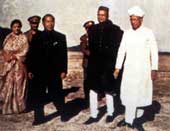
| A file picture of former President Dr Radhakrishnan arriving for the first Nagaland statehood day function in Kohima |
lThe author is former chief minister of Nagaland
The Nagas have been on the crossroads of hope and despair since a group of bureaucrats and self-proclaimed social workers huddled together in 1960 to sign what they called a “16-point statehood agreement with the government of India”. The votaries of the so-called agreement tout it as a significant development in the shaping of the destiny of the Naga people. In reality, however, it has proved otherwise. The formation of the Naga People’s Convention (NPC), which was the signatory to the agreement, heralded the beginning of division and mistrust that has besieged Naga society for the past 40 years or so.
The NPC was never a contending party in the Indo-Naga conflict. None of its members were involved directly in the Naga political movement, nor had they ever held any position in the Naga National Council (NNC), which spearheaded the movement. It was formed to play the role of a facilitator between the two contending parties. But at the end it hijacked the movement and submitted a 16-point memorandum to the Union government as a basis for finding a solution to the Naga political problem.
The development sowed the feeling of mistrust and dissension in Naga society. The NNC, its supporters and sympathisers all over Nagaland viewed it as a betrayal of trust and hence the very purpose of the formation of the NPC — to bring peace in trouble-torn Nagaland — was negated. The government agreed on some points and disagreed on others from among the 16 points. For instance, no agreement could be arrived at on clause number 13 pertaining to the integration of Naga contiguous areas. In the end, the two sides merely agreed that other Naga tribes, inhabiting the areas contiguous to the present Nagaland, should be allowed to join Nagaland if they so desired. Thus, after dividing the soul and mind, the NPC struck the proverbial last nail by geographically dividing the people. Nonetheless, the NPC agreed on the disagreement and signed what will be more apt to call a memorandum of understanding rather than an Accord. The hope of the Naga people for the dawn of peace remained as elusive as ever.
The so-called agreement was also full of superfluous clauses and repetitions of what a state under an Union should be — there should be a legislative Assembly, there should be a council of ministers, there should be a separate Governor and separate high court so on and so forth. These are the paraphernalia or organs available in the Constitution once a state is created and to achieve these did not require any explicit agreement.
Moreover, many of the clauses of the agreement were either not fulfilled or arbitrarily withdrawn. It was agreed that the Naga Hills-Tuensang Area (NHTA), created as an autonomous district on December 1, 1957, was to be re-designated Nagaland and would become a state, administratively placed under the ministry of external affairs. But in 1972, the Centre unilaterally transferred the administration of Nagaland to the home affairs ministry. In protest, on June 29, 1972, the Nagaland Assembly adopted a resolution saying: Whereas the government of India and the Naga people have signed a 16-point agreement in 1960, and whereas, one of the points (point number 2) was that Nagaland shall be under the ministry of external affairs, the unilateral decision taken by the government of India to transfer Nagaland from the ministry of external affairs to the ministry of home affairs before full implementation of the 16-point agreement of 1960 is a clear violation of the said agreement. This Assembly, therefore, resolves that Nagaland should continue to be under the ministry of external affairs and the decision of the government of India so taken be withdrawn forthwith.
The Centre, however, did not take any note of the protest resolution and continued to keep Nagaland under the home affairs ministry. This was also a violation on principle of another clause of the agreement, wherein it was agreed that no Act of law passed by the Parliament would have legal force in Nagaland, unless specifically applied to it by a majority vote of the Naga Assembly.
The only bright area in the so-called agreement was the creation of Article 371 (a) of the Constitution. The article gave ample scope for the Nagas to protect their distinct culture and customs. Unfortunately, the article, too, was superficial, as its implementation has not been achieved. In the ultimate analysis, one can conclude that the agreement only helped in impeding the creation of a better and peaceful Nagaland and the dream of a peaceful Nagaland remained as elusive as ever.
The agreement would not have failed so miserably if it had been signed between the contending parties and not with those who had no locus standi in the Naga political movement. Besides, the agreement, if at all entered into and signed between the appropriate authorities, should have been comprehensive, considering that the Nagas are ethnically different from those in the mainland. Now that another opportunity to work out a permanent settlement to the problem has knocked on our doors, it is imperative for the contending parties to take note of past mistakes in order to chart out a future course. Only then can the Nagas shape their destiny in their own distinct way. More importantly, only then can the much-awaited dawn of peace be glimpsed.
SALIENT FEATURES OF STATEHOOD AGREEMENT, 1960
lThe territories that were hitherto known as the “Naga Hills-Tuensang Area” under the “Naga Hills-Tuensang Area Act, 1957” and any other Naga area, which may thereafter come under it, shall form a state within the Indian Union and be thereafter known as Nagaland
lNagaland shall be under the ministry of external affairs (subsequently brought under the home ministry in 1972)
lNo Acts of law passed by Parliament will affect (a) the religious or social practices on Nagaland, (b) Naga customary laws and procedures, (c) civil and criminal justice so far as these concern decisions according to Naga customary laws, (d) the ownership and transfer of land and its resources
lThe government of India to provide grants-in-aid in the form of (a) annual lump sum amount for development of Nagaland (b) a fixed recurring sum
lAll the reserved forests and other Naga areas that were transferred out of Naga area will be returned to Nagaland with a clearly defined boundary
lOther Naga tribes inhabiting the areas contiguous to present Nagaland will be allowed to join the state if they so desire
lThe rules embodied in the protected area 1958 — innerline regulation — shall remain in force in Nagaland