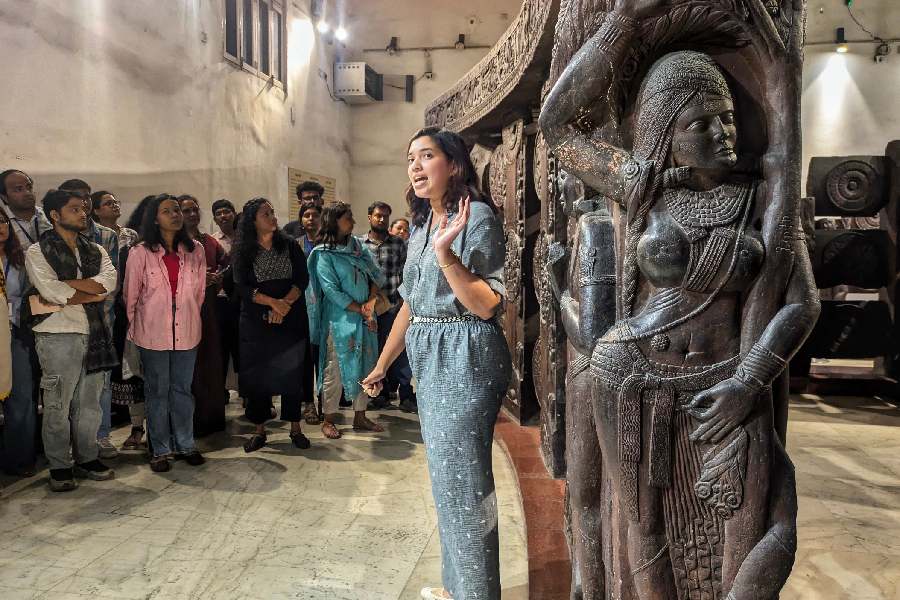
The Indian Museum has been an object of intrigue for centuries. Established in 1814, it is the oldest museum in the Asian Pacific region.
Recently, Kolkata Centre for Creativity in collaboration with the Indian Museum and The Metropolitan Museum of Art (MET) on conservation and the importance of cultural exchange titled ‘Shared Knowledge, Shared Collections’.
Present at the symposium were Ushmita Sahu, director and head curator at Emami Art and head of the KCC Conservation Lab; Sayan Bhattacharya, director, Indian Museum Kolkata; Sanjay Kumar Manjul, additional director general (Archaeology), Institute of Archaeology and Iconic Sites, Archaeological Survey of India; Vinod Daniel, chairman of AusHeritage, Elizabeth Cedar Tunick, deputy chief development officer, The Metropolitan Museum of Art; and Heidi Holder, chair of education, The Metropolitan Museum of Art.
“India needs 10,000 conservators, whereas we have only 1,000; that too, only 300 might be properly trained. So the human resources are severely lacking here,” said Daniel, adding, “India is the gold mine for historic artefacts and collections in Asia. So, conservation becomes a major deal for us. That is the purpose behind this programme,” added Daniel.
Sayan Bhattacharya has been a long-time patron of culture at the Indian Museum, indulging in all things Bengal and India.
“From Nalanda to Takshashila, knowledge was always invited, nurtured, and conserved in these institutions. In our intrinsically connected world, these notions are necessary today,” said Bhattacharya.
There are five functions for a museum. With collection, excavation, education and research, the most important part is preserving those collections.
“This symposium is conceived as a platform for dialogue — one that reflects on how conservation practice in India can be strengthened through collaboration, shared learning, and sustained institutional engagement. India is home to an extraordinary range of cultural material — archaeological artefacts, manuscripts, paintings, textiles, sculptures, and living traditions,” said Sahu.
“We are particularly grateful for the collaboration with The Metropolitan Museum of Art, whose ongoing engagement with conservation professionals in India has played a significant role in expanding opportunities for training and exchange,” added Sahu.
Holder shared an extensive presentation on how The MET in New York works. It is not just a museum but a space for cultural exchange, date nights, live music, and teenage representation for a day called Teens take the MET.
“The first opportunity of understanding others is how to get a sense of what is happening. So, as a memory, I want to understand what visitors already know. These are things that shape the programme,” said Holder.
“I try to find out who the visitors are, what do they come to see? I try to find out the communities that build up here, and the hindrances of the visitors. We are always evolving because of this research,” added Holder.