The Korean Wave is a tsunami. No matter which social strata you belong to in urban India, you are sure to have experienced it in some measure. The last few years the presence of all things Korean seems to have gotten intensified.
In 2021, there was a stall at Jadavpur’s 8B area in south Calcutta selling corn dogs. Korean Fried Chicken street stalls are a dime a dozen. BTS tour movies were screened till about 2022 at malls such as Mani Square on E.M. Bypass.
BTS accessories — keychains, phone cases, waist chains — command unimaginable popularity among GenZ and Gen Alpha. BTS-themed diaries and notebooks are to be found in small and big stationery shops. The spicy Gochujang shares domestic shelf space with tabasco and oyster sauce. And it is not unusual to know of people who take online Korean language classes.
More Indians would have heard of Jeju — rather than Jejuri — or Busan and Haewoo, all dots on the map of South Korea. A Tamil film Made in Korea was released only this year on Netflix; it explores an Indian woman’s fascination for Korea.
The K-dramas are imaginatively written and neatly produced, full of scenic shots and pretty people with perfect skin and hair. A lot of them are about travelling back in time and that is how even non-Koreans unwittingly imbibe the history of Joseon, a dynasty that ruled Korea for several centuries. Most K-dramas are sure to have scenes of food and people eating if not entirely revolving around food. And generations raised on Maggi now struggle to make sense of their children’s craving for ramyeon and tteokbokki.
The K prefix is so trendy that future generations might believe Kolkata was actually Olkata. This year’s Oscar-winning film was KPop Demon Hunters.
And would you have noticed how K-dramas promote K-tourism, K-food, K-beauty products? K-celebrities directly and indirectly promote these. When Demon Hunters turned out to be such a huge revenue hunter for Netflix, the OTT on which it was released, it immediately signed a deal with multinational toymakers to make dolls, action figures and other things related to the film.
All of these things do not add up to South Korea as it is. For instance, a book like Kim Jiyoung, Born 1982 brings into focus the hardships of Korean women. The Economist’s Glass Ceiling Index named South Korea the worst place to be a working woman out of 29 OECD countries in 2024. According to Human Rights Watch, the labour rights landscape has many “gaps in protections”. And in 2024, South Korea’s Constitutional Court held that the country’s current climate measures were “insufficient” for safeguarding citizens’ rights.
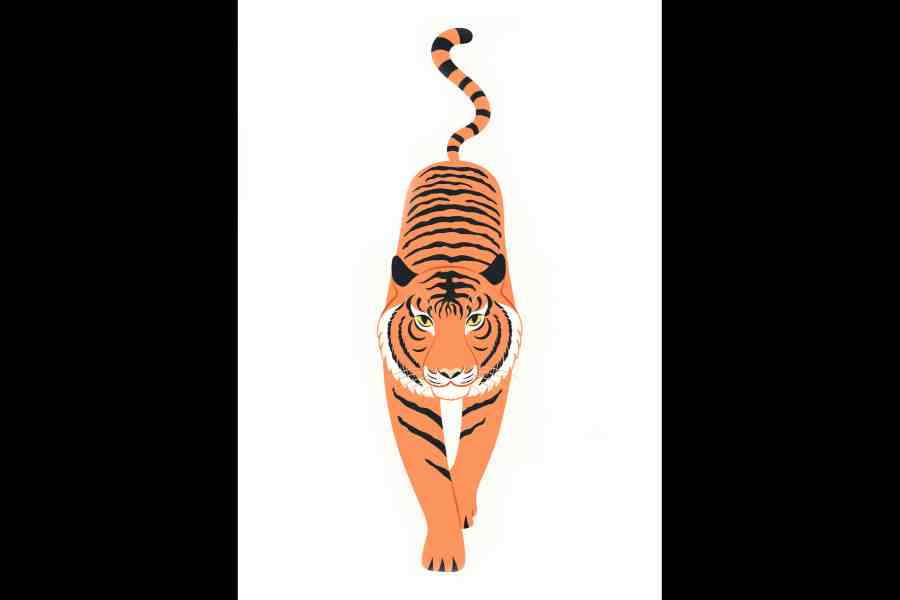
None of this is shocking. But what might be of surprise is how this country in East Asia — it is said that the map of the Korean peninsula resembles an ascending tiger — has curated its own reality. And not just that, it has packaged and promoted it to become this overwhelming cultural force.
Speaking of tigers, after regaining consciousness post a close encounter with a tiger, our very own Lalmohanbabu famously said, “Haloom obdi to chhilum.” Meaning, he had been conscious till the first roar. This infographic is about all that happened before haloom or hallyuoom, all that has gone into making the tiger roar.
Ministry of Magic
From the time of the first President Syngman Rhee (1948-1960), there has been a stress on national culture. Successive governments enforced and also improvised on this. The Ministry of Culture and Information was formed when Park Chung Hee was in power — 1961 to 1979. It was Park who called culture and education “the Second Economy”. Every other government has come up with culture masterplans — sometimes heritage has been the focus, sometimes development of contemporary culture and eventually expanding cultural exchange with other countries. In 2008, the Ministry of Culture and Tourism became the Ministry of Sports, Culture and Tourism. At the time the Korean Wave was already a trend.
Why Culture?
Because of “the sense of cultural discontinuity between Korean traditional culture and contemporary culture, owing to the influence of Japanese colonialism (1910-1945), the divided Korea (1945-present), the Korean War (1950-1953), rapid modernisation and the apparently indiscriminate influx of western culture,” writes Haksoon Yim in Cultural Identity And Cultural Policy in South Korea. In effect, the government constructed a distinct Korean cultural identity.
Count the Money
Ministry of culture’s budget
- 1948 – No separate budget
- 1998 – $14 million
- 2001 – $84 million
- 2004 – $132.8 million
- 2008 – $153 million plus
- 2013 – $3.53 billion
- 2021 – $6.1 billion
(6.86 trillion won)
- 2026 – $54 billion.
(At 7.8 trillion, this budget is higher than the 2021 budget. But because of won to dollar exchange rate fluctuations, it appears lower.)
2026 Action Plan
Released by the ministry, it states:
- Positioning K‑culture as a core future growth industry
- Strengthening Korea as a cultural powerhouse
- Accelerating achievement of 30 million inbound tourists through K‑tourism
- It identified as K-culture industries—film/video/animation, games, music, webtoons/web novels, and publishing.
All Consuming
In a survey conducted in 2023 it was revealed that the following countries were most receptive to K-content
- Indonesia
- India
- Thailand
- United Arab Emirates
- Vietnam
- Egypt
Diplomacy
K-pop stars, actors and even chefs are used as ambassadors of K-culture
- K-culture has been the intermediary mending relations with Japan. Think OTT shows such as Can This Love Be Translated?, Gimbap and Onigiri and K-foodie meets J-foodie
- K-pop group Red Velvet performed for Kim Jong-un in North Korea in 2018. News reports said, it highlighted “the thawing ties” between the two rival countries after years of friction over the North’s nuclear programme
- K-pop group EXO met US President Donald Trump during a presidential visit to South Korea in 2019, while BTS met Joe Biden at the White House in 2022
- BTS has addressed the United Nations thrice, each time speaking on issues that concern youth.
BTS and its ARMY
Some facts about this band of seven South Korean men
- The Hyundai Research Institute in 2018 estimated that BTS is expected to generate $3.69 billion in the Korean economy, which was nearly 0.3 per cent of the country’s gross domestic product that year
- All male citizens must enlist in the military by a certain age. South Korea did not want to lose the revenue BTS was bringing in, and for that, it passed the BTS law in 2020
- As per this law, entertainers can defer their military service until they are 30 if they have been awarded a medal of cultu-ral merit
- The BTS members had to enlist eventually and from 2022 till recently, the band was in retirement
- Its first concert in many years was held this March at Gwanghwamun Square in Seoul.
The Concert
- 1,04,000 tickets given out; 7,000 police officers deployed to manage the crowds
- From Malaysia to China, France to Bolivia, people descended on Seoul
- Netflix streamed the show in more than 190 countries
- The Korea Culture and Tourism Institute estimates the upcoming 34-city world tour of BTS will yield $840 million per show.
K-profits
- In the 1980s and 1990s, heavy and chemical industries formed the mainstay of exports
- Thereafter, high-tech manufacturing
- In 2025, semiconductors remained the largest contributor, followed by automobile
- Cultural exports reached $37.94 billion, making culture the country’s fourth-largest export sector in 2025
- The US, China and Japan together account for over 40 per cent of exports on K-food and K-beauty. While emerging markets are India, Latin America and West Asia
- K-cosmetics are so popular that companies in other countries have introduced their own K-beauty ranges
- The plan for South Korea is to expand cultural exports to 50 trillion won ($36 billion) by 2030, with a focus on music, dramas, webtoons, beauty products and food.