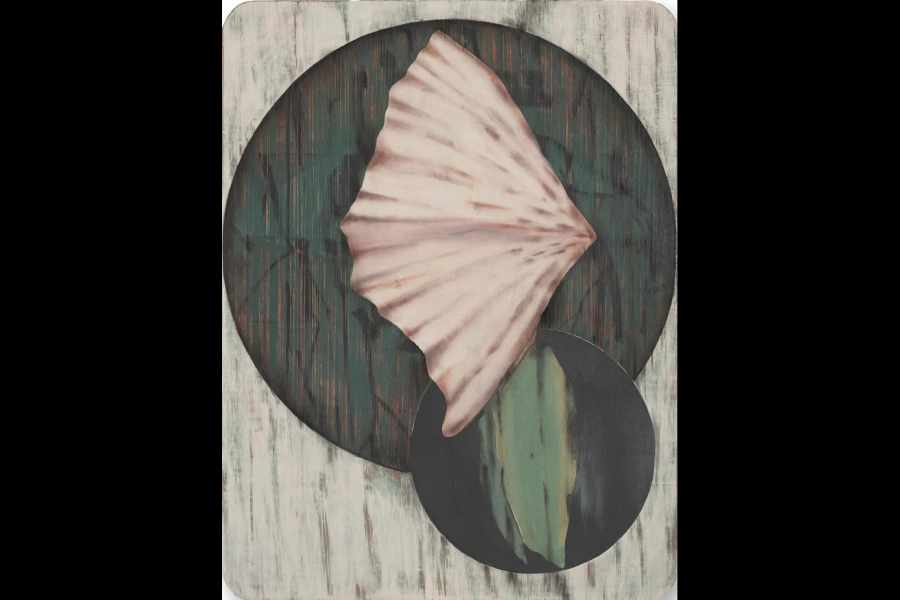
The solo exhibition of Suman Dey’s works, Chance Remains of Another Time (Emami Art), unfolds like a slow walk through a city after rain when ordinary objects are briefly infused with new life and new meaning. The exhibition, composed largely of abstract and semi-abstract paintings and modular polyptychs, turns the debris of urban life into a language of memory and attentive scrutiny. Dey’s paintings are built from fragments: circles that resemble tea stains, fan-like forms that hover among leaf, shell and folded cloth, with weathered grids, torn edges, fading stripes. The surfaces appear rubbed, stained and excavated rather than painted in any conventional sense. Browns, soot blacks, oxidised greens and muted creams dominate the palette, giving the works the patina of objects left too long in the monsoon air.
The strongest works resist pure formalism. Beneath their geometry lies observation. One senses crumbling walls layered with old posters, the accidental markings of roadside commerce, traces of insects, damp wood, rusted shutters. Dey compresses these encounters into compositions that feel both architectural and fragile, as though the city itself were slowly disintegrating into memory. The polyptychs are especially effective. Their fragmented structures mirror the discontinuous experience of contemporary urban life where recollection arrives in flashes rather than complete narratives. Yet the works never collapse into chaos. Dey maintains a careful equilibrium between control and ruin, silence and accumulation.
There are echoes here of European and American post-war abstraction: the scarred surfaces of Antoni Tàpies, the poetic geometry of Paul Klee, even the atmospheric austerity of Sean Scully. But Dey’s sensibility remains rooted in Calcutta’s visual texture, in the poetry of things overlooked. At times, the exhibition edges close to aestheticised melancholy; a few works lean heavily on distressed beauty. Still, the best paintings avoid sentimentality through restraint. They linger because they never fully resolve into image or symbol. What emerges finally is a body of work about attention itself: about learning to see the city not as spectacle, but as accumulation, residue and quiet persistence.