Emami Art brought together nine young women artists into a quietly moving exhibition, Nothing Twice, about the fragility of ordinary life. Borrowing its title from Wisława Szymborska’s poem on the unrehearsable nature of existence, the show resisted spectacle. Instead, it lingered on the domestic, the tactile, and the easily overlooked. Curated by Ushmita Sahu, the exhibition assimilated painting, textiles, photography, ceramics, drawing, and video with remarkable cohesion. The works were united by an attention to material memory: thread, clay, pigment, and paper become repositories of lived experience. There were echoes of feminist art histories from the 1970s, particularly practices that reclaimed domestic labour and craft from the margins of ‘serious art’. Yet Nothing Twice never felt academically burdened.
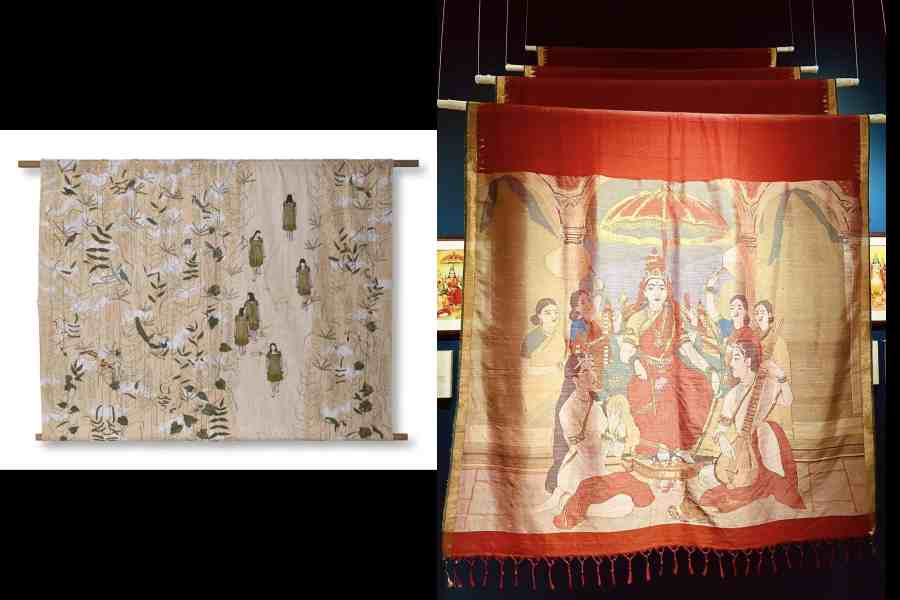
Moumita Basak’s textile-based works stood out for the way they entwine ecology, gender, and labour into surfaces that appeared both fragile and resistant (picture, left). Shilpi Sharma’s ceramics, inspired by natural weathering and organic structures, possessed a meditative stillness; the cracks and the textures seemed to honour decay rather than conceal it. Riti Sengupta’s photographic practice, concerned with memory and the politics of representing women, introduced another register: archival yet unsettled, personal yet socially alert.
Ritwika Ganguly’s interest in subconscious gestures and fleeting observations lent her work an understated psychological tension. Arieno Kera drew from Naga cultural memory without reducing it to ethnographic shorthand, translating inherited forms into contemporary visual language. The paintings of Krisha Bhuva, Manmita Ray, Mitali Das, and Priti Roy continued the exhibition’s investment in quiet emotional states where repetition and attentiveness become forms of endurance.
The strength of Nothing Twice lay in its refusal of monumentality. These artists found meaning in kitchens, fabrics, overlooked corners, and passing glances. In an art world often addicted to scale and declaration, this exhibition insisted on something softer but no less radical: attention itself as an ethical act.
At TRI Art & Culture, Khadi: A Canvas staged what can be called an ambitious conversation between two architects of Indian modernity: Raja Ravi Varma and Mahatma Gandhi. Through 19 exquisitely woven khadi sarees created in the jamdani technique by tribal women from Srikakulam, the exhibition connected Ravi Varma’s democratisation of visual culture with Gandhi’s politics of self-reliance and handspun cloth.
Curated by Lavina Baldota in collaboration with the textile artist, Gaurang Shah, the show was about labour, process, and technical virtuosity. The woven recreations of Ravi Varma’s paintings were astonishing in their detail: facial expressions, shadows, folds, even botanical textures emerge thread by thread (picture, right). Displayed alongside lithographs, printing stones, and tools used to spin the fabric, the exhibition revealed the invisible labour behind image-making and weaving alike.
Digital Atma (Spirits) X The Wandering Souls at A.M (Art Multi-disciplines) approached contemporary digital life with the intensity of a philosophical lament. Structured as an interdisciplinary curatorial project combining poetry, sound, image, and performance, the exhibition examined how technology mediates identity, intimacy, and embodiment in an increasingly virtual world. Its central premise is compelling: the body survives in physical space while the soul drifts elsewhere, dispersed across networks, screens, and disembodied interactions.
The recurring motif of disembodiment, of voices transformed into technological echoes, captured a distinctly present anxiety: the erosion of tactile and emotional immediacy. Particularly effective was the exhibition’s insistence that estrangement often disguises itself as connection. Technology promises intimacy while frequently delivering isolation. The show was curated by Ayan Mukherjee and brought together the artists, Paul Holmes, Rajib Chowdhury, Rounak Patra, Smarak Roy and Ushnish Mukhopadhyay.