 |
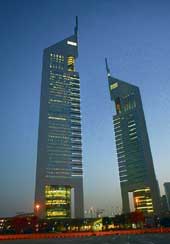
| Dubai’s Emirates Towers |
Dubai, June 27 (Reuters): Wealthy Gulf Arab investors have only to snap their fingers and someone in Dubai’s burgeoning community of western-trained architects will design the impossible ? or the unthinkable.
The emirate is fast becoming an architect’s playground as more and more outlandish structures take it closer to its dream of being the world’s most visually striking metropolis. Architects are flocking to the city of 1.3 million where a construction boom fuelled by a surge in petrodollar wealth is changing the landscape.
Within three years this city, which 30 years ago was little more than a creek on the edge of the desert, will include the world’s tallest tower and lifesize reconstructions of the Eiffel Tower, the Tower of Babel and the main Pyramid of Giza.
“Dubai has hundreds of architect offices now, employing thousands of architects and designers. We are bringing (them) from all over the world, and yet it’s not enough for the work available,” said Falah al-Salman, an Iraqi-Canadian architect in Dubai.
“The developers want us to be imaginative and innovative beyond anything anywhere in the rest of the world. They also want to be different from each other in each project, never mind different from other cities in the world.” One of the most striking of the new wave of buildings is ‘The Gate’ ? the headquarters of Dubai’s financial centre that looks like a giant computer chip, or a traditional fort along the Gulf coast, depending on your view.
Hazel Wong, a Chinese-Canadian architect with more than a decade of experience in Dubai, said it was “paradise” for the profession. Wong was lead architect for the Emirates Towers, opened in 2000. The twin towers, in the shape of triangular prisms, are a favourite with architects and the public.
But leading British architects ? some of whom have themselves won contracts to design in Dubai ? have slammed the building frenzy in trade journals, rueing a lack of a vernacular tradition to influence the stylistic direction.