 |
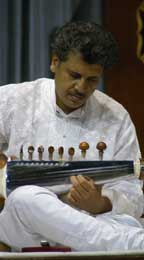
| Narendranath Dhar on stage |
The Ramakrishna Mission Institute of Culture presented a sarod recital by Narendranath Dhar of Lucknow at the Vivekananda Hall. A senior representative of the Gwalior Sarod Gharana, Dhar opened his recital with a well-structured alap in Shri raga. The 17-minute vilambit alap established the raga character hauntingly.
The ringing vibrato of the characteristic Sri rishav, strict adherence to raga delineation norms and correct alap methodology were the factors responsible. At a time in which most leading practitioners happily ignore the last two parameters, Dhar needs to be congratulated for playing a major raga the way it ought to be played and not the way current maestros play it. It was heartening to observe that the note nishad, overemphasised by at least two leading sarod players nowadays, was lingered upon only in the approach to the tar saptak sadaj and in the sanchari section.
For the rest of the alap it was rishav all the way with breathers on the medial sadaj and the pancham. The silsila evident in the 13-minute jod was similarly impressive. The jhala that was perhaps too brief, was in the typical ‘rhythm-of-three’ style of Gwalior Sarod Gharana.
With Pandit Ravi Shankar rarely heard in the city, young instrumentalists who want to develop a sound idea of Shri Raga ought to make it a point to listen more to Narendranath Dhar.
The volume of the sound system was suddenly lowered for no apparent reason on the 15th minute of the vilambit teental gatkari in the raga Puria Dhanashri. The gatkari was also in the original sarod-style with bol prastar and astute development of rhythms and tihais. Here again, strict observance of the traditional sequence of gatkari sections, or silsila, was notable.
The modern sarod style emanating from Ustad Amjad Ali Khan (Dhar’s current guru) showed itself in the ekhara and khayal style taankari played at a tempo twice the basic beat in the drut teental gatkari. Good bol-ang taans were played at a faster tempo later. The brief jhala work, too, was good. Samar Saha on the tabla was a picture of cooperation. In fact, he got the tabla volume reduced to a minimum in order not to drown the lowered volume of the sarod. Both experience and expertise were strongly evident in his tabla accompaniment.
All the items that followed — the 10-minute aochar and 12-minute Dhamar tala gatkari in Chhaya Nat, the brief aochar and jhaptal gatkari in Kedar and the Jayjawanti drut teental gatkari knit around an interesting composition in which each phrase is played twice — had an unmistakable stamp of classicality not very common nowadays.
The concluding sitarkhani tala gatkari in Mishra Bhairavi was full of melody and appeal. The phrase development, strung out over two octaves, was rich in tone. This showed Dhar, classical to the core, could be romantic as well when the occasion called for it.