
 |
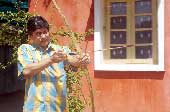
| Chief electoral officer A.K.Pandey with his prized bow and arrow. Picture by Hardeep Singh |
So what if it’s election time and he is the chief electoral officer? Do not be surprised if you spot Arvind Kumar Pandey oiling bamboo bows or flying aero-models of planes and helicopters to amuse himself.
You might mistake him as a crazy fan of vintage automobiles, when you see him on his Mini Rajdoot (of Bobby film fame) or repairing his 1964 model Standard car. But mind you, this jack of all trades, also has the distinction of being master of many.
Pandey has a patent for low weight motor engine to his name. The international patent is under process even as the Indian Institute of Technology, Delhi, and Sonalika Tractors are developing a prototype of the engine developed by Pandey. If the engine clicks, Pandey could well become the Bill Gates of India, money wise. Besides, the IAS officer of the 1981 batch is an ex-nuclear scientist.
Not surprisingly, Pandey has interest in a variety of fields and can speak at length about the Mahabharat, the theory of relativity and traditional archery to Nokia 9210 communicator. Pandey is fond of traditional archery and keeps his prized possessions — a bamboo bow and a few arrows under lock and key. “Well, I need to preserve it. Every Sunday I oil the bow or else its elasticity will be affected and it may also break,” he says.
Pandey had learnt archery from the Biaga tribals of Madhya Pradesh during his IAS training. Still a scientist at heart, Pandey loves to keep in touch with the latest developments in science and technology and loves mastering complicated gizmos, be it computer softwares or mobile phones. Son of a civil servant in Uttar Pradesh, Pandey completed his ISC when he was only 14-years-old and secured the seventh position.
From 1972 to 1980 Pandey was an active scientist. After completing his MSc in nuclear physics from Benaras Hindu University in 1972, he was involved in research work in Varanasi as well as Mumbai. In between he tried to become a pilot in 1975. He even successfully obtained his student’s pilot license, during which he realised the need for lighter engines for small aircrafts. “The weight of a passenger car is much more than the weight of people it carries. I thought that the engine weight must be reduced drastically. Wankel had developed an engine, without a crankshaft or flywheel in 1945. I studied the problems of this engine and invented mine which can be used for small aircraft to small cars and bicycles also. Once the prototype is developed, there will be scope for vast potentialities internationally,” he says.
His pilot training over, Pandey moved to Mumbai to complete his Ph.D on gravitational effects and quantum theory at Tata Institute of Fundamental Research. With his passion for aeromodelling, which needs the same command as flying a real plane because both have the same control switches, Pandey does virtual flying. During his stay at IIT, Mumbai, he came in contact with computers. That was in 1973 when computers had first arrived in India. The association with computer continues till date and he wishes to nurture this passion after retirement.
In the early eighties, he felt that being an IAS officer will give him the opportunity to work in different fields. In 1980, he took the Uttar Pradesh state civil service exam, successfully followed by the Union Public Service Commission test in 1981. “He is a genius,” Pandey’s wife Sarita says with a chuckle. A journalism topper from BHU, Sarita narrated how she and her husband developed a photo laboratory at home and how they developed their first colour film way back in 1983. She showed pictures of their son, Ayushman, when he was a toddler. Ayushman is now an engineering student at BIT, Mesra. Pandey has not planned about his post-retirement phase. “I might go back to my ancestral village in Basti, where we own some land. I will plant some trees and try to connect the Internet through satellite. By then science will certainly develop enough to allow villagers to use the Internet through satellite.”
Pandey regrets not completing the pilot course because he gives a logical end to everything that he begins. He has started with the Lok Sabha election and here’s hoping this stint ends successfully like all his endeavours.
Anupam Seshank