
New Delhi, Oct. 24: The Narendra Modi government today triggered a gender revolution through the barrel of a gun, allowing women in the Indian Air Force to be eligible for flying fighter planes.
The first women to fly Indian Air Force fighter jets are expected to qualify by June 2017. They will be selected from the current batch of flying cadets in the Air Force Academy, Hyderabad, and put through two years of training. Women in the air force now fly transport planes and helicopters.
Allowing women into the cockpits of fighter jets immediately puts them in leadership roles, where they will be expected to command crews while being engaged in direct combat. It exposes them to greater risk of injury, death and capture.
Around 1,400 women now serve in the air force, 110 of them flying helicopters and transporters.
The Centre is also taking a "comprehensive review pertaining to induction of women in the armed forces, both in short service commission and permanent commission".
This opens the possibility that women will be allowed to serve on board warships of the navy and in select ground combatant units of the army.
By deciding to put women in fighter jets, Prime Minister Narendra Modi and defence minister Manohar Parrikar have ended a debate that had occupied the establishment at least since the 1999 Kargil war.
The debate on allowing women in combat roles was shaped not only by questions of culture but also by the dictates of operational environments.
The top brass have worried whether Indian men can accept women as commanders and whether they can temper the macho military environment in which risqué language is often used.
In an operational situation, women combatants would be expected to also be capable of, say, evacuating casualties under fire like men.
But, above all, the debate was shaped by worries over how the citizenry would respond to Indian women combatants landing in a hostage situation. For example, if a woman fighter pilot is shot down in enemy territory and taken prisoner of war, what would the public response be?
In the Kargil war, one pilot who was shot down in Pakistani territory was killed and another taken prisoner. The body of an Indian army officer, Saurav Kalia, who fell into enemy hands was returned bruised and mutilated.
But in the same war, women flying helicopters on medical evacuation missions took many soldiers to safety from the front.
In 2007, these questions were the overriding concern of an inter-services committee headed by Air Marshal Sumit Mukherjee, which recommended deferring a combat role for women.
The Prime Minister's Office was known to be reconsidering the matter since January this year. It ordered the armed forces to showcase all-women contingents at the Republic Day Parade where US President Barack Obama was the chief guest.
The Centre clinched the debate earlier this month, on Air Force Day (October 8), when the Chief of Air Staff, Air Chief Marshal Arup Raha, declared at the service parade: "We have women pilots flying transport aircraft and helicopters; we are now planning to induct them into the fighter stream to meet the aspirations of young women of India."
In its statement today, the defence ministry said: "This progressive step is in keeping with the aspirations of Indian women and is in line with contemporary trends in (the) armed forces of developed nations."
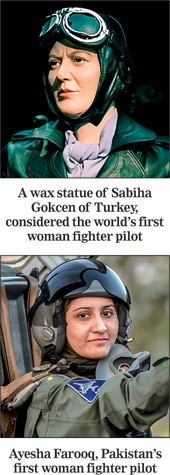
Most modern air forces accept women as combat fliers although their numbers are very small. The first recorded woman to fly a fighter plane was Sabiha Gokcen of Turkey in 1936, nearly 80 years ago.
Women served in significant numbers in all-women fighting crews of the Soviet air force during the Second World War. The Soviet Union recorded the highest number of women casualties in combat.
In 2013, the first women qualified as fighter pilots in Pakistan and China. In America, the first women fighter pilots had qualified in 1993 and in Britain in 1994.
The defence ministry justified its decision today by saying "their (women's) performance has been praiseworthy and on a par with their male counterparts" in the spheres of flying helicopters and transport planes in the air force.
It added: "Inducting women into the fighter stream would provide them with an equal opportunity to prove their mettle in combat roles as well."
In discussions within the government, there has been a consensus that women will not be allowed to serve in army units that are raised for close-quarters combat. This rules out the infantry, the armoured and mechanised forces and the special forces.
Women in the army serve in branches such as the signals, engineers, army aviation (air traffic control), army air defence, electronics and mechanical engineers, army service corps, army ordnance corps, intelligence corps, army education corps and judge advocate general.
India's navy inducts women in the judge advocate general, logistics, observer, air traffic controller, naval constructor and education branches.
In the air force, apart from flying helicopters and transporters, women serve in the navigation, aeronautical engineering, administration, logistics, accounts, education and meteorology branches.
With the decision to open up their induction into the fighter stream, women have become eligible for induction into all the air force's branches and streams.