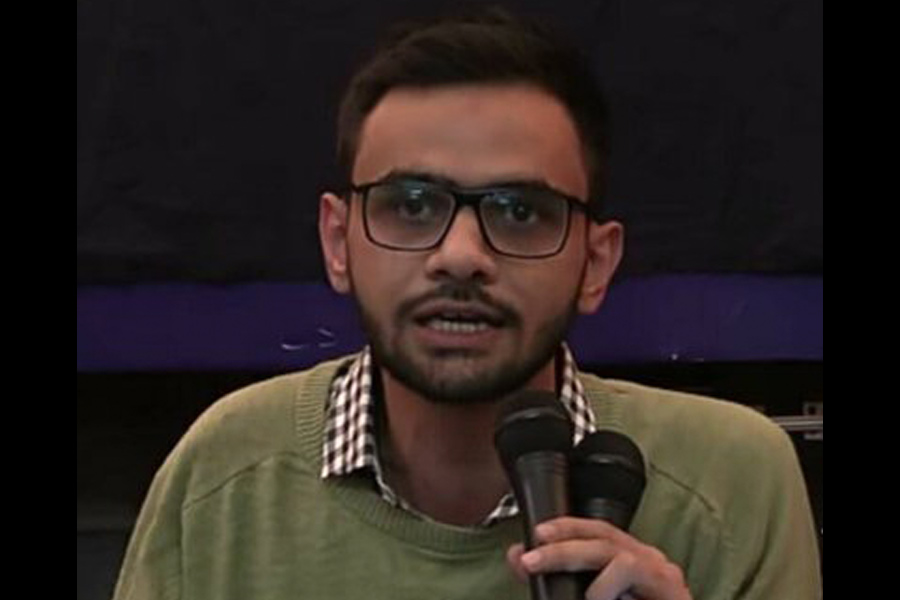
The Supreme Court on Wednesday reserved its verdict on the bail pleas of rights activist Umar Khalid and other co-accused in the February 2020 Delhi communal riots that left 56 dead during the height of the anti-CAA movement.
A bench of Justice Aravind Kumar and Justice N.V. Anjaria asked Delhi police and the defendants to file before December 18 comprehensive compilation reports on their respective contentions.
The court heard the arguments of both sides for over a fortnight in the lead-up to Wednesday’s hearing.
Besides Khalid, the others seeking bail are Sharjeel Imam, Gulfisha Fatima and Meeran Haider. Delhi High Court had earlier dismissed their bail pleas. The accused have been in jail for over five years.
The judgment is not expected to be pronounced before at least the second week of January as the Supreme Court will be on Christmas recess from December 22 to January 5.
Winding the arguments on behalf of the Delhi police on Wednesday, additional solicitor-general S.V. Raju disputed Khalid’s claim that he was not even present in Delhi when the riots broke out.
Raju told the bench that the prosecution had collected enough evidence, including call data records and phone locations, to establish Khalid’s role as a key conspirator in the riots. He said the Delhi police had materials to establish that Khalid was part of the Jamia Coordination Committee, Delhi Protests Support Group and other WhatsApp groups that were actively used to whip up the sectarian violence in Delhi.
Besides creating a reign of terror in the capital, Khalid and his co-conspirators also organised “chakka jam” and “rail roko” disruptions in the lead-up to the riots, Raju said. These conspiracies were hatched at various places like Shaheen Bagh, Seelampur and Jamianagar, he added.
Responding to queries from the bench, Raju cited the Supreme Court judgment in the 2013 Rajiv Gandhi assassination case — State of Tamil Nadu vs Nalini and others — wherein the Supreme Court had held that each member of the conspiracy was equally liable for punishment. The ASG argued that the materials collected on the co-accused could, therefore, be used against Khalid as well.
Senior advocate Kapil Sibal, representing Khalid, said his client was not present in the national capital and that one of his earlier speeches at Amaravati in Andhra Pradesh was being cited against him.
Sibal said organising protest programmes such as “chakka jam” and “rail roko” may be an offence, but can by no stretch of the imagination be considered terrorist acts under the Unlawful Activities Prevention Act (UAPA).
The Delhi police had earlier told the Supreme Court that Khalid, Imam and the others had planned to create a Bangladesh-Nepal type of unrest to bring about a “regime change”.