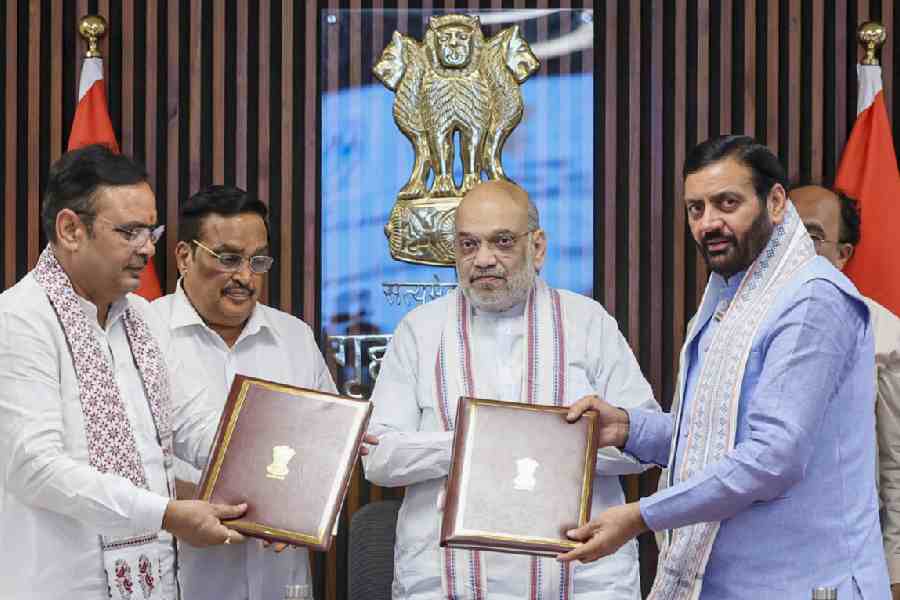
Water problems being faced by the people of Rajasthan and Haryana for nearly three decades were resolved on Monday with the two states signing an agreement in the presence of Union Home Minister Amit Shah for the construction and implementation of the Yamuna Water Project.
Following the agreement, drinking water will be supplied to the districts of Sikar, Churu and Jhunjhunu in Rajasthan, as well as Bhiwani and Fatehabad areas in Haryana.
Home minister Shah said that this agreement will greatly help in resolving the drinking water problem in Rajasthan and Haryana, particularly in Rajasthan.
Rajasthan Chief Minister Bhajan Lal Sharma, Haryana Chief Minister Nayab Singh Saini, Union Jal Shakti Minister C R Patil and senior officials from the central and the state governments were present during the ceremony.
The home minister said the agreement is an excellent example of the mantra 'Solution through Dialogue', given by Prime Minister Narendra Modi, while Sharma and Saini hailed the memorandum of understanding (MoU) saying it was a matter of great satisfaction.
While Sharma heaved a sigh of relief, Saini assured full cooperation in executing the agreement.
An MoU was signed on May 12, 1994 by the Yamuna basin states -- Uttar Pradesh, Haryana, Rajasthan, Himachal Pradesh and the National Capital Territory of Delhi -- regarding allocation of the surface flow of the river. After its creation in 2000, Uttarakhand was also included in the MoU.
Addressing the meeting, Shah said the project seeks to facilitate the conveyance of Rajasthan's allocated share of Yamuna waters through an underground pipeline system from the Western Yamuna Canal, enabling the state to effectively utilise the water allocated to it under the 1994 MoU on the sharing of utilisable surface waters of the Upper Yamuna Basin.
"This agreement demonstrates that if states move forward with the spirit of cooperative federalism, even a problem persisting for three decades can be resolved easily," he said.
Shah said that under today's agreement, approximately 580 Million Cubic Meters (MCM) of water will be supplied from the Yamuna Canal to Rajasthan through three underground pipelines from July to October.
These three pipelines have a diameter of more than 3.6 metres and will provide drinking water to the people of both Rajasthan and Haryana.
Shah said the agreement is an excellent example of a "win-win situation" for both states.
The home minister said that this agreement will greatly help in resolving the drinking water problem in Rajasthan and Haryana, particularly in Rajasthan.
The water that was earlier going to waste will now quench the thirst of the people and will be stored in large ponds to recharge the groundwater level, he said.
Rajasthan Chief Minister Sharma called the day "extremely emotional" for him.
In a post in Hindi on X, he said, "My fellow citizens of the state, especially the millions of families in the Shekhawati region, have been waiting for the waters of the Yamuna for several decades. The shortage of water in drinking, irrigation, and industry has impacted the pace of development in every sector.
"Today, it feels as though Mother Yamuna has bestowed her blessings upon Rajasthan. Under the visionary leadership of the Honourable Prime Minister Shri @narendramodi ji, the guidance of the Honourable Union Home and Cooperation Minister Shri @AmitShah ji, and the tireless efforts of the Rajasthan government, the MoU was signed today for the construction and implementation of the Yamuna water project."
He said this is not merely an agreement but a victory for the age-old hopes, faith and struggles of millions of families. This "historic step" will write a new chapter in Rajasthan's development, water security and prosperous future.
"Coming generations will forever remember this day as a golden and transformative moment in the history of Rajasthan," Sharma said.
The arid Shekhawati region, comprising Churu, Sikar and Jhunjhunu districts, is set to be the biggest beneficiary of the implementation of the long-pending 1994 Upper Yamuna River Board (UYRB) agreement.
Water from the Yamuna is expected to reduce dependence on groundwater, which is the primary source of drinking water across much of the Shekhawati region.
Shekhawat is one of the most water-stressed regions in the desert state of Rajasthan.
Under the agreement, water will be transported from the Hathnikund Barrage in Haryana.
BJP leader Rajendra Rathore, who is from Churu, said that more than 75 lakh people will benefit from the project.
"This will not only resolve the drinking water scarcity but will also increase the groundwater table. The agreement is a major step towards strengthening water security in the Shekhawati region," he told reporters in Jaipur.
Under the 1994 agreement among the Yamuna basin states, Rajasthan was allocated 1,917 cusecs of Yamuna water (around 577 million cubic metres annually) during the monsoon months. However, the state could not utilise its share because no conveyance system connecting Hathnikund Barrage to Rajasthan had been built.
Haryana Chief Minister Saini on Monday said that the signing of the agreement is a matter of great satisfaction as ensuring the supply of water to those in need is a shared responsibility. He assured full cooperation from Haryana and said that no obstacle would be allowed to hinder the implementation of the project.
The chief minister further said that various aspects of the project had been discussed in detail before the signing of the MoU under the leadership of Union Jal Shakti Minister Patil.