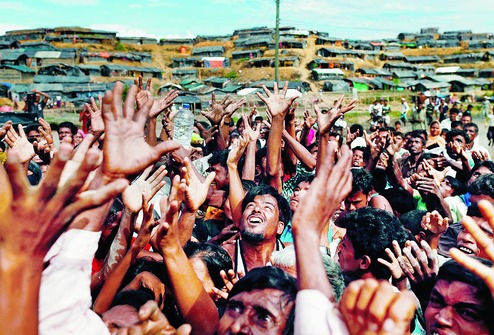

New Delhi, Sept. 14: India today declared plans to fly in food and mosquito nets to help Bangladesh handle an influx of close to 400,000 Rohingya refugees from Myanmar even as New Delhi moved closer to deporting forced migrants from that community in Indian territory.
The relief operation, titled "Operation Insaniyat", kicked off with multiple air force planes landing in Dhaka with 53,000kg of food - rice, pulses, sugar, salt, cooking oil, tea and ready-to-eat noodles.
But in the evening, the Narendra Modi government tied itself in knots through a flip-flop over a petition it is required to submit to the Supreme Court, which is hearing arguments against India's plans to deport the Rohingya refugees.
A draft of that petition appeared to justify the community's eviction on the ground that they represent a security threat. The home ministry subsequently claimed that the petition wasn't official.
Senior diplomats confirmed to The Telegraph that the foreign ministry had communicated concerns to the Prime Minister's Office after reports of the draft petition emerged in the evening amid worries about uncomfortable questions it would spark.
But the diplomats conceded that the flip-flop over the draft petition on a day India tried to project its humanitarian side underscored the fissures within the government on the Rohingya crisis.
Today's consignment was part of a total of 7 million kilos of food, apart from thousands of mosquito nets that India has promised to Bangladesh, after intense pressure from Dhaka.
"We appreciate the actions of the government of Bangladesh in making every effort to deal with the urgent requirements of food, clothing and shelter for the large number of refugees that have placed a huge demand on its resources," Indian high commissioner to Bangladesh Harsh Shringla said at Dhaka airport when the first IAF plane landed. "It is in this context that the government of India, in consultation with the government of Bangladesh, has decided to provide urgent humanitarian assistance to support the efforts of Bangladesh."
But that projection - of gratitude towards Bangladesh and of humanitarian assistance to a community - was undermined by the draft petition that portrayed the refugees as potential terrorist recruits, the diplomats said.
Bangladesh, one foreign ministry official argued, could then legitimately ask India why those that are a security threat to New Delhi wouldn't also be a concern for Dhaka.
The supplies India is sending will be moved to an enclave that Bangladesh has created along its border with Myanmar's Rakhine state - the province from where most Rohingya refugees have fled following clashes involving security forces.
The Indian supplies to Bangladesh follow pressure from Dhaka on New Delhi, which has muddied its own position on the Rohingya crisis through repeated confusing signals.
At the heart of those mixed signals lies a divide within the government over priorities while handling the crisis. While the security establishment - the home ministry and intelligence agencies - have sought to unambiguously argue for the deportation of 40,000 Rohingya refugees in India, the foreign office has prodded the Prime Minister towards a more nuanced position. India, the foreign ministry is arguing, should quietly press Myanmar to adopt recommendations of a panel headed by former UN secretary-general Kofi Annan on giving Rohingyas greater rights.
But the home ministry has publicly stated it has plans to deport the refugees, while Modi praised Myanmar's leader Aung San Suu Kyi's handling of the crisis during a visit there earlier this month.
Amid pressure from Dhaka, the foreign ministry issued a statement asking Myanmar to show "restraint and maturity" and prepared to launch the relief assistance. In the meantime, the home ministry drafted the petition.