 |
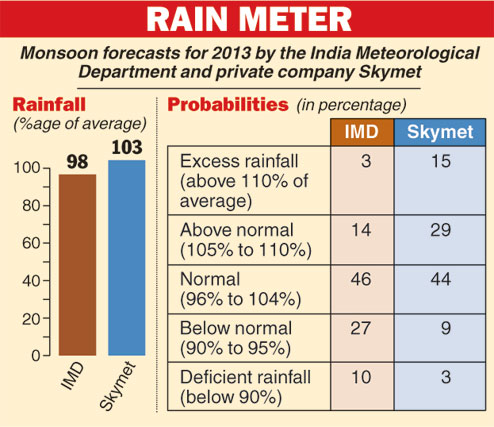
New Delhi, April 26: India’s national weather agency has predicted a normal monsoon this year, nine days after a similar forecast by a private company, but scientists caution that both forecasting strategies have limited reliability.
The India Meteorological Department (IMD) today released its preliminary long-range forecast, saying monsoon rainfall in 2013 would be 98 per cent of the long-period average . Any rainfall figure between 96 per cent and 104 per cent of the average is described as “normal”.
The IMD, whose forecast is based on a statistical model that relies on five weather parameters, said two of the five were favourable to a good monsoon, two were unfavourable, and one was neutral.
“But weather forecasting is not simple arithmetic — the model forecasts a high probability of a normal monsoon,” said Laxman Singh Rathore, IMD director-general.
Private weather services company Skymet too had predicted a normal monsoon last week, but the forecasting techniques used by the IMD and Skymet are different.
Skymet relied on a dynamical forecasting model, a number-crunching technique where supercomputers guzzle global weather data to make forecasts. The IMD sees dynamical forecasts as “experimental”, with less reliability than the statistical model it has used.
“The best dynamical model has a correlation of 0.6 while the statistical model we’ve used has a correlation of 0.74,” said D. Sivananda Pai, head of the IMD’s long-range forecasting division.
A correlation of 0.74 would imply that the long-range forecast can at best predict up to 54 per cent of the variations in rainfall, said a senior atmospheric scientist who requested anonymity. The other 46 per cent is, for the moment, beyond the reach of predictability.
For a correlation of 0.6, the corresponding success figure is 36 per cent.
The IMD forecast will be updated in June with more detailed predictions of rainfall across the various geographical regions during July, August and September.
About 15 research groups scattered across academic institutions are exploring the various aspects of the monsoon to try and contribute to improved forecasts.
The IMD said sea-surface temperatures in the Pacific Ocean, which can influence monsoon rainfall, appeared to be neutral for this year’s monsoon. It said two other parameters — southern Indian Ocean sea-surface temperatures and the sea-level pressure over East Asia — were favourable.
But two other parameters — north Atlantic sea-surface temperatures and land surface air temperatures in northwestern Europe — are unfavourable for the monsoon.