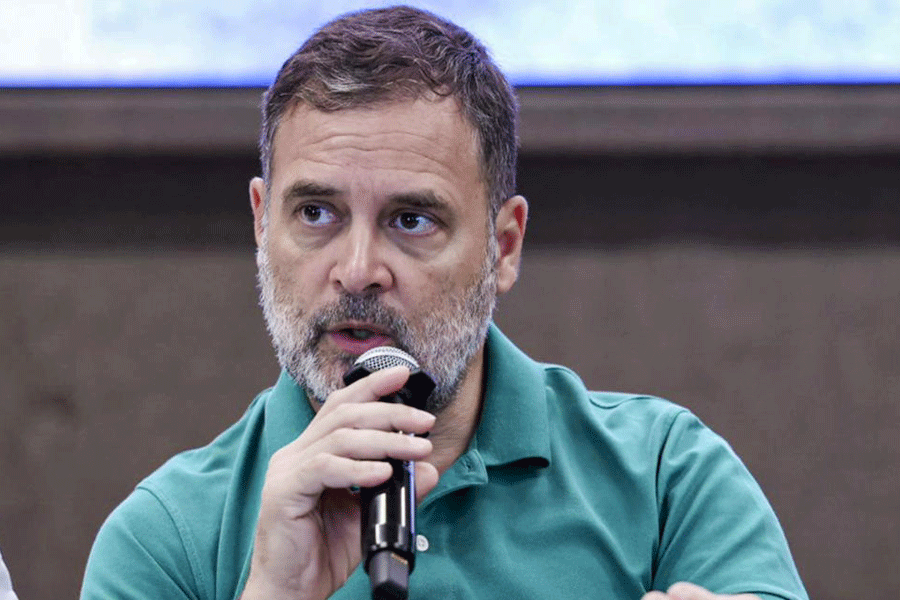
New Delhi: The international science journal Nature has named a data scientist in Raipur among 10 people who helped shape science in 2025, citing his work exposing scientific misconduct and research integrity breaches in higher education institutions.
Achal Agrawal, who runs the online platform India Research Watch (IRW), has flagged concerns that some universities have boosted their standing in the country’s annual academic rankings by inflating research output and citations through questionable means.
His analysis of a global public database of retracted papers has shown that India’s retraction rate rose from 0.7 per 1,000 papers in 2014 to 1.4 in 2021, peaked at 4.8 in 2022 and fell to 2.8 in 2024. Retractions signal that the published findings are unreliable because of either flawed or fraudulent research.
Many in academic circles believe the IRW played a role in nudging India’s higher education authorities to introduce earlier this year a penalty for retracted research papers in the National Institutional Ranking Framework (NIRF), the annual ranking exercise.
Agrawal’s efforts to raise awareness about research integrity breaches have “placed him at the centre of the nation’s conversation about academic incentives”, Nature said on Wednesday, featuring him among 10 people who “helped make amazing discoveries or brought attention to crucial issues” in 2025.
After returning to India in 2018 with a PhD in mathematics from France’s University of Paris-Saclay, Agrawal wanted to work in education, though he was unsure how. Over the next four years, he moved across three private universities, served as a data scientist in a start-up, and taught children the basics of computers in a government school in an Uttarakhand village.
In one of the universities, he noticed what he describes as an enthusiasm to publish research papers at an unusually high pace. “Where I was in France, we were expected to publish at least one conference paper per year. Here, there appeared to be pressure to publish five papers per year,” Agrawal told The Telegraph. He encountered both faculty and students engaging in what he considers questionable practices to raise their count of published research papers.
Agrawal set up the IRW in 2022 and began to analyse trends in research paper publications and the NIRF rankings. In 2024, Agrawal and a collaborator, Moumita Koley at the Indian Institute of Science, Bangalore, flagged concerns that some universities are “possibly gaming the NIRF rankings” by manipulating research metrics, which are used to assess institutions.
Subhash Lakhotia, an emeritus professor of zoology at the Banaras Hindu University, who also serves as an adviser to the IRW, has described Agrawal’s efforts as a “bold initiative” to flag instances of breaches of research ethics and integrity.
“Many of us hope that the concerned regulatory bodies and academic institutions will appreciate and support this initiative so that the damage being inflicted on the country’s overall research quality because of high retractions and poor quality of papers can be reversed,” Lakhotia said.