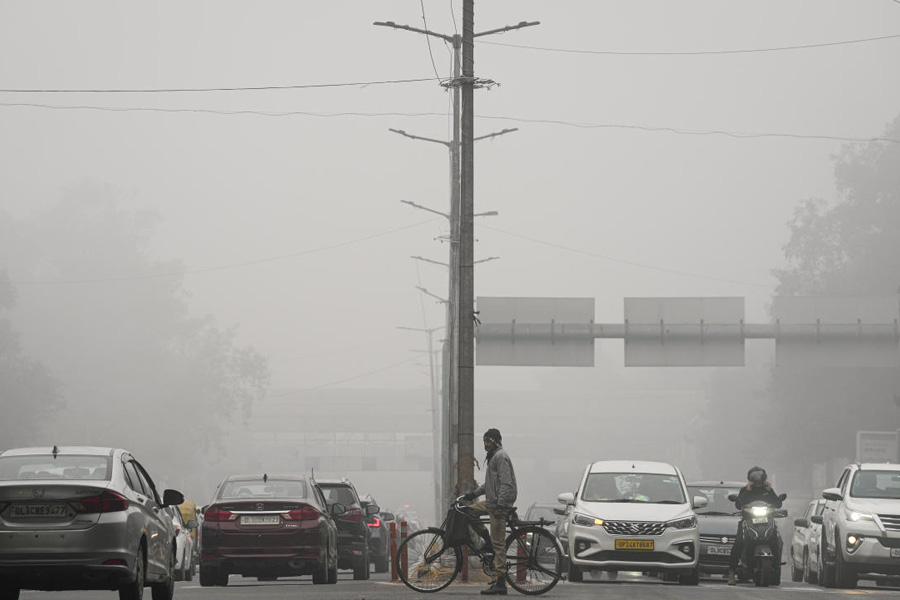
Delhi faced a double whammy on Thursday as dense fog combined with severe air pollution blanketed the national capital, sharply reducing visibility and disrupting road and air traffic across the city and the wider Delhi-NCR region.
According to the India Meteorological Department (IMD), dense fog conditions prevailed over the city based on the 6 am observation.
Visibility at Palam Airport dropped to 150 metres, while Safdarjung Airport reported visibility of 200 metres.
Later, officials said the current visibility at Indira Gandhi International Airport, Palam was 100 metres, adding that general visibility was expected to increase to 150 metres in the next 30 minutes and improve gradually thereafter, with no further reductions expected.
Dense fog enveloped large parts of Delhi-NCR in the early morning hours, significantly affecting road traffic.
Vehicles were seen moving slowly on major arterial roads and highways connecting Delhi with neighbouring cities such as Gurugram, Ghaziabad and Noida. Morning commuters faced delays as motorists exercised caution due to poor visibility.
Weather officials said foggy conditions are likely to persist during early mornings in the coming days as winter intensifies. The IMD has forecast dense fog on Thursday and Friday.
The low visibility also impacted flight operations.
As many as 27 flights of various airlines were cancelled and many more delayed at Delhi Airport, a DIAL official said.
"As of now, 27 flights are cancelled -- 16 departures and 11 arrivals -- at Delhi Airport due to dense fog and low visibility," the Delhi International Airport Ltd (DIAL) official said.
In the early hours of Thursday, the Delhi Airport announced that Low Visibility Procedures were in progress, asking passengers to contact their airlines for updates. It later issued another advisory stating that flight operations were under CAT III conditions, which could lead to disruptions.
“We are working closely with all stakeholders to minimise inconvenience to passengers,” the airport said.
Subsequently, Delhi airport issued another passenger advisory at 09:18 hrs, stating: "All flight operations are normal at Delhi Airport. Wishing all our passengers a smooth and pleasant journey ahead! Passengers are advised to stay in touch with their respective airlines for the latest flight updates."
CAT-III refers to a type of instrument landing system (ILS) approach that allows aircraft to land in conditions of very low visibility, such as fog, rain or snow, with a runway visual range (RVR) of 50-200 meters.
Flight disruptions have become frequent over the past few days as visuals across Delhi showed a thick layer of toxic smog further reducing visibility.
Amid dense fog and low visibility in Delhi and most parts of North India, several airlines, including SpiceJet, Air India and IndiGo, issued travel advisories urging passengers to check the status of their flights in advance.
Taking to its official X handle, SpiceJet informed passengers that all departures, arrivals and their consequent flights may be affected due to dense fog in Delhi, advising them to check their flight status through the official website.
Air India also released an advisory citing potential poor visibility over the next few days, stating that this could impact its primary hub in Delhi as well as a few other airports in northern and eastern India and some other cities.
The airline said it was taking measures to mitigate fog-related disruptions and that round-the-clock assistance would be provided to passengers to make alternative arrangements.
Under Air India’s ‘FogCare’ initiative, passengers booked on flights with potential delays will receive advance alerts on their mobile phones. They will also have the option to change their flight without paying extra or seek a full refund.
IndiGo, in an X post, released an advisory for disruptions in flight operations due to low visibility in Chandigarh. “As a precaution, some flights have been cancelled throughout the day to prioritise safety,” the airline wrote, advising passengers to allow extra travel time and check their flight status beforehand.
Meanwhile, air quality in the national capital remained in the ‘very poor’ category, with the Air Quality Index (AQI) recorded at 358, according to the Central Pollution Control Board (CPCB).
On the weather front, the minimum temperature in Delhi settled at 9.0 degrees Celsius, which is 0.9 notches above the season’s average, while the maximum temperature is expected to hover around 23 degrees Celsius, the IMD said. Relative humidity was recorded at 100 per cent at 8.30 am.
As per the CPCB classification, an AQI between zero and 50 is considered ‘good’, 51 to 100 ‘satisfactory’, 101 to 200 ‘moderate’, 201 to 300 ‘poor’, 301 to 400 ‘very poor’ and 401 to 500 ‘severe’.