The Centre on Wednesday withdrew its order directing smartphone manufacturers to mandatorily pre-install the government-developed Sanchar Saathi cybersecurity app on handsets, bowing to pressure from the Opposition that saw it as a snooping tool and widespread concern about a possible invasion of privacy.
The department of telecommunications (DoT) issued a statement on Wednesday saying the app had “no other function other than protecting the users”. It stated that given Sanchar Saathi’s “increasing acceptance”, the government has decided “not to make the pre-installation mandatory for mobile manufacturers”.
“The number of users has been increasing rapidly, and the mandate to install the app was meant to accelerate this process and make the app available to less aware citizens easily.
“Just in last one day, 6 lakh citizens have registered for downloading the app, which is a 10x increase in its uptake,” the DoT statement added.
The DoT had on November 28 given manufacturers 90 days to comply with the directive to pre-install the app. The directive had been sent privately.
On Tuesday, communications minister Jyotiraditya Scindia defended the app and suggested that it was not binding on cellphone users. “If you do want it on your phone, keep it. If you want to delete it, delete it,” he said outside Parliament.
Unlike Sanchar Saathi, other platforms from the government, like DigiLocker and DigiYatra, require an individual’s consent before installation.
The Indian government’s plan had little precedent, according to industry sources. Russia may be the only other known example. Moscow in August ordered that a state-backed messenger application called MAX, a rival to WhatsApp that critics say could be used to track users, must be pre-installed on all mobile phones and tablets.
“The app is secure and purely meant to help citizens from bad actors in the cyber world,” the Indian government said in its statement on Wednesday.
Opposition leaders and cybersecurity experts had expressed concern about Sanchar Saathi.
The digital rights organisation Internet Freedom Foundation said Scindia’s explanation was incorrect, pointing to “Paragraph 7(b)”, which states that Sanchar Saathi cannot be “disabled or restricted”.
The DoT message on Wednesday was put out after Scindia told Parliament: “Snooping is not possible with the Sanchar Saathi app, nor will snooping happen.”
The original directive went beyond mandatory pre-installation of the app, providing for pushing the app into existing handsets through software updates.
The original directive said: “For all such devices that have been already manufactured and are in sales channels in India, the manufacturer and importers of mobile handsets shall make an endeavour to push the app through software updates.”
The foundation said that the directive was being showcased as a “benign” IMEI checker but “tomorrow, through a server-side update, it could be repurposed for client-side scanning for ‘banned’ applications, flag VPN usage, correlate SIM activity, or trawl SMS logs in the name of fraud detection”.
The government said on Wednesday that so far “1.4 crore users have downloaded this app and are contributing to information on 2,000 fraud incidents per day”.
Till August, the app had over 50 lakh downloads. According to the government, over 37.28 lakh lost or stolen mobile devices had been blocked, and 22.76 lakh traced. The app continues to be available on Apple’s App Store and Google’s Play Store.
Earlier on Wednesday, senior Congress leader Randeep Singh Surjewala said in a notice to Parliament that the government needed to clarify the legal authority for “mandating a non-removable app” and called for the House to debate privacy and security risks.
“The grave, serious and real apprehension is also that such compulsorily installed app can have a backdoor, thereby absolutely compromising the data and privacy of the user,” he added.
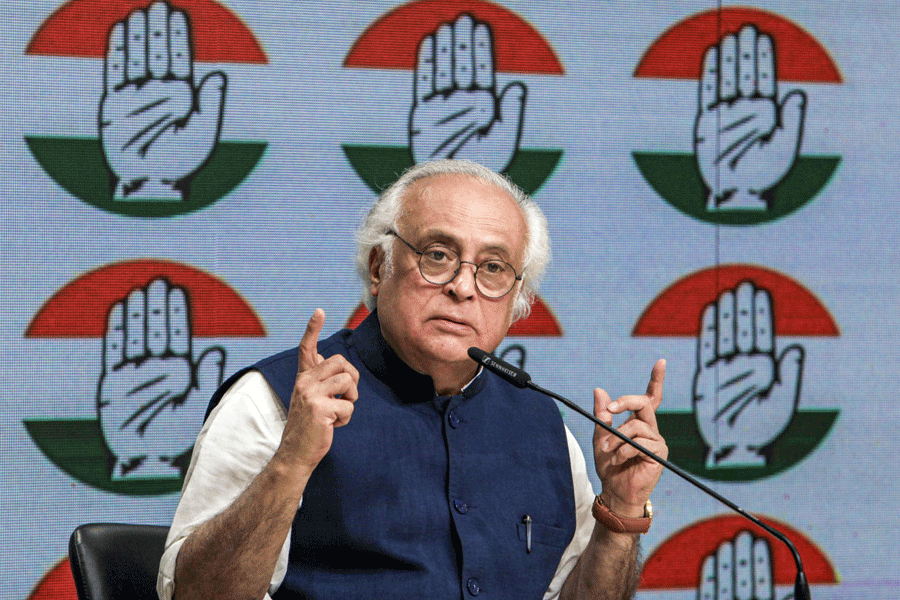
Congress’s media and publicity department head Pawan Khera said the BJP government had been “brazenly snooping” on citizens but when caught “red-handed” this time, it attempted to mislead the entire nation with a “false and deceptive” clarification.
“Their communications minister confidently claimed that the Sanchar Saathi app can be deleted, a statement that collapses instantly under the weight of the government’s own direction, where Section 7(b) categorically states that the pre-installed app cannot be removed, nor can any of its ‘functionalities be disabled or restricted’,” Khera told a media conference in New Delhi.
“This is not a clarification; it is a blatant lie, an attempt to cover up an unconstitutional order by feeding misinformation to 140 crore Indians. When a government begins to lie about its own surveillance machinery, it exposes not just incompetence, but dangerous authoritarian intent,” the Congress leader said.
“The BJP is now in your bedroom. Through digital espionage and unchecked surveillance, the government seeks to manipulate, intimidate and control individuals, normalising an oppressive, dystopian environment where civil liberties are eroded, and dissent is systematically suppressed,” Khera said.
“Big Brother cannot watch us, and yet this DoT direction is beyond unconstitutional, representing a brazen attempt to turn every citizen into a permanent subject of state surveillance,” Khera said.
Shiv Sena (UBT) chief Uddhav Thackeray said the Sanchar Saathi app was another version of the Pegasus spyware and accused the BJP-led government of trying to spy on the people who voted it to power.
Additional reporting from agencies