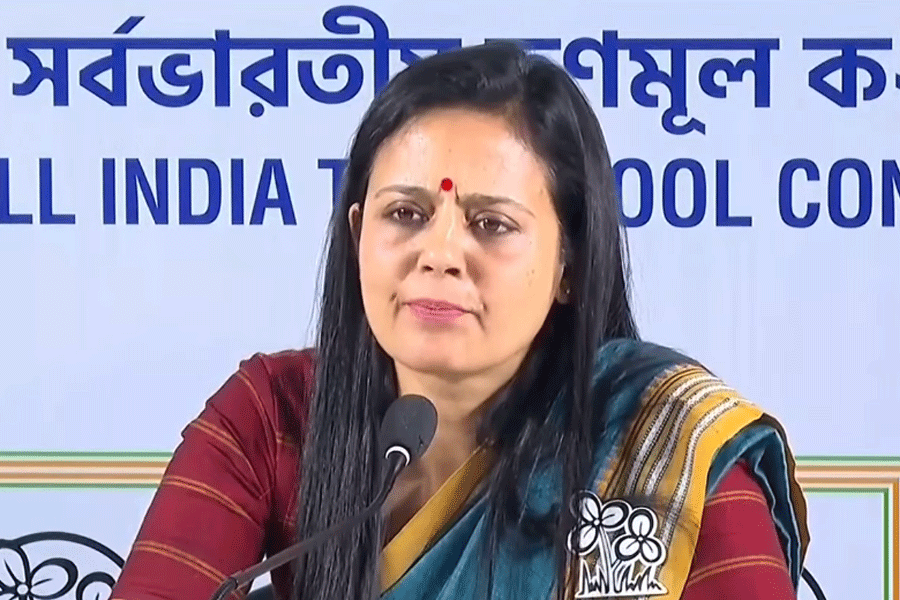
New Delhi, Aug. 18: Rural development minister Narendra Singh Tomar has written a Hindi letter to all parliamentarians, providing some more provocation to Opposition MPs who have been alleging a growing Hindi chauvinism under the Narendra Modi government.
This time, the first protests have come not from the southern states but from Odisha.
Biju Janata Dal member Tathagata Satpathy has posted a copy of Tomar's letter on Twitter with the question: "Why are Union ministers forcing Hindi on non-Hindi-speaking Indians? Is this an attack on other languages?"
Under the Official Languages Rules, all southern and eastern states, including Odisha, come under Region C.
"Communications from a central government office to (any) state or Union territory in Region 'C' or to any office (not being a central government office) or person in such state shall be in English," the Rules say.
Rural development ministry officials explained that their minister, who is from Madhya Pradesh, communicated only in Hindi.
"A similar letter has gone out, jointly in Hindi and English, from the secretaries in the departments of rural development and panchayati raj to all state governments," an official said.
"It asks them to organise events between August 21 and 25 for the Prime Minister's New India Pledge (Sankalp Se Siddhi)."
Tomar, whose latest letter asked the MPs to participate in these events in their constituencies, had earlier too written all-Hindi letters to parliamentarians.
Satpathy now plans to formally complain to the minister. "My reply will be in Odia," he told The Telegraph.
Several MPs from south India too have been responding in their mother tongues to Hindi letters from central ministers to underscore that Hindi is not a lingua franca for them.
DMK member Tiruchi Siva could not confirm whether he had received this particular letter from Tomar but recalled receiving Hindi letters from textile minister Smriti Irani. "I would write back in Tamil," he said.
Parliamentarians from across the southern states confirmed that they frequently received Hindi letters from the Centre.
B.K. Hariprasad, Congress Rajya Sabha MP from Karnataka, said he had received Tomar's letter and added: "Ministers from north India in this government have usually been writing to MPs in Hindi."
CPM member M.B. Rajesh too said that many of the letters he had received from ministers were in Hindi. "Once I wrote to a minister in Malayalam saying that I can't read Hindi."
Rajesh said he had drawn inspiration from former Kerala chief minister E.K. Nayanar, who too had responded in Malayalam to a Hindi letter he had received from his then Uttar Pradesh counterpart, Mulayam Singh Yadav.
Siva said the Modi government was clearly prioritising Hindi over other languages.
"All central government schemes, new and old, are being given Hindi names," he said. "Government officials seem to be under pressure to speak in Hindi when they appear before parliamentary committees. Earlier, they used to depose in English."
Their opposition to the "imposition" of Hindi unites bitter Tamil Nadu rivals AIADMK and DMK.
Siva has a private member's bill pending in the Rajya Sabha seeking official language status for all the 22 Indian languages mentioned in the Eighth Schedule of the Constitution.
AIADMK member M. Thambidurai made the same appeal to the government in the Lok Sabha during last week's special discussion of the Quit India Movement.
"Let us together pledge to see that all the languages of the country are called national languages and not regional languages," Thambidurai, the deputy Speaker in the Lok Sabha, said.
"It is the bounden duty of Parliament to protect all the (Indian) languages and give equal status to all the languages instead of giving priority to one language."
MPs from non-Hindi-speaking states see the Modi government as reopening an issue that had more or less been settled after Lal Bahadur Shastri's Congress government tried to impose Hindi in 1965, sparking bloody protests in Tamil Nadu.
The Constituent Assembly had hotly debated the question of a national language. Hindi in the Devanagari script was declared the "official language" as a compromise solution while English remained earmarked for official use for the first 15 years after the Constitution's adoption in 1950.
After the language riots of the mid-1960s, the government extended the use of English, making it the second official language of India.