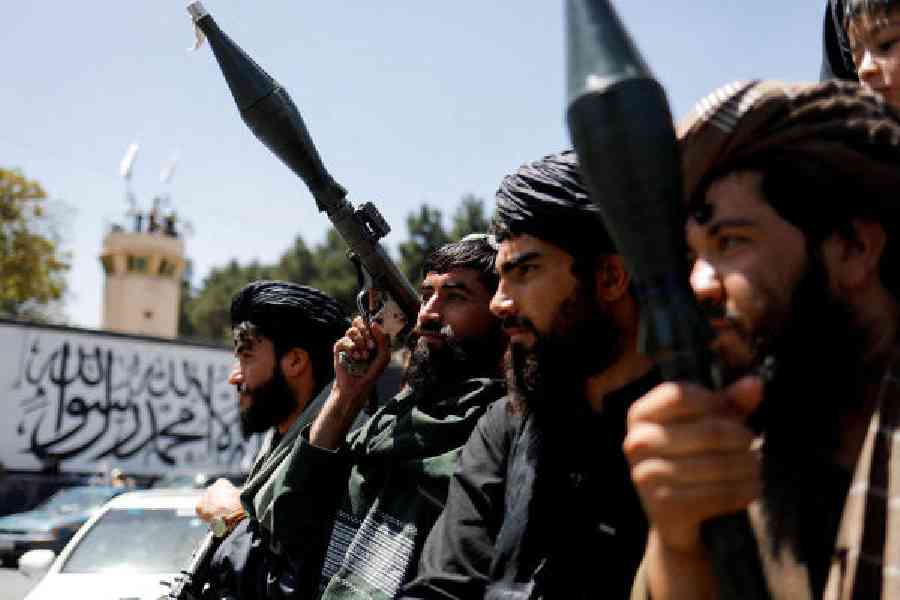
India on Wednesday called for “pragmatic engagement” with the Taliban instead of the continuation of the current approach of the West, in particular, to use punitive measures to pressure Afghanistan’s rulers to change their policies on women and human rights.
“India calls for a pragmatic engagement with the Taliban. A coherent policy of engagement should incentivise positive actions,” India’s permanent representative to the UN, Harish Parvathaneni, told a Security Council meeting on Afghanistan.
“A focus on only punitive measures will only ensure that a ‘business as usual’ approach continues as we have been seeing now for the last four-and-a-half years. We call on the United Nations and the international community to adopt nuanced policy instruments that help (in) bringing sustainable benefits for the people of Afghanistan.”
The US, UK and several western countries have imposed asset freezes, travel bans and diplomatic isolation to pressure the Taliban on human rights and governance issues.
India, too, is yet to recognise the regime but has over the past two months stepped up its diplomatic engagement with the Taliban and upgraded its technical mission in Kabul to an embassy.
“The recent decision by my government of restoring the status of our technical mission in Kabul to that of an embassy underscores this resolve (to adopt nuanced policy instruments to benefit the Afghan people),” ambassador Harish said.
“We will continue our engagements with all stakeholders to augment our contribution to Afghanistan’s comprehensive development, humanitarian assistance, and capacity-building initiatives, in keeping with the priorities and aspirations of Afghan society.”
The ambassador also spoke about the situation arising in Afghanistan out of the clashes with Pakistan along the Durand Line that separates the two countries.
“The Secretary-General’s report also highlights the severe humanitarian and economic impact resulting from recent border clashes and border crossing closures, displacing hundreds of families inside Afghanistan, disrupting vital trade, causing financial distress and widespread losses for farmers during the critical fruit harvest season and threatening the livelihoods of Afghan people…. It is incumbent on all not to weaponise trade and transit vulnerabilities,” the ambassador said.
Echoing the concerns expressed by the United Nations Assistance Mission in Afghanistan over the airstrikes, the Indian mission head backed the calls for paying full respect to the United Nations Charter and international law, with particular attention to the protection of innocent civilians.
“We also note with grave concern the practice of ‘trade and transit terrorism’ that the people of Afghanistan are being subjected to by the cynical closure of access for a landlocked country whose people are suffering numerous debilitating conditions since many years,” he said.
“These acts are in violation of WTO norms. Such open threats and acts of war against a fragile and vulnerable LLDC nation, trying to rebuild in difficult circumstances, constitute a blatant violation of the UN Charter and international law. While we condemn such acts, we also strongly support the territorial integrity, sovereignty and independence of Afghanistan.”
The LLDC is the formal classification used by the United Nations for the 32 developing countries across the world that lack territorial access to the sea.
Following the frontier clashes that have taken place sporadically through the year, Pakistan has several times closed its border crossings with Afghanistan for trade and transit, most recently since last week.
Islamabad accuses Kabul of providing a safe haven to the Tehreek-e-Taliban Pakistan, which has carried out repeated terror attacks on Pakistani cities and establishments.