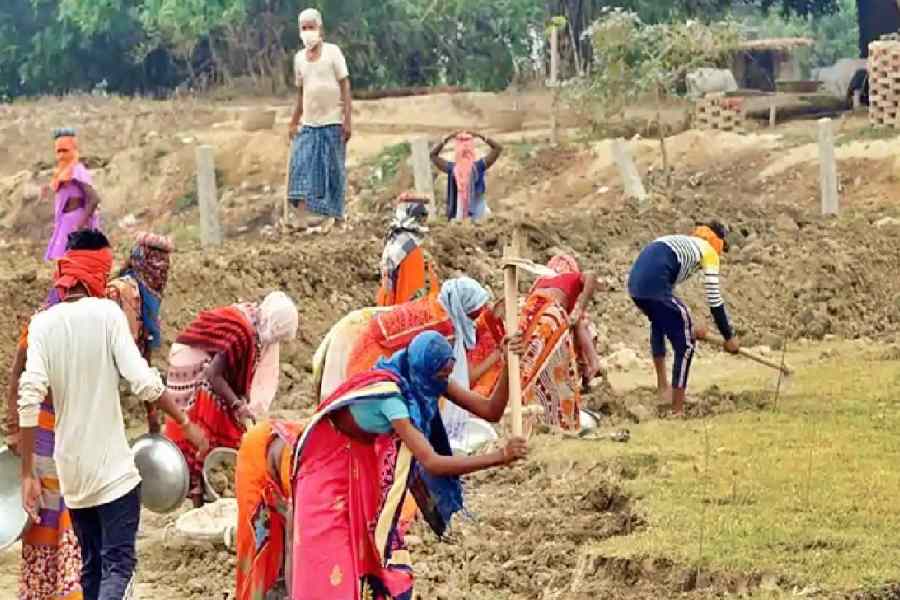
Millions of workers enrolled under the rural job scheme are staring at an uncertain future, with the government failing to revise the wage rate for 2026-27 under the MGNREGA or offer clarity on when the new substitute law will be enforced.
In a break with the norm, the Centre has not revised the wage rates under the Mahatma Gandhi National Rural Employment Guarantee Act (MGNREGA) for 2026-27, raising concern over the continuation of the 100-day rural job scheme till the Viksit Bharat-Guarantee for Rozgar and Ajeevika Mission (Gramin) (VB-G RAM G) comes into force.
The VB-G RAM G bill, passed by Parliament in December last year, seeks to replace the MGNREGA.
Social activists and researchers said the scheme was practically in limbo.
Notifications on revised wage rates under the MGNREGA are issued in March. In 2024 and 2025, the notifications were issued on March 27. The government notified the revised rates on March 24 in 2023, on March 28 in 2022, on March 15 in 2021 and on March 24 in 2020.
In a written reply in the Lok Sabha on August 2, 2024, minister of state for rural development Kamlesh Paswan had said: “The revised wage rate is made applicable from April 1 of each financial year.”
Social activist Nikhil Dey, associated with the Mazdoor Kishan Shakti Sangathan, said the wage rate under the MGNREGA was lower than the minimum wage in many states. The denial of a hike has made matters worse, he added.
“This is an attack on the poor workers under the MGNREGA. The government has stated that the wage rates have to be revised every year. This year, it is violating its own norms,” Dey said.
Purbayan Chakraborty, a lawyer and activist, said the ministry of rural development (MoRD) had suspended the implementation of the MGNREGA in Bengal for the last four years over alleged irregularities. The entire country is staring at a similar situation as the VB-G RAM G remains in limbo and the MGNREGA is hobbled by a funds crunch. The budget has allocated ₹30,000 crore for the MGNREGA for 2026-27.
“The pending liability under the MGNREGA for 2025-26 is around ₹10,000 crore. There is usually heavy demand for work in April, May and June every year. The remaining amount after payment of liability may not be adequate for providing work for the summer months. It means the MGNREGA has been practically put on hold for the entire country,” Chakraborty said.
Chakradhar Buddha, senior researcher at LibTech India that works on the implementation of social welfare schemes, said VB-G RAM G was expected to be implemented in 2026–27 as the Union budget has allocated ₹95,000 crore for it. However, the MoRD is yet to complete the minimum requirements necessary for its enforcement.
“The transition from the MGNREGA to VB-G RAM G has not taken place so far. The MoRD is required to determine the normative allocations for states, following which the law can be operationalised. Despite having adequate time, this has not been done. States are also yet to finalise their schemes in line with the VB-G RAM G framework,” Buddha said.
Under VB-G RAM G, the funds burden of states has been increased to 40 per cent from 10 per cent under the MGNREGA. While the MGNREGA guarantees 100 days of employment to every rural family in a year, VB-G RAM G increased the permissible work days to 125.
Buddha said the MGNREGA technically continued to remain in force but there were signs of a slowdown, with the states not launching or executing projects at the required scale. “The current allocation of around ₹30,000 crore for MGNREGA is grossly inadequate, and this is directly affecting the availability of work,” he said.
Buddha said the statutory provisions under the MGNREGA must be upheld as long as the law was in force.
“In the absence of the new law, the MGNREGA continues to be the governing framework, and the annual revision of wages must take place. It is unfortunate that the revised wage rates have not yet been notified,” he said.
He also noted that the MoRD had imposed restrictions such as a cap of 20 projects per gram panchayat at any given time. “We can already see that employment generation under the MGNREGA has come down significantly. This is happening in March, which is typically a busy period for the MGNREGA,” Buddha said.