The Congress will on January 10 kick off a 47-day MGNREGA Bachao Sangram, a countrywide campaign for the revival of the UPA-era rural employment guarantee law and the withdrawal of the VB-G RAM G Act that has replaced it.
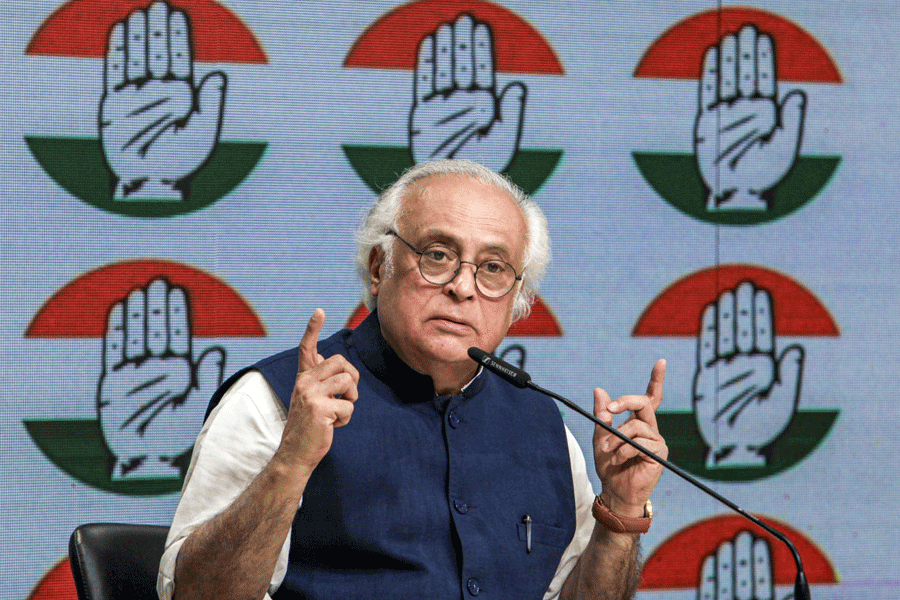
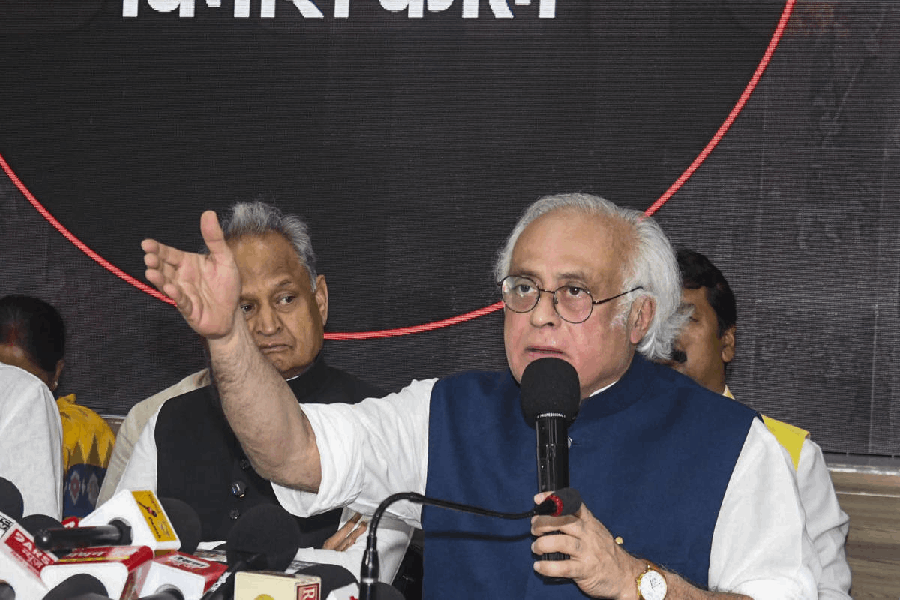
Party general secretaries K.C. Venugopal and Jairam Ramesh told a news conference on Saturday that the new legislation, passed by Parliament last month, nullified many of the benefits of its predecessor.
"Under the VB-G RAM G, employment is no longer a right. Work will be provided only in panchayats notified by the central government," Venugopal said.
He said this conversion of constitutional promise into government permission had weakened a demand-driven poverty alleviation scheme that had gone on to become one of the country’s most successful social welfare programmes.
Apart from the projects being limited to select panchayats, the funds will be budget-capped which means that once the allocation is exhausted, work will stop, he said.
The Congress said the agitation — to be held across states, districts, blocks and gram panchayats — would be preceded by preparatory meetings on January 8 where district-wise responsibilities would be finalised.
A one-day fast will be held on January 10 at all district headquarters. This will be followed by demonstrations, rallies and panchayat-level chaupals (small meetings) till February 25.
Venugopal underlined that the UPA-era scheme had provided work annually to 5-6 crore rural families, reduced hunger and migration, raised rural wages and created durable assets such as ponds, roads, canals and check dams.
It had served as a crucial safety net during droughts, floods, the Covid pandemic and economic crises, benefiting women, Dalits and Adivasis the most, with women accounting for nearly 60 per cent of the workdays.
Ramesh described the upcoming agitation as a "national sangram (battle)" and said: "The sangram is to restore the constitutional right to work."
He went on: "The law bulldozed through to replace the MGNREGA, 2005, is a recipe for dangerous centralisation, the devastation of state finances, and the loss of bargaining power for rural daily wage earners."
Ramesh said that unlike the Delhi-centric farmers’ agitation of 2020-21, the MGNREGA campaign would take place at the state, district and panchayat levels.
However, the campaign's outcome would be similar to that of the successful farmers’ agitation, which had forced the Centre to revoke three new farm laws, he said.
Responding to reporters’ questions, Venugopal said the Congress would consult all its allies on the way forward, and that states ruled by the party or its allies would explore the best possible ways of implementing the new law.
Hinting at approaching the courts against the new law, Congress leaders said this was just the first phase of the agitation and that they would later discuss how to carry it forward.