The Congress on Wednesday cited L.K. Advani’s praise for Muhammad Ali Jinnah and Jaswant Singh’s book on Pakistan’s founder to counter the BJP’s charge of appeasement of the Muslim League by the Grand Old Party.
During a discussion on the celebrations of 150 years of Bankim Chandra Chattopadhyay’s Vande Mataram, Prime Minister Narendra Modi had accused the Congress under Jawaharlal Nehru of adopting the first two stanzas of the song for singing at public events to appease the Muslim League.
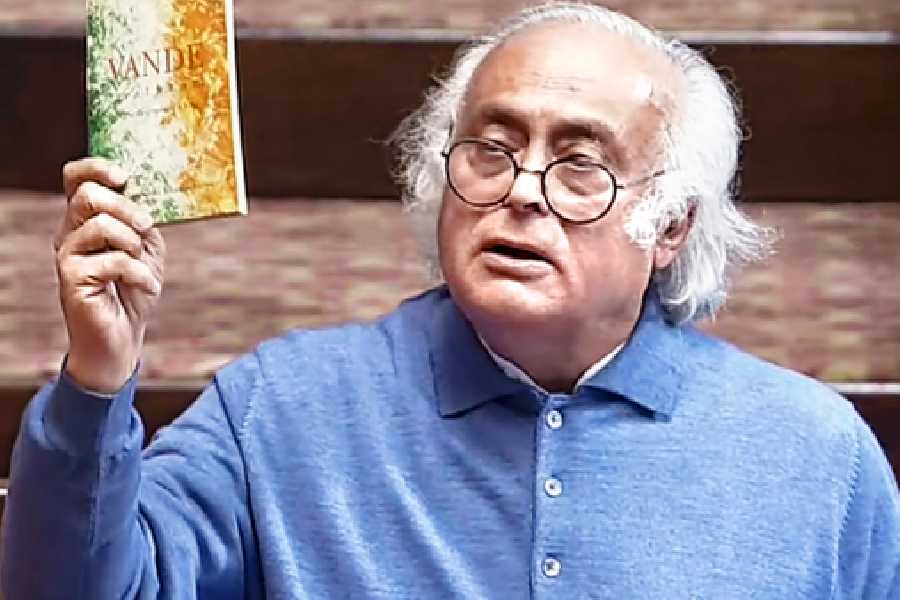
During a discussion on the song in Rajya Sabha on Wednesday, Congress member Jairam Ramesh cited instances of alliance between Sangh parivar organisations like Hindu Mahasabha with the Muslim League in forming governments in Bengal, Sind and North-West Frontier Province in the 1930s. He said Syama Prasad Mookerjee served as the finance minister in the government led by Fazlul Haq, who moved the Pakistan resolution in 1940 in Lahore.
“On June 4, 2005, Bharat Ratna Lal Krishna Advani went to Karachi and praised Jinnah out of hatred towards Nehru. Is that not appeasement? In 2009, a biography on Jinnah was written by Jaswant Singh, the cabinet colleague of Atal Bihari Vajpayee. Isn’t it appeasement? The objective of this debate is to insult Nehru,” Ramesh said.
He cited Vande Mataram, a book by Sabyasachi Bhattacharya, former vice-chancellor of Visva-Bharati and former chairman of the Indian Council of Historical Research, to argue that the first two stanzas of the song were adopted by the Congress on the advice of Rabindranath Tagore. Ramesh said Tagore had issued a media statement on October 30, 1937, which was published in Anandabazar Patrika, admitting that some stanzas of the poem were adopted for singing on his advice.
Ramesh said Chattopadhyay was the founding member of the Indian Association for Cultivation of Science, set up in 1876, and he believed that science and spiritualism should complement each other. He quoted from Chattopadhyay’s article on equality, where the author described casteism as a curse on Indian society.
He said the government was insulting Tagore by presenting him as someone who was against the ideals of Chattopadhyay. He cited an incident mentioned in the introduction of the English translation of Chattopadhyay’s Anand Math. Chattopadhyay had praised Tagore and described him as the “rising Sun” in literature, Ramesh quoted.
Trinamool Congress member Ritabrata Banerjee said in 1905, when Bengal was being partitioned, an anti-partition movement erupted with Tagore as the “nerve centre”.
“On August 7, 1905, at the first mass meeting of anti-partition protest, Tagore sang the first two stanzas of Vande Mataram,” he said.
Banerjee criticised Modi for addressing Chattopadhyay as “Bankim da”, demanding that the Prime Minister apologise in Parliament.