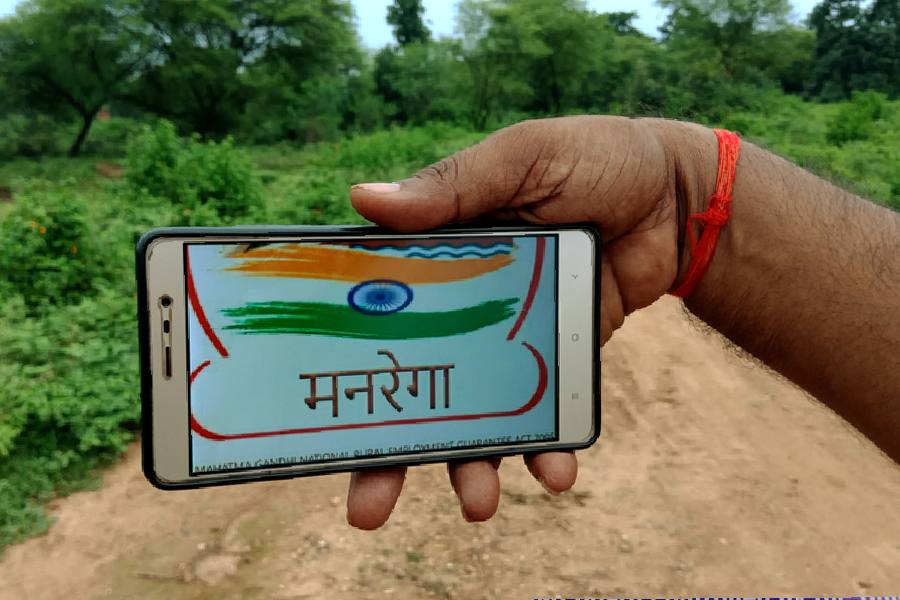
The government proposes to rename the Mahatma Gandhi National Rural Employment Guarantee Act (MGNREGA) as the Pujya Bapu Grameen Rozgar Yojana with a provision to increase the permissible workdays per household to 125 a year from 100, sources said.
They said the Union cabinet had on Friday approved a bill to amend the Act that is likely to be introduced in Parliament next week.
Chakradhar Buddha, a senior researcher at LibTech India, a research organisation working on social welfare programmes, said the challenge before the Centre was to ensure that the increase in workdays did not remain on paper.
“There is no real benefit to workers from a mere name change or even from increasing the permissible number of workdays to 125,” he said.
“In practice, the average number of days of employment available to a household under the scheme remains below 50 a year. The government’s own Economic Survey had last year underlined that the actual demand for work under the scheme was not being accurately captured….”
Buddha added: “Unless this fundamental issue is addressed, superficial changes will not make any meaningful difference to the workers.”
Sources suggested the bill might increase the states’ financial burden under the scheme. They said the bill says that while the expenditure under the scheme is expected to rise to ₹1.5 lakh crore a year, the central government would only pay ₹95,000 crore of it.
If such a proposal is made and passed, the Centre will be picking up only 63.33 per cent of the tab for the scheme, leaving the states to pay 36.66 per cent – far higher than their current share of 10 per cent or less of the total cost.
Currently, the Centre bears the entire wage expenses while splitting the cost of materials in a 75:25 ratio with the states. Since the material cost has to be restricted to within 40 per cent of the total cost, this means the Centre forks out 90 per cent or more of the total expenditure on the scheme.
“If the Centre indeed spends ₹95,000 crore and the states around ₹55,000 crore, this means the Union government is going to share the wage payment with the states, too,” social activist Nikhil Dey said.
He feared that any such change in the funding pattern would “plunge the scheme into crisis”.
The NDA governmenthas long attracted criticism over several of its decisionson the programme.
Civil society organisations have alleged that the government’s shift to technology-based applications to register attendance and pay the wages has left many genuine workers in the lurch, given the connectivity problems in many rural areas.
They have also criticised the government for keeping the budget allocation for the scheme stagnant at ₹86,000 crore in 2025-26 – the same as in 2024-25 – thereby reducing the funding in real terms.
The UPA government had launched the scheme in 2006, particularly to help rural workers during the lean season. The scheme now provides for up to 100 days’ unskilled work a year to every rural household. More than one member of a family can secure job cards and work under the scheme.