
New Delhi, March 24: Two-and-a-half years ago, he had felt "weird" to be dragged to a police lock-up on the charge of insulting the Constitution with his cartoons.
Today, Aseem Trivedi felt vindicated when the country's highest court threw out one of the laws under which he had been arrested as "unconstitutional".
"The judgment has given out a clear message, that free speech is our birthright. If free speech is not absolute, it is not free speech," said the 29-year-old cartoonist, an Internet freedom campaigner and one of the petitioners against Section 66A of the Information Technology Act.
Trivedi's had been among the first high-profile arrests under the section.
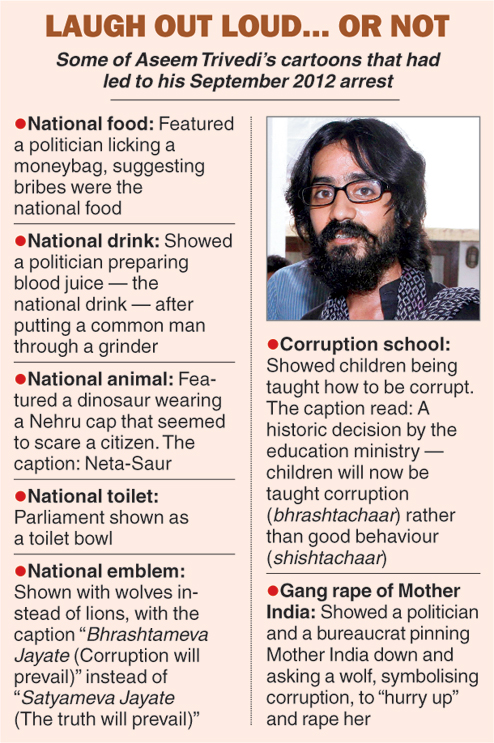
He was arrested in September 2012 on a politician's complaint, after angering Maharashtra's then Congress-NCP government by backing up Anna Hazare's anti-corruption campaign with his cartoons.
He was booked under Section 66A, which carries up to a three-year jail term, as well as the National Emblem Act, 1971, and - most surprisingly - the colonial-era law against "sedition".
"I felt weird. I thought I had the right to poke fun at the state as a citizen and an artist," he said.
"I didn't know what to do, whom to approach. I was being hauled up for a work of art that was not intended to harm anyone."
Shaken, Trivedi had been unbowed. When he became eligible for bail, he refused to seek the relief till the sedition law had been repealed.
By the time his friends brought him round, he had spent five days in custody. Eventually, rapped by Bombay High Court and roasted in the media, the administration dropped the sedition charges. After today's court ruling, only the case under the National Emblem Act remains.
Trivedi had started a campaign, Cartoons Against Corruption, to support Hazare's movement and launched the website www.cartoonsagainstcorruption.com targeting politicians. He displayed his cartoons at Hazare's Mumbai fast venue in December 2011, but within days the police had the website blocked.
While this helped his cartoons go viral on the social media, Trivedi started Save Your Voice, a campaign for Internet freedom.
He caught netizens' imagination with his cheeky "Wish Kapil Sibal Day" on April 1, All Fool's Day, meant to draw attention to the then Union information technology minister's stand against "objectionable" content.
"After my arrest, I realised that even the cops didn't know what Section 66A was. They didn't know what to ask me during my questioning. Neither they nor I really understood why I was in custody," Trivedi laughed.
He believes that every case under Section 66A was filed "to satisfy a politician's ego".
"You may not like my cartoons, you might feel insulted by them. But can you hang me for it?"
He signed off with the hope that India's politicians would develop a "sense of humour".