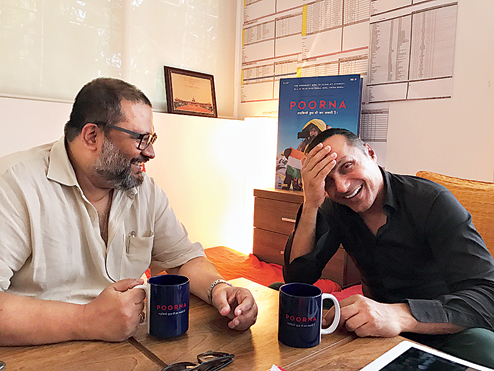

Actor-Director in Anuranan in 2006. Actor-Director in Antaheen in 2009. Friends ever since. But with Poorna, things will never be the same again. Because Director Aniruddha Roy Chowdhury — or rather Tony — has been stunned by what his Actor, Rahul Bose, has done as a Director. “This is the best Indian film I have seen in the last 10 years,” were Tony’s first words to t2, after watching the film — the real-life story of a 13-year-old Adivasi girl summiting Everest — in Mumbai on Sunday.
Next day, Tony landed up at Rahul’s Bandra office to rediscover his friend, through a chat for t2....
SUCH A CRAZY, FANTASTICAL STORY YOU DON’T HAVE TO DRAMATISE IT
Tony: I have come to meet you because I am immensely happy and in Bangla will say, tripto, after watching the film. You have made such an amazing film, Rahul! You have pushed yourself and treated this film in such a human and heartwarming way. It’s technically beautiful and yet the technique doesn’t show, the story shines through.
Rahul: Right.
Tony: I want to know how? Because, just now coming to your office I climbed four storeys and...
Rahul: At last, exercise, Tony!!
Tony: I know you as a friend for many years but I have started discovering you in a new way, with Poorna. The way I saw you at the end of the screening, the way Mariya (plays Priya) hugged you, their love for you in their eyes, it was so beautiful, so profound. So tell me how Poorna happened and how you made such a lovely film...
Rahul: I was offered Poorna for the role of Dr R.S. Praveen Kumar and I was so shocked and ashamed that I didn’t know this story, did you?
Tony: No not at all...
Rahul: ... and I pride myself on being up to date with sport and I pride myself on being up to date with social issues, this story involves both and I didn’t know about this real-life incident. I felt ashamed. So I raised the money for the film, and as things transpired, ended up making it.
This is the kind of story that even a Bollywood writer could not write. ‘Sir, terah saal ki ladki, Everest ke shikhar par pahunchti hai ... to main kehta ki sharam karo, kam se kam 16 saal ka to bana!’ Right, so because it was such a crazy, fantastical story you don’t have to dramatise it. Then you factor in it’s a girl not a boy.
And, she’s an Adivasi girl. She is in Telangana where there is no hill, let alone a mountain. She is under-educated and she is poor, neither does she have the nutrition or the coaching or the experience. She is not a girl living in a hamlet in the Himalayas where your lungs are big anyway. Then you put this together and you say that it’s a miracle.

A BEAUTIFUL LOVE SONG TO INDIA TO SAY THAT MAKE THIS HAPPEN EVERY DAY!
Tony: How does the miracle happen?
Rahul: When I went and did my research I realised that India has a system for everything. And the system almost always has flaws and doesn’t work most of the time, but when the system works — under a passionate, visionary, hardworking, honest officer here — and the kid is found, India is immaculate, India is magical.
Tony: Absolutely.
Rahul: The tragedy is that it happens in every 10 to 15 years but in Poorna’s case it happened and this is a rich, robust, beautiful love song to India to say that make this happen every day! Okay, she doesn’t have to go to Everest but she can become a NASA scientist. He doesn’t have to go to the South Pole but he can become an engineer. These children everywhere, if the system was to work, even if they become school teachers, if a child in Poorna’s village becomes a school teacher she will be carried on their shoulders back home. So it is that. So now I’m making that film and I know it’s a long answer. Here it is: You are on a platform. Looking for bogey no. 1C. We see you walking down the platform. And we see someone spitting; that’s a hygiene issue. Then we see a woman washing her baby’s bottom on the edge of the platform; that’s a cleanliness issue. Then you see a mother feeding her son and her daughter watching hungrily; that’s a social issue. As you come to your bogey you see a stray dog trying to lick some scraps of food and somebody kicks the dog; that’s cruelty to animals.
We have seen four issues as we follow you to bogey 1C. But we are never made aware of them. They exist, they are, that is the Indian canvas every day, all around us. Bogey 1C is Poorna the narrative, the platform is my texture. And that’s the texture that runs through the film.
IN NINE YEARS, I HAVE LEARNT A LOT ABOUT MYSELF, ABOUT LIFE
Tony: And then there is this cop who wants to do something meaningful and Poorna happens.... what timing! So that is also magic, a little girl from Telangana, poor, no medical facilities, no nutrition, dreaming to reach up there... the Himalayas.... I am getting goosebumps. And, I must tell you, it has helped me dream again.
Rahul: Oh! Wow!
Tony: After watching Poorna, I have started dreaming once more. But, getting back to you, I have never seen this side of you. Eta (‘Poorna’) to tui na. Or, jodi eta tui, aami definitely jantam na. How has this happened?
Rahul: Eta aami. Etaii aami.
Tony: I have never seen you like this!
Rahul: I’ll tell you, Tony, because when we are working together, we are working on a level of focus, because we both are obsessed with making the scene work. Also, time has passed. Antaheen happened in 2008. Nine years. Since then I have learnt a lot. I have learnt a lot about myself, about life.
Tony: Bangla-e bolley bodhshokti, knowing life. I think life has taught you a lot of things. And so you have delivered this film.
Rahul: Yeah. I am so thankful to the different sides of my life. Cinema puts you in a bubble. Life takes you out of the bubble. Whether it’s my Andaman, Kashmir and Manipur kids in The Foundation. Whether it’s my discovery of what’s happening in rugby amongst the tribal girls in Orissa, in the districts like Nanded and Kolhapur. Whether it’s my simple understanding of what Bombay is all about today and the different tectonic plates that push and pull the city, I don’t know, but it’s the conglomeration of all of this.
But the softness, the sensitivity, the humanism behind Poorna which you saw is suffused through every cell of my body.
Will I be less of a headache on the set if my costume is not right? No. Even during Poorna, you saw in the film I only wear bush shirts, one day there was a first trial, second trial, third trial... the shirts didn’t fit. I refused to wear them. So there is still that side of me, no question, it’s not gone anywhere. That’s the side you keep seeing but I own it with pride.
I refuse to take anything less than perfection when things can be made perfect. Why should I, why should you, why should anybody? Because I know the rest is all chaos and the world is an uncertain place. The least we can do is set our sights on some kind of perfection, some kind of pride, some kind of certainty. But working with these girls (the actors in Poorna) was something else.

I CRIED WHEN ADITI TOUCHED THE SUMMIT. WHAT COULD BE MORE RIDICULOUS THAN THAT?!
Tony: After yesterday’s show, when Mariya came to say bye to you as she was going back to Hyderabad, I could see that you were trying to act strong. The kid was not leaving you. She was hugging you, you were comforting her. You were talking to other people, Naseeruddin Shah Sir, Sudhir (Mishra) bhai... and Mariya was waiting there to say bye, and I could see the pain in your eyes.... So, personally, I want to know how you have changed so much, your internal growth to make something so beautiful, so sensitive, so soft. And yet so thrilling....
Rahul: Every word you are saying is true, Tony. I was propelled by... look, I cried when Aditi touched the summit. What could be more ridiculous than that?!
Tony: And I still remember that you never cried in my films. I wanted you to cry in a scene in Antaheen but you said it’s better for the audience to imagine your tears then... now for you to cry in this film for this kid....
Rahul: I’ll tell you something I haven’t told anyone before. When we were shooting my reaction to the news that Poorna had summited... I broke down. I actually broke down, we haven’t used it but that’s what this story has done to me. That is the power of this real-life story.
There is this little girl who Praveen Kumar told me that before she set out for the last push at 9pm — she finally summited at 6.30am — he had told the Sherpa to radio base camp every hour so that he would know everything is okay. First hour the call came, second hour the call came then the calls stopped for the next four hours and that’s when he said ‘I knew something terrible had happened and I didn’t think about the fact that this was the end of my career or the end of the initiative but I just thought about the fact that I was responsible for this girl’s tragedy’.
This is the feeling behind those tears.
Tony: For the audience also... everybody was crying. Everybody in the hall had tears in their eyes.... Let’s talk about the visual treatment of the film. Did you stage anything? It looked so real as if you have grabbed the audience in the theatre and put them in the village or beside Poorna. I want to know in terms of the making, how did you make it so real, so true, so authentic and so layered?
HONEST AND REAL... AND BLOODY BEAUTIFUL
Rahul: Tony, I can’t explain that. I can only say a few things. First, the language. The film is in Hindi which is essentially a little dishonest — it should be a mixture of Hindi and Telugu because it’s Hyderabad and Nizamabad but it still needs a mixture. So we took the entire film’s language and pushed it through a chhanni (sieve) of Telugu. And whatever Telugu words stayed, stayed, so you are completely aware where you are socio-culturally but there is not one word that you don’t understand. Similarly the same approach to the acting...
Tony: I will come to that later...
Rahul: Okay, the mise en scene in terms of how I want to shoot this film... I had Babel as one of my references, not the Japanese part of it but the Middle Eastern part. I told Subhransu (DOP) that I want texture, I do not want exoticised beauty or fancy angles. I want texture and in that texture there will be the beauty. So he lit for texture, he graded for texture.
Tony: Honest and real....
Rahul: But bloody beautiful! It had to have a high sense of aesthetics.... The production designer was told, I don’t want that chunni in the background waving. I don’t want red and yellows.
Tony: That scene in the village, it’s fabulous! Where they are throwing colours, and I have never seen this kind of marriage. So this is something new to me as an audience.
Rahul: I let the camera run. Great use of digital. I let the camera run and run and run... and cut it on the table later. Let people do what they have to. The moment you stop people and make them do that again, something goes, let them do and you will find the moments and all the village stuff that we did, the kids had been rehearsed one month before. We had taped down... I had come down for the recce three times to the village... so we had taped down all the movable and immovables in the workshop room and the kids did their scenes at the workshop over many days.
Tony: Coming to acting, I mean... they are so beautiful, they are so profound...
Rahul: They are great actors, Tony.
Tony: They have never acted before, they told me this is the first time they are acting. And the kind of shots they are giving in close-up... the look in their eyes, the faraway look, that thinking mode, the determination... I could see everything in their eyes. How did you manage to do that? It’s terrific and I must say the guy who is the young instructor...
Rahul: Shekhar babu... Gyanendra Singh...
Tony: He is so beautiful... I mean he was throwing a kind of energy to the audience, the attitude that you can make it. Even Dhritimanda (Chaterji), the way he was supporting. Even the woman, Heeba Shah. And the girl’s father, what a beautiful actor man!
Rahul: Harishchandra! Amazing.

I AM NAKED IN THIS MOVIE. BUT WHAT BLISS!
Tony: So, how did all this acting happen? How did you manage? I know you had changed your cameraman, you started directing yourself, a lot of things were happening. How did you manage despite all of this?
Rahul: I think the workshops helped a lot for me to arrive at a final vision of the film’s pitch and sensibility. I always get a lot of cues from how the characters are playing out. You also have to work with actors. Really work with them as a friend, as a confidant. You have to share your secrets, you have to make them fearless. The best way to do that is to tell them that they are great and that all they have to do is listen to you and they will be sublime in the film. For that they have to trust you to understand performances. All my actors, even the ones in Everybody Says I’m Fine! trusted me completely.
Aditi and I took at least 20 long walks through this movie talking about what kind of scene it was. As an actor you know how to direct other actors because you know what’s going through their mind.
Tony: But the kids! They were so technically right as far as giving their emotions...
Rahul: ... you know exactly what they’re going through.
Tony: And one more thing the sound design, who did that?
Rahul: Shajit Koyeri. He is a National Award winner. It’s wonderful!
Tony: It’s mind-blowing, from the first cut into the village — what a cut! The sound design, the edit and cinematography are terrific.... Yesterday when I saw the film I was emotionally so moved with the film I wasn’t aware of anything technical, only the story came to me. I wanted to see that every bit of filmmaking in it because it is your film. But I didn’t notice anything because I was so moved. I have to see the film again.
Rahul: The only time you see the director’s hand is when she is summiting.
Tony: Even the cinematography is beautiful. Beautiful! I always tell my people that less is more.
Rahul: At the end of the day a director’s only responsibility is to pour her or his entire soul’s experiences into a film. As you said, I am naked in this movie. But what bliss!